

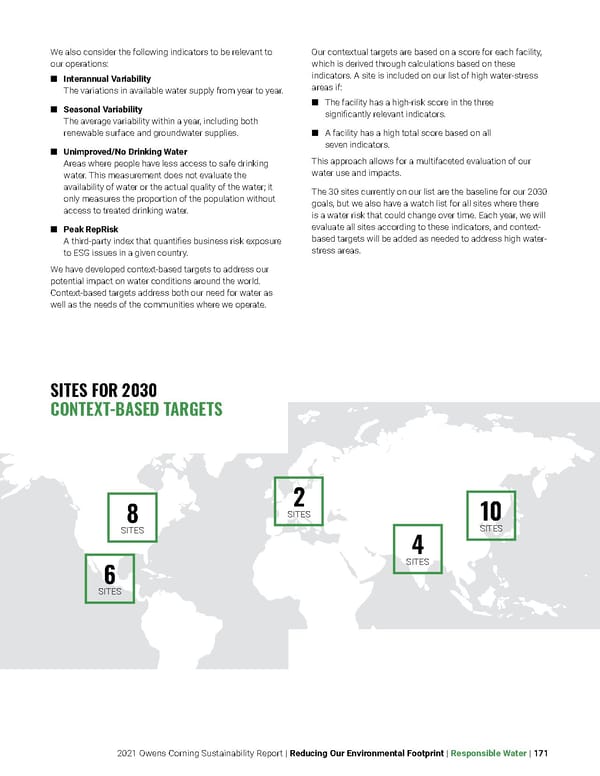
2021 Owens Corning Sustainability Report | Reducing Our Environmental Footprint | Responsible Water | 171 SITES FOR 2030 CONTEXT-BASED TARGETS Our contextual targets are based on a score for each facility, which is derived through calculations based on these indicators. A site is included on our list of high water-stress areas if: ■ The facility has a high-risk score in the three significantly relevant indicators. ■ A facility has a high total score based on all seven indicators. This approach allows for a multifaceted evaluation of our water use and impacts. The 30 sites currently on our list are the baseline for our 2030 goals, but we also have a watch list for all sites where there is a water risk that could change over time. Each year, we will evaluate all sites according to these indicators, and context- based targets will be added as needed to address high water- stress areas. We also consider the following indicators to be relevant to our operations: ■ Interannual Variability The variations in available water supply from year to year. ■ Seasonal Variability The average variability within a year, including both renewable surface and groundwater supplies. ■ Unimproved/No Drinking Water Areas where people have less access to safe drinking water. This measurement does not evaluate the availability of water or the actual quality of the water; it only measures the proportion of the population without access to treated drinking water. ■ Peak RepRisk A third-party index that quantifies business risk exposure to ESG issues in a given country. We have developed context-based targets to address our potential impact on water conditions around the world. Context-based targets address both our need for water as well as the needs of the communities where we operate. 8 SITES 6 SITES 2 SITES 4 SITES 10 SITES
 Owens Corning Sustainability Report Page 170 Page 172