

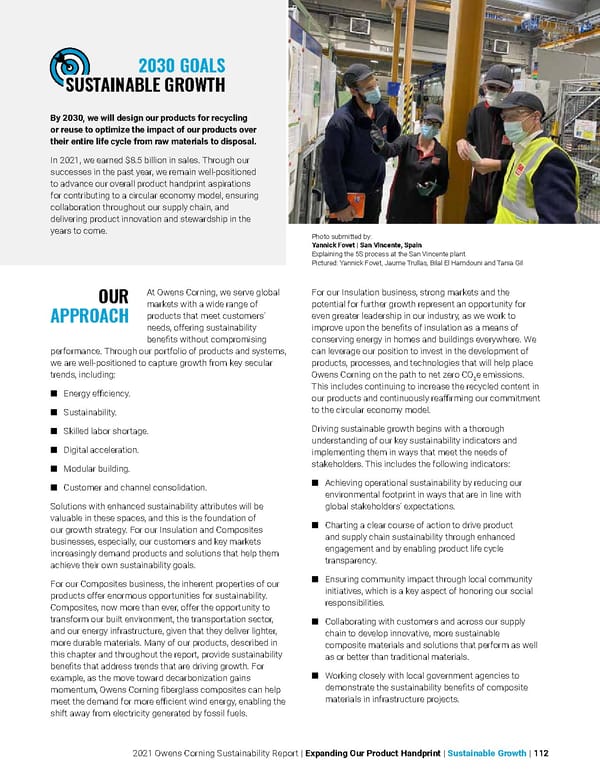
2021 Owens Corning Sustainability Report | Expanding Our Product Handprint | Sustainable Growth | 112 By 2030, we will design our products for recycling or reuse to optimize the impact of our products over their entire life cycle from raw materials to disposal. In 2021, we earned $8.5 billion in sales. Through our successes in the past year, we remain well-positioned to advance our overall product handprint aspirations for contributing to a circular economy model, ensuring collaboration throughout our supply chain, and delivering product innovation and stewardship in the years to come. OUR APPROACH At Owens Corning, we serve global markets with a wide range of products that meet customers’ needs, offering sustainability benefits without compromising performance. Through our portfolio of products and systems, we are well-positioned to capture growth from key secular trends, including: ■ Energy efficiency. ■ Sustainability. ■ Skilled labor shortage. ■ Digital acceleration. ■ Modular building. ■ Customer and channel consolidation. Solutions with enhanced sustainability attributes will be valuable in these spaces, and this is the foundation of our growth strategy. For our Insulation and Composites businesses, especially, our customers and key markets increasingly demand products and solutions that help them achieve their own sustainability goals. For our Composites business, the inherent properties of our products offer enormous opportunities for sustainability. Composites, now more than ever, offer the opportunity to transform our built environment, the transportation sector, and our energy infrastructure, given that they deliver lighter, more durable materials. Many of our products, described in this chapter and throughout the report, provide sustainability benefits that address trends that are driving growth. For example, as the move toward decarbonization gains momentum, Owens Corning fiberglass composites can help meet the demand for more efficient wind energy, enabling the shift away from electricity generated by fossil fuels. For our Insulation business, strong markets and the potential for further growth represent an opportunity for even greater leadership in our industry, as we work to improve upon the benefits of insulation as a means of conserving energy in homes and buildings everywhere. We can leverage our position to invest in the development of products, processes, and technologies that will help place Owens Corning on the path to net zero CO 2 e emissions. This includes continuing to increase the recycled content in our products and continuously reaffirming our commitment to the circular economy model. Driving sustainable growth begins with a thorough understanding of our key sustainability indicators and implementing them in ways that meet the needs of stakeholders. This includes the following indicators: ■ Achieving operational sustainability by reducing our environmental footprint in ways that are in line with global stakeholders’ expectations. ■ Charting a clear course of action to drive product and supply chain sustainability through enhanced engagement and by enabling product life cycle transparency. ■ Ensuring community impact through local community initiatives, which is a key aspect of honoring our social responsibilities. ■ Collaborating with customers and across our supply chain to develop innovative, more sustainable composite materials and solutions that perform as well as or better than traditional materials. ■ Working closely with local government agencies to demonstrate the sustainability benefits of composite materials in infrastructure projects. 2030 GOALS SUSTAINABLE GROWTH Photo submitted by: Yannick Fovet | San Vincente, Spain Explaining the 5S process at the San Vincente plant. Pictured: Yannick Fovet, Jaume Trullas, Bilal El Hamdouni and Tania Gil
 Owens Corning Sustainability Report Page 111 Page 113