

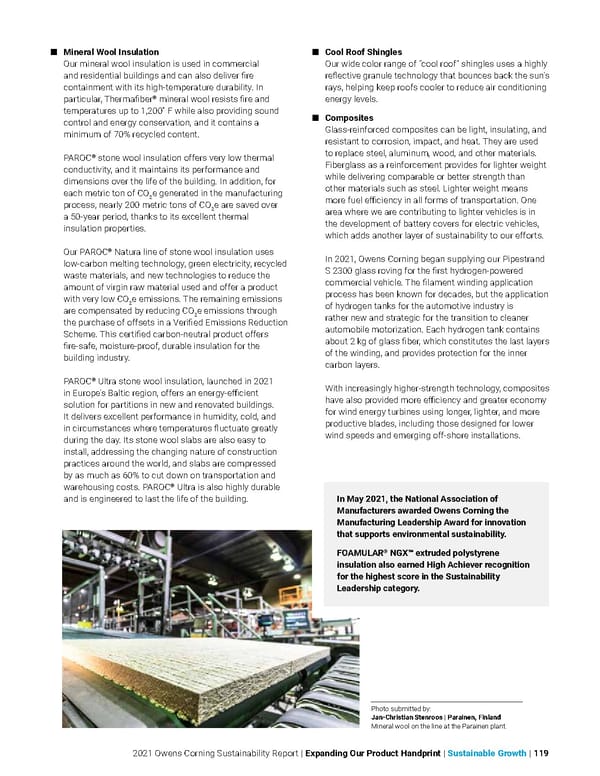
2021 Owens Corning Sustainability Report | Expanding Our Product Handprint | Sustainable Growth | 119 ■ Mineral Wool Insulation Our mineral wool insulation is used in commercial and residential buildings and can also deliver fire containment with its high-temperature durability. In particular, Thermafiber ® mineral wool resists fire and temperatures up to 1,200 ̊ F while also providing sound control and energy conservation, and it contains a minimum of 70% recycled content. PAROC ® stone wool insulation offers very low thermal conductivity, and it maintains its performance and dimensions over the life of the building. In addition, for each metric ton of CO 2 e generated in the manufacturing process, nearly 200 metric tons of CO 2 e are saved over a 50-year period, thanks to its excellent thermal insulation properties. Our PAROC ® Natura line of stone wool insulation uses low-carbon melting technology, green electricity, recycled waste materials, and new technologies to reduce the amount of virgin raw material used and offer a product with very low CO 2 e emissions. The remaining emissions are compensated by reducing CO 2 e emissions through the purchase of offsets in a Verified Emissions Reduction Scheme. This certified carbon-neutral product offers fire-safe, moisture-proof, durable insulation for the building industry. PAROC ® Ultra stone wool insulation, launched in 2021 in Europe’s Baltic region, offers an energy-efficient solution for partitions in new and renovated buildings. It delivers excellent performance in humidity, cold, and in circumstances where temperatures fluctuate greatly during the day. Its stone wool slabs are also easy to install, addressing the changing nature of construction practices around the world, and slabs are compressed by as much as 60% to cut down on transportation and warehousing costs. PAROC ® Ultra is also highly durable and is engineered to last the life of the building. ■ Cool Roof Shingles Our wide color range of “cool roof” shingles uses a highly reflective granule technology that bounces back the sun’s rays, helping keep roofs cooler to reduce air conditioning energy levels. ■ Composites Glass-reinforced composites can be light, insulating, and resistant to corrosion, impact, and heat. They are used to replace steel, aluminum, wood, and other materials. Fiberglass as a reinforcement provides for lighter weight while delivering comparable or better strength than other materials such as steel. Lighter weight means more fuel efficiency in all forms of transportation. One area where we are contributing to lighter vehicles is in the development of battery covers for electric vehicles, which adds another layer of sustainability to our efforts. In 2021, Owens Corning began supplying our Pipestrand S 2300 glass roving for the first hydrogen-powered commercial vehicle. The filament winding application process has been known for decades, but the application of hydrogen tanks for the automotive industry is rather new and strategic for the transition to cleaner automobile motorization. Each hydrogen tank contains about 2 kg of glass fiber, which constitutes the last layers of the winding, and provides protection for the inner carbon layers. With increasingly higher-strength technology, composites have also provided more efficiency and greater economy for wind energy turbines using longer, lighter, and more productive blades, including those designed for lower wind speeds and emerging off-shore installations. Photo submitted by: Jan-Christian Stenroos | Parainen, Finland Mineral wool on the line at the Parainen plant. In May 2021, the National Association of Manufacturers awarded Owens Corning the Manufacturing Leadership Award for innovation that supports environmental sustainability. FOAMULAR ® NGX™ extruded polystyrene insulation also earned High Achiever recognition for the highest score in the Sustainability Leadership category.
 Owens Corning Sustainability Report Page 118 Page 120