

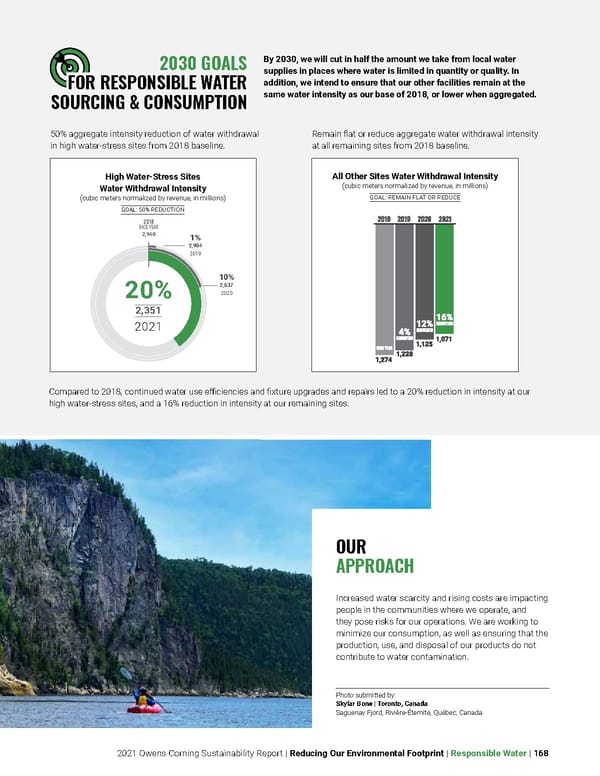
2021 Owens Corning Sustainability Report | Reducing Our Environmental Footprint | Responsible Water | 168 By 2030, we will cut in half the amount we take from local water supplies in places where water is limited in quantity or quality. In addition, we intend to ensure that our other facilities remain at the same water intensity as our base of 2018, or lower when aggregated. 50% aggregate intensity reduction of water withdrawal in high water-stress sites from 2018 baseline. Remain flat or reduce aggregate water withdrawal intensity at all remaining sites from 2018 baseline. 2030 GOALS FOR RESPONSIBLE WATER SOURCING & CONSUMPTION OUR APPROACH Increased water scarcity and rising costs are impacting people in the communities where we operate, and they pose risks for our operations. We are working to minimize our consumption, as well as ensuring that the production, use, and disposal of our products do not contribute to water contamination. Compared to 2018, continued water use efficiencies and fixture upgrades and repairs led to a 20% reduction in intensity at our high water-stress sites, and a 16% reduction in intensity at our remaining sites. High Water-Stress Sites Water Withdrawal Intensity (cubic meters normalized by revenue, in millions) GOAL: 50% R EDUCTION 20% 2,351 2021 201 8 BASE YEAR 2,94 0 1% 2,90 4 2019 10% 2,63 7 2020 All Other Sites Water Withdrawal Intensity (cubic meters normalized by revenue, in millions) GOAL: REMAIN FLAT OR REDUCE Photo submitted by: Skylar Bone | Toronto, Canada Saguenay Fjord, Rivière-Éternité, Québec, Canada.
 Owens Corning Sustainability Report Page 167 Page 169