

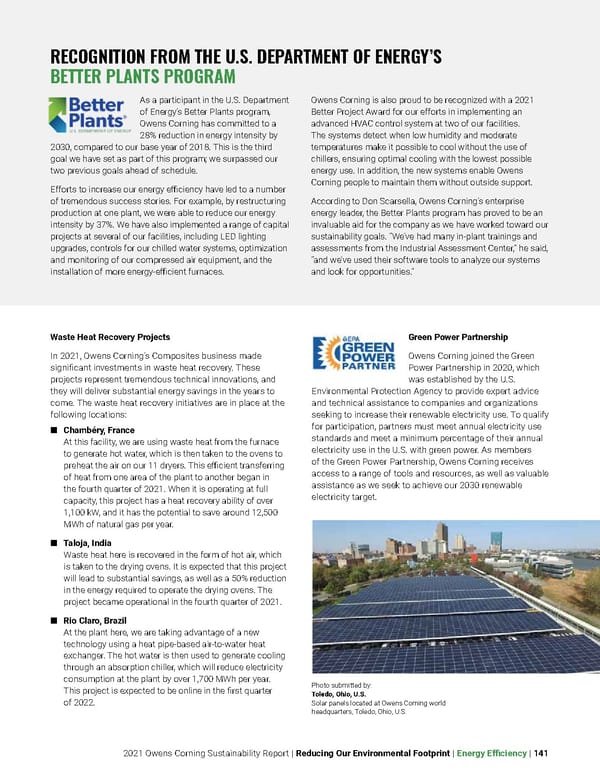
2021 Owens Corning Sustainability Report | Reducing Our Environmental Footprint | Energy Efficiency | 141 Waste Heat Recovery Projects In 2021, Owens Corning’s Composites business made significant investments in waste heat recovery. These projects represent tremendous technical innovations, and they will deliver substantial energy savings in the years to come. The waste heat recovery initiatives are in place at the following locations: ■ Chambéry, France At this facility, we are using waste heat from the furnace to generate hot water, which is then taken to the ovens to preheat the air on our 11 dryers. This efficient transferring of heat from one area of the plant to another began in the fourth quarter of 2021. When it is operating at full capacity, this project has a heat recovery ability of over 1,100 kW, and it has the potential to save around 12,500 MWh of natural gas per year. ■ Taloja, India Waste heat here is recovered in the form of hot air, which is taken to the drying ovens. It is expected that this project will lead to substantial savings, as well as a 50% reduction in the energy required to operate the drying ovens. The project became operational in the fourth quarter of 2021. ■ Rio Claro, Brazil At the plant here, we are taking advantage of a new technology using a heat pipe-based air-to-water heat exchanger. The hot water is then used to generate cooling through an absorption chiller, which will reduce electricity consumption at the plant by over 1,700 MWh per year. This project is expected to be online in the first quarter of 2022. Green Power Partnership Owens Corning joined the Green Power Partnership in 2020, which was established by the U.S. Environmental Protection Agency to provide expert advice and technical assistance to companies and organizations seeking to increase their renewable electricity use. To qualify for participation, partners must meet annual electricity use standards and meet a minimum percentage of their annual electricity use in the U.S. with green power. As members of the Green Power Partnership, Owens Corning receives access to a range of tools and resources, as well as valuable assistance as we seek to achieve our 2030 renewable electricity target. As a participant in the U.S. Department of Energy’s Better Plants program, Owens Corning has committed to a 28% reduction in energy intensity by 2030, compared to our base year of 2018. This is the third goal we have set as part of this program; we surpassed our two previous goals ahead of schedule. Efforts to increase our energy efficiency have led to a number of tremendous success stories. For example, by restructuring production at one plant, we were able to reduce our energy intensity by 37%. We have also implemented a range of capital projects at several of our facilities, including LED lighting upgrades, controls for our chilled water systems, optimization and monitoring of our compressed air equipment, and the installation of more energy-efficient furnaces. Owens Corning is also proud to be recognized with a 2021 Better Project Award for our efforts in implementing an advanced HVAC control system at two of our facilities. The systems detect when low humidity and moderate temperatures make it possible to cool without the use of chillers, ensuring optimal cooling with the lowest possible energy use. In addition, the new systems enable Owens Corning people to maintain them without outside support. According to Don Scarsella, Owens Corning’s enterprise energy leader, the Better Plants program has proved to be an invaluable aid for the company as we have worked toward our sustainability goals. “We’ve had many in-plant trainings and assessments from the Industrial Assessment Center,” he said, “and we’ve used their software tools to analyze our systems and look for opportunities.” RECOGNITION FROM THE U.S. DEPARTMENT OF ENERGY’S BETTER PLANTS PROGRAM Photo submitted by: Toledo, Ohio, U.S. Solar panels located at Owens Corning world headquarters, Toledo, Ohio, U.S.
 Owens Corning Sustainability Report Page 140 Page 142