

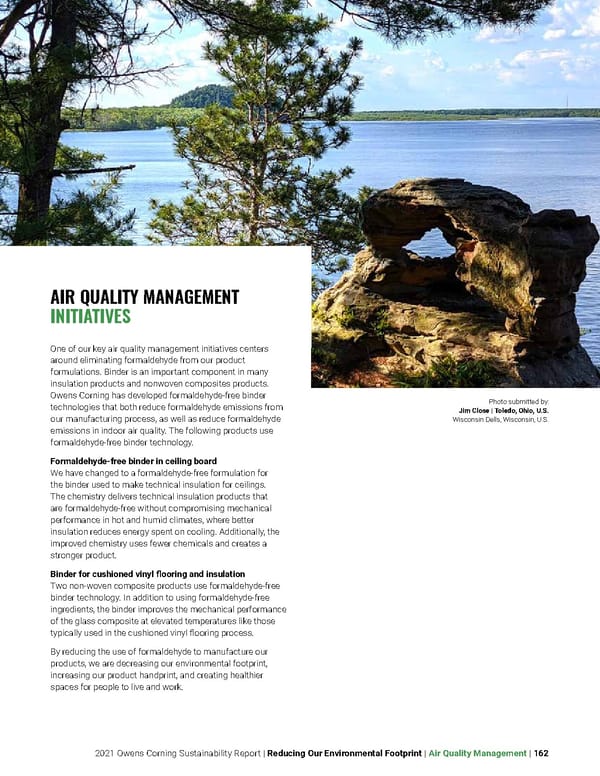
2021 Owens Corning Sustainability Report | Reducing Our Environmental Footprint | Air Quality Management | 162 AIR QUALITY MANAGEMENT INITIATIVES One of our key air quality management initiatives centers around eliminating formaldehyde from our product formulations. Binder is an important component in many insulation products and nonwoven composites products. Owens Corning has developed formaldehyde-free binder technologies that both reduce formaldehyde emissions from our manufacturing process, as well as reduce formaldehyde emissions in indoor air quality. The following products use formaldehyde-free binder technology. Formaldehyde-free binder in ceiling board We have changed to a formaldehyde-free formulation for the binder used to make technical insulation for ceilings. The chemistry delivers technical insulation products that are formaldehyde-free without compromising mechanical performance in hot and humid climates, where better insulation reduces energy spent on cooling. Additionally, the improved chemistry uses fewer chemicals and creates a stronger product. Binder for cushioned vinyl flooring and insulation Two non-woven composite products use formaldehyde-free binder technology. In addition to using formaldehyde-free ingredients, the binder improves the mechanical performance of the glass composite at elevated temperatures like those typically used in the cushioned vinyl flooring process. By reducing the use of formaldehyde to manufacture our products, we are decreasing our environmental footprint, increasing our product handprint, and creating healthier spaces for people to live and work. Photo submitted by: Jim Close | Toledo, Ohio, U.S. Wisconsin Dells, Wisconsin, U.S.
 Owens Corning Sustainability Report Page 161 Page 163