

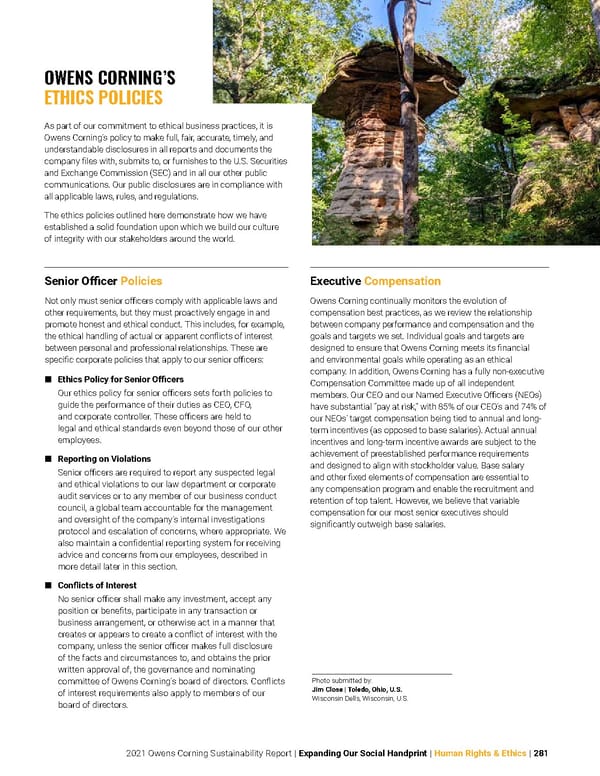
2021 Owens Corning Sustainability Report | Expanding Our Social Handprint | Human Rights & Ethics | 281 OWENS CORNING’S ETHICS POLICIES As part of our commitment to ethical business practices, it is Owens Corning’s policy to make full, fair, accurate, timely, and understandable disclosures in all reports and documents the company files with, submits to, or furnishes to the U.S. Securities and Exchange Commission (SEC) and in all our other public communications. Our public disclosures are in compliance with all applicable laws, rules, and regulations. The ethics policies outlined here demonstrate how we have established a solid foundation upon which we build our culture of integrity with our stakeholders around the world. Executive Compensation Owens Corning continually monitors the evolution of compensation best practices, as we review the relationship between company performance and compensation and the goals and targets we set. Individual goals and targets are designed to ensure that Owens Corning meets its financial and environmental goals while operating as an ethical company. In addition, Owens Corning has a fully non-executive Compensation Committee made up of all independent members. Our CEO and our Named Executive Officers (NEOs) have substantial “pay at risk,” with 85% of our CEO’s and 74% of our NEOs’ target compensation being tied to annual and long- term incentives (as opposed to base salaries). Actual annual incentives and long-term incentive awards are subject to the achievement of preestablished performance requirements and designed to align with stockholder value. Base salary and other fixed elements of compensation are essential to any compensation program and enable the recruitment and retention of top talent. However, we believe that variable compensation for our most senior executives should significantly outweigh base salaries. Photo submitted by: Jim Close | Toledo, Ohio, U.S. Wisconsin Dells, Wisconsin, U.S. Senior Officer Policies Not only must senior officers comply with applicable laws and other requirements, but they must proactively engage in and promote honest and ethical conduct. This includes, for example, the ethical handling of actual or apparent conflicts of interest between personal and professional relationships. These are specific corporate policies that apply to our senior officers: ■ Ethics Policy for Senior Officers Our ethics policy for senior officers sets forth policies to guide the performance of their duties as CEO, CFO, and corporate controller. These officers are held to legal and ethical standards even beyond those of our other employees. ■ Reporting on Violations Senior officers are required to report any suspected legal and ethical violations to our law department or corporate audit services or to any member of our business conduct council, a global team accountable for the management and oversight of the company’s internal investigations protocol and escalation of concerns, where appropriate. We also maintain a confidential reporting system for receiving advice and concerns from our employees, described in more detail later in this section. ■ Conflicts of Interest No senior officer shall make any investment, accept any position or benefits, participate in any transaction or business arrangement, or otherwise act in a manner that creates or appears to create a conflict of interest with the company, unless the senior officer makes full disclosure of the facts and circumstances to, and obtains the prior written approval of, the governance and nominating committee of Owens Corning’s board of directors. Conflicts of interest requirements also apply to members of our board of directors.
 Owens Corning Sustainability Report Page 280 Page 282