

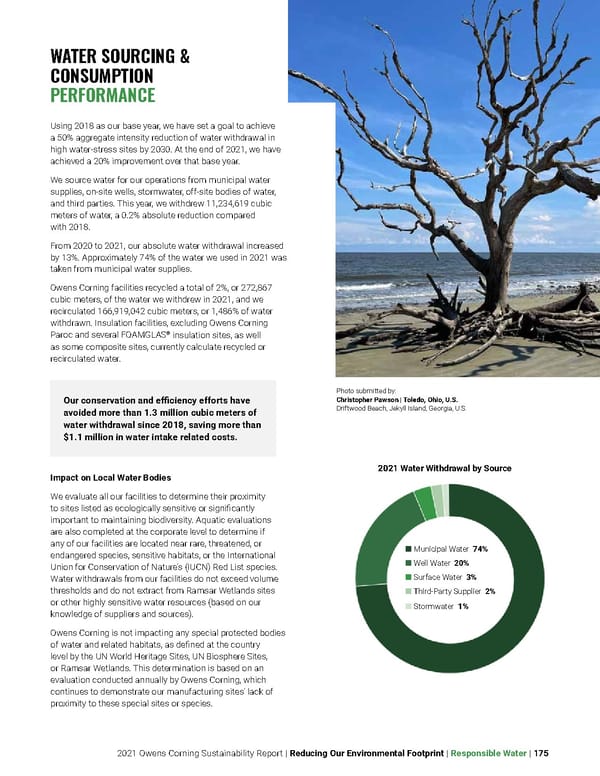
2021 Owens Corning Sustainability Report | Reducing Our Environmental Footprint | Responsible Water | 175 Impact on Local Water Bodies We evaluate all our facilities to determine their proximity to sites listed as ecologically sensitive or significantly important to maintaining biodiversity. Aquatic evaluations are also completed at the corporate level to determine if any of our facilities are located near rare, threatened, or endangered species, sensitive habitats, or the International Union for Conservation of Nature’s (IUCN) Red List species. Water withdrawals from our facilities do not exceed volume thresholds and do not extract from Ramsar Wetlands sites or other highly sensitive water resources (based on our knowledge of suppliers and sources). Owens Corning is not impacting any special protected bodies of water and related habitats, as defined at the country level by the UN World Heritage Sites, UN Biosphere Sites, or Ramsar Wetlands. This determination is based on an evaluation conducted annually by Owens Corning, which continues to demonstrate our manufacturing sites’ lack of proximity to these special sites or species. WATER SOURCING & CONSUMPTION PERFORMANCE Using 2018 as our base year, we have set a goal to achieve a 50% aggregate intensity reduction of water withdrawal in high water-stress sites by 2030. At the end of 2021, we have achieved a 20% improvement over that base year. We source water for our operations from municipal water supplies, on-site wells, stormwater, off-site bodies of water, and third parties. This year, we withdrew 11,234,619 cubic meters of water, a 0.2% absolute reduction compared with 2018. From 2020 to 2021, our absolute water withdrawal increased by 13%. Approximately 74% of the water we used in 2021 was taken from municipal water supplies. Owens Corning facilities recycled a total of 2%, or 272,867 cubic meters, of the water we withdrew in 2021, and we recirculated 166,919,042 cubic meters, or 1,486% of water withdrawn. Insulation facilities, excluding Owens Corning Paroc and several FOAMGLAS ® insulation sites, as well as some composite sites, currently calculate recycled or recirculated water. 2021 Water Withdrawal by Source Municipal Water 74% Well Water 20% Surface Water 3% Third-Party Supplier 2% Stormwater 1% Our conservation and efficiency efforts have avoided more than 1.3 million cubic meters of water withdrawal since 2018, saving more than $1.1 million in water intake related costs. Photo submitted by: Christopher Pawson | Toledo, Ohio, U.S. Driftwood Beach, Jekyll Island, Georgia, U.S.
 Owens Corning Sustainability Report Page 174 Page 176