

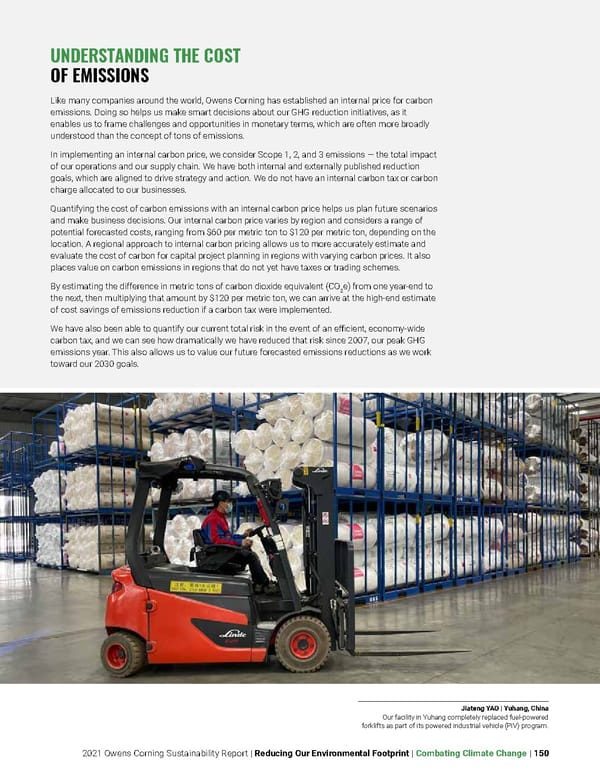
2021 Owens Corning Sustainability Report | Reducing Our Environmental Footprint | Combating Climate Change | 150 UNDERSTANDING THE COST OF EMISSIONS Like many companies around the world, Owens Corning has established an internal price for carbon emissions. Doing so helps us make smart decisions about our GHG reduction initiatives, as it enables us to frame challenges and opportunities in monetary terms, which are often more broadly understood than the concept of tons of emissions. In implementing an internal carbon price, we consider Scope 1, 2, and 3 emissions — the total impact of our operations and our supply chain. We have both internal and externally published reduction goals, which are aligned to drive strategy and action. We do not have an internal carbon tax or carbon charge allocated to our businesses. Quantifying the cost of carbon emissions with an internal carbon price helps us plan future scenarios and make business decisions. Our internal carbon price varies by region and considers a range of potential forecasted costs, ranging from $60 per metric ton to $120 per metric ton, depending on the location. A regional approach to internal carbon pricing allows us to more accurately estimate and evaluate the cost of carbon for capital project planning in regions with varying carbon prices. It also places value on carbon emissions in regions that do not yet have taxes or trading schemes. By estimating the difference in metric tons of carbon dioxide equivalent (CO 2 e) from one year-end to the next, then multiplying that amount by $120 per metric ton, we can arrive at the high-end estimate of cost savings of emissions reduction if a carbon tax were implemented. We have also been able to quantify our current total risk in the event of an efficient, economy-wide carbon tax, and we can see how dramatically we have reduced that risk since 2007, our peak GHG emissions year. This also allows us to value our future forecasted emissions reductions as we work toward our 2030 goals. Jiateng YAO | Yuhang, China Our facility in Yuhang completely replaced fuel-powered forklifts as part of its powered industrial vehicle (PIV) program.
 Owens Corning Sustainability Report Page 149 Page 151