

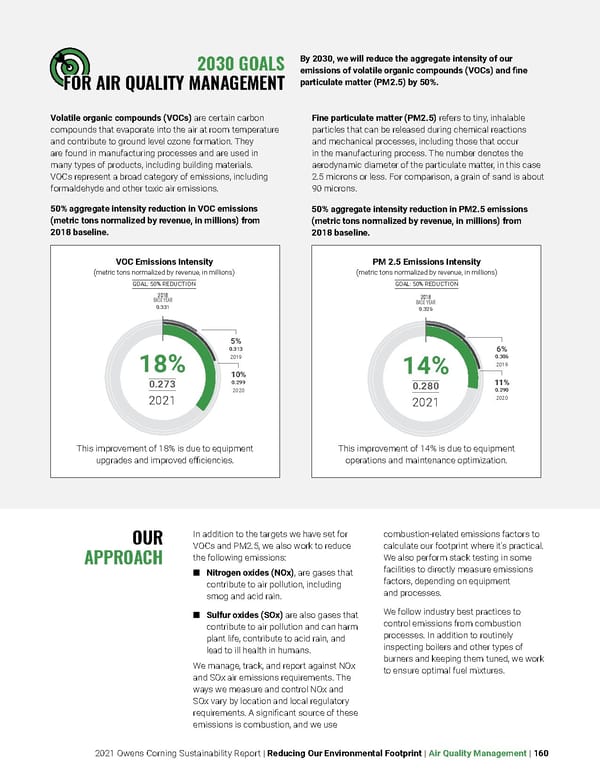
2021 Owens Corning Sustainability Report | Reducing Our Environmental Footprint | Air Quality Management | 160 By 2030, we will reduce the aggregate intensity of our emissions of volatile organic compounds (VOCs) and fine particulate matter (PM2.5) by 50%. OUR APPROACH In addition to the targets we have set for VOCs and PM2.5, we also work to reduce the following emissions: ■ Nitrogen oxides (NOx) , are gases that contribute to air pollution, including smog and acid rain. ■ Sulfur oxides (SOx) are also gases that contribute to air pollution and can harm plant life, contribute to acid rain, and lead to ill health in humans. We manage, track, and report against NOx and SOx air emissions requirements. The ways we measure and control NOx and SOx vary by location and local regulatory requirements. A significant source of these emissions is combustion, and we use combustion-related emissions factors to calculate our footprint where it’s practical. We also perform stack testing in some facilities to directly measure emissions factors, depending on equipment and processes. We follow industry best practices to control emissions from combustion processes. In addition to routinely inspecting boilers and other types of burners and keeping them tuned, we work to ensure optimal fuel mixtures. 2030 GOALS FOR AIR QUALITY MANAGEMENT Volatile organic compounds (VOCs) are certain carbon compounds that evaporate into the air at room temperature and contribute to ground level ozone formation. They are found in manufacturing processes and are used in many types of products, including building materials. VOCs represent a broad category of emissions, including formaldehyde and other toxic air emissions. Fine particulate matter (PM2.5) refers to tiny, inhalable particles that can be released during chemical reactions and mechanical processes, including those that occur in the manufacturing process. The number denotes the aerodynamic diameter of the particulate matter, in this case 2.5 microns or less. For comparison, a grain of sand is about 90 microns. 50% aggregate intensity reduction in VOC emissions (metric tons normalized by revenue, in millions) from 2018 baseline. This improvement of 14% is due to equipment operations and maintenance optimization. 50% aggregate intensity reduction in PM2.5 emissions (metric tons normalized by revenue, in millions) from 2018 baseline. This improvement of 18% is due to equipment upgrades and improved efficiencies. VOC Emissions Intensity (metric tons normalized by revenue, in millions) GOAL: 50% R EDUCTION 18% 0.273 2021 201 8 BASE YEAR 0.331 5% 0.313 2019 10% 0.299 2020 PM 2.5 Emissions Intensity (metric tons normalized by revenue, in millions) GOAL: 50% R EDUCTION 14% 0.280 2021 201 8 BASE YEAR 0.326 6% 0.306 2019 11% 0.290 2020
 Owens Corning Sustainability Report Page 159 Page 161