

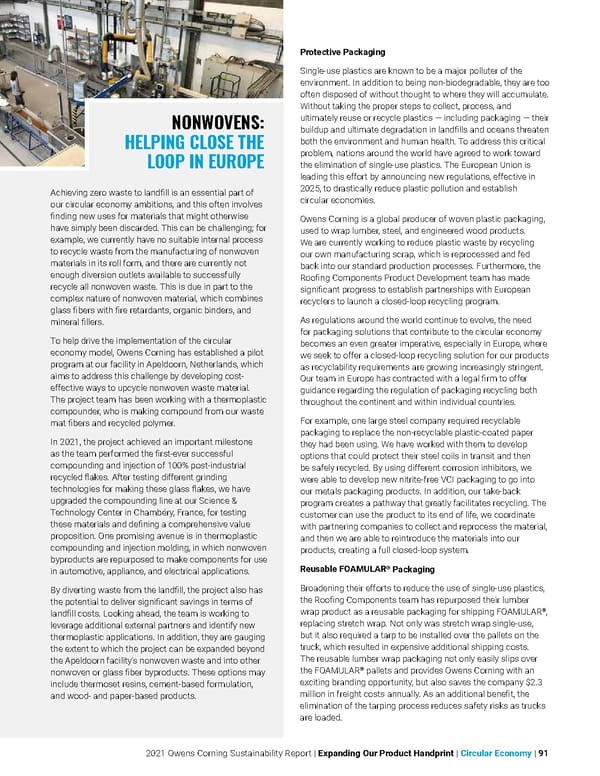
2021 Owens Corning Sustainability Report | Expanding Our Product Handprint | Circular Economy | 91 Achieving zero waste to landfill is an essential part of our circular economy ambitions, and this often involves finding new uses for materials that might otherwise have simply been discarded. This can be challenging; for example, we currently have no suitable internal process to recycle waste from the manufacturing of nonwoven materials in its roll form, and there are currently not enough diversion outlets available to successfully recycle all nonwoven waste. This is due in part to the complex nature of nonwoven material, which combines glass fibers with fire retardants, organic binders, and mineral fillers. To help drive the implementation of the circular economy model, Owens Corning has established a pilot program at our facility in Apeldoorn, Netherlands, which aims to address this challenge by developing cost- effective ways to upcycle nonwoven waste material. The project team has been working with a thermoplastic compounder, who is making compound from our waste mat fibers and recycled polymer. In 2021, the project achieved an important milestone as the team performed the first-ever successful compounding and injection of 100% post-industrial recycled flakes. After testing different grinding technologies for making these glass flakes, we have upgraded the compounding line at our Science & Technology Center in Chambéry, France, for testing these materials and defining a comprehensive value proposition. One promising avenue is in thermoplastic compounding and injection molding, in which nonwoven byproducts are repurposed to make components for use in automotive, appliance, and electrical applications. By diverting waste from the landfill, the project also has the potential to deliver significant savings in terms of landfill costs. Looking ahead, the team is working to leverage additional external partners and identify new thermoplastic applications. In addition, they are gauging the extent to which the project can be expanded beyond the Apeldoorn facility’s nonwoven waste and into other nonwoven or glass fiber byproducts. These options may include thermoset resins, cement-based formulation, and wood- and paper-based products. Protective Packaging Single-use plastics are known to be a major polluter of the environment. In addition to being non-biodegradable, they are too often disposed of without thought to where they will accumulate. Without taking the proper steps to collect, process, and ultimately reuse or recycle plastics — including packaging — their buildup and ultimate degradation in landfills and oceans threaten both the environment and human health. To address this critical problem, nations around the world have agreed to work toward the elimination of single-use plastics. The European Union is leading this effort by announcing new regulations, effective in 2025, to drastically reduce plastic pollution and establish circular economies. Owens Corning is a global producer of woven plastic packaging, used to wrap lumber, steel, and engineered wood products. We are currently working to reduce plastic waste by recycling our own manufacturing scrap, which is reprocessed and fed back into our standard production processes. Furthermore, the Roofing Components Product Development team has made significant progress to establish partnerships with European recyclers to launch a closed-loop recycling program. As regulations around the world continue to evolve, the need for packaging solutions that contribute to the circular economy becomes an even greater imperative, especially in Europe, where we seek to offer a closed-loop recycling solution for our products as recyclability requirements are growing increasingly stringent. Our team in Europe has contracted with a legal firm to offer guidance regarding the regulation of packaging recycling both throughout the continent and within individual countries. For example, one large steel company required recyclable packaging to replace the non-recyclable plastic-coated paper they had been using. We have worked with them to develop options that could protect their steel coils in transit and then be safely recycled. By using different corrosion inhibitors, we were able to develop new nitrite-free VCI packaging to go into our metals packaging products. In addition, our take-back program creates a pathway that greatly facilitates recycling. The customer can use the product to its end of life, we coordinate with partnering companies to collect and reprocess the material, and then we are able to reintroduce the materials into our products, creating a full closed-loop system. Reusable FOAMULAR ® Packaging Broadening their efforts to reduce the use of single-use plastics, the Roofing Components team has repurposed their lumber wrap product as a reusable packaging for shipping FOAMULAR ® , replacing stretch wrap. Not only was stretch wrap single-use, but it also required a tarp to be installed over the pallets on the truck, which resulted in expensive additional shipping costs. The reusable lumber wrap packaging not only easily slips over the FOAMULAR ® pallets and provides Owens Corning with an exciting branding opportunity, but also saves the company $2.3 million in freight costs annually. As an additional benefit, the elimination of the tarping process reduces safety risks as trucks are loaded. NONWOVENS: HELPING CLOSE THE LOOP IN EUROPE
 Owens Corning Sustainability Report Page 90 Page 92