

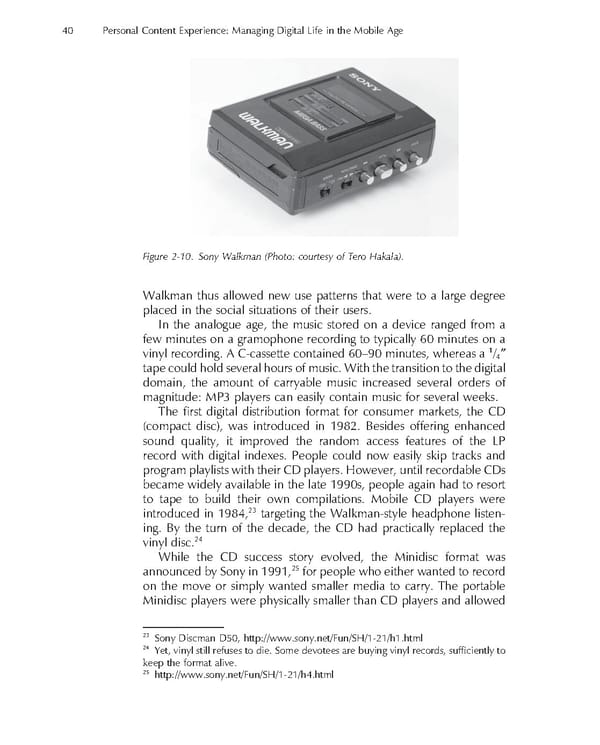
40 Personal Content Experience: Managing Digital Life in the Mobile Age Figure 2-10. Sony Walkman (Photo: courtesy of Tero Hakala). Walkman thus allowed new use patterns that were to a large degree placed in the social situations of their users. In the analogue age, the music stored on a device ranged from a few minutes on a gramophone recording to typically 60 minutes on a 1 vinyl recording. A C-cassette contained 60–90 minutes, whereas a / ″ 4 tape could hold several hours of music. With the transition to the digital domain, the amount of carryable music increased several orders of magnitude: MP3 players can easily contain music for several weeks. The fi rst digital distribution format for consumer markets, the CD (compact disc), was introduced in 1982. Besides offering enhanced sound quality, it improved the random access features of the LP record with digital indexes. People could now easily skip tracks and program playlists with their CD players. However, until recordable CDs became widely available in the late 1990s, people again had to resort to tape to build their own compilations. Mobile CD players were 23 introduced in 1984, targeting the Walkman-style headphone listen- ing. By the turn of the decade, the CD had practically replaced the vinyl disc.24 While the CD success story evolved, the Minidisc format was 25 announced by Sony in 1991, for people who either wanted to record on the move or simply wanted smaller media to carry. The portable Minidisc players were physically smaller than CD players and allowed 23 Sony Discman D50, http://www.sony.net/Fun/SH/1-21/h1.html 24 Yet, vinyl still refuses to die. Some devotees are buying vinyl records, suffi ciently to keep the format alive. 25 http://www.sony.net/Fun/SH/1-21/h4.html
 Personal Content Experience Page 63 Page 65