

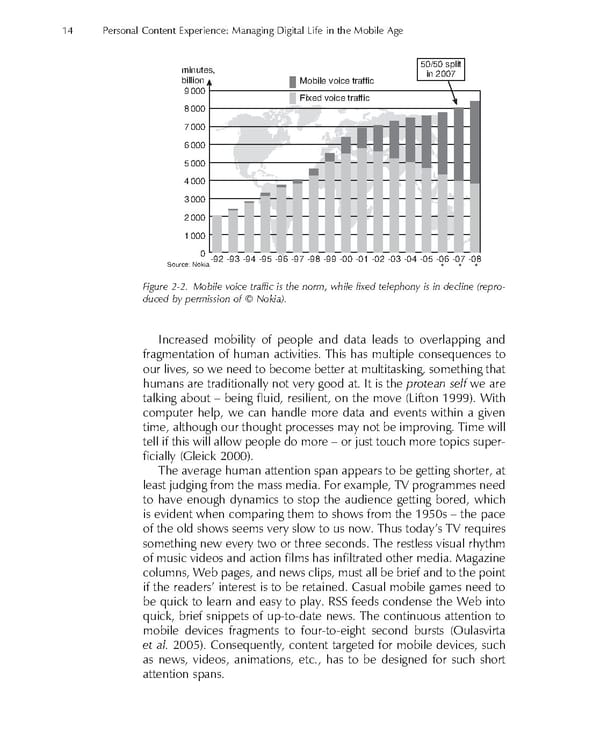
14 Personal Content Experience: Managing Digital Life in the Mobile Age minutes, 50/50 split billion Mobile voice traffic in 2007 9 000 Fixed voice traffic 8 000 7 000 6 000 5 000 4 000 3 000 2 000 1 000 0 -92 -93 -94 -95 -96 -97 -98 -99 -00 -01 -02 -03 -04 -05 -06 -07 -08 Source: Nokia *** Figure 2-2. Mobile voice traffi c is the norm, while fi xed telephony is in decline (repro- duced by permission of © Nokia). Increased mobility of people and data leads to overlapping and fragmentation of human activities. This has multiple consequences to our lives, so we need to become better at multitasking, something that humans are traditionally not very good at. It is the protean self we are talking about – being fl uid, resilient, on the move (Lifton 1999). With computer help, we can handle more data and events within a given time, although our thought processes may not be improving. Time will tell if this will allow people do more – or just touch more topics super- fi cially (Gleick 2000). The average human attention span appears to be getting shorter, at least judging from the mass media. For example, TV programmes need to have enough dynamics to stop the audience getting bored, which is evident when comparing them to shows from the 1950s – the pace of the old shows seems very slow to us now. Thus today’s TV requires something new every two or three seconds. The restless visual rhythm of music videos and action fi lms has infi ltrated other media. Magazine columns, Web pages, and news clips, must all be brief and to the point if the readers’ interest is to be retained. Casual mobile games need to be quick to learn and easy to play. RSS feeds condense the Web into quick, brief snippets of up-to-date news. The continuous attention to mobile devices fragments to four-to-eight second bursts (Oulasvirta et al. 2005). Consequently, content targeted for mobile devices, such as news, videos, animations, etc., has to be designed for such short attention spans.
 Personal Content Experience Page 37 Page 39