

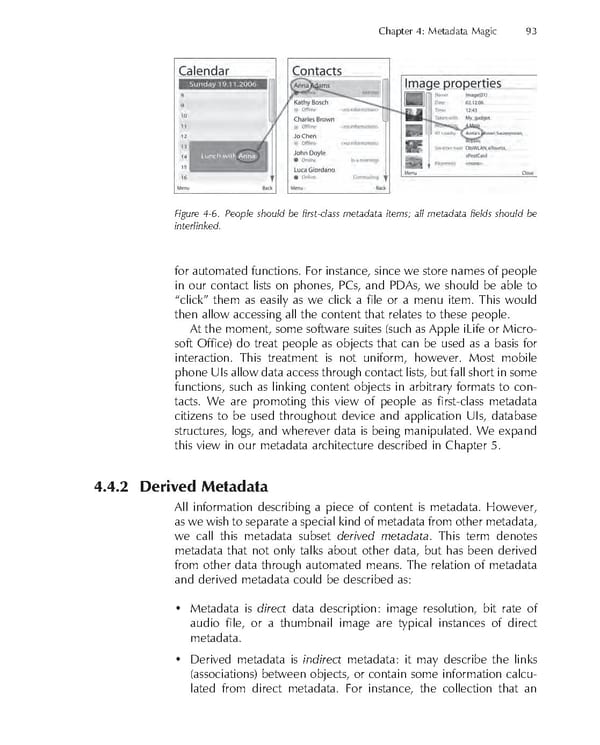
Chapter 4: Metadata Magic 93 Figure 4-6. People should be fi rst-class metadata items; all metadata fi elds should be interlinked. for automated functions. For instance, since we store names of people in our contact lists on phones, PCs, and PDAs, we should be able to “click” them as easily as we click a fi le or a menu item. This would then allow accessing all the content that relates to these people. At the moment, some software suites (such as Apple iLife or Micro- soft Offi ce) do treat people as objects that can be used as a basis for interaction. This treatment is not uniform, however. Most mobile phone UIs allow data access through contact lists, but fall short in some functions, such as linking content objects in arbitrary formats to con- tacts. We are promoting this view of people as fi rst-class metadata citizens to be used throughout device and application UIs, database structures, logs, and wherever data is being manipulated. We expand this view in our metadata architecture described in Chapter 5. 4.4.2 Derived Metadata All information describing a piece of content is metadata. However, as we wish to separate a special kind of metadata from other metadata, we call this metadata subset derived metadata. This term denotes metadata that not only talks about other data, but has been derived from other data through automated means. The relation of metadata and derived metadata could be described as: • Metadata is direct data description: image resolution, bit rate of audio fi le, or a thumbnail image are typical instances of direct metadata. • Derived metadata is indirect metadata: it may describe the links (associations) between objects, or contain some information calcu- lated from direct metadata. For instance, the collection that an
 Personal Content Experience Page 116 Page 118