

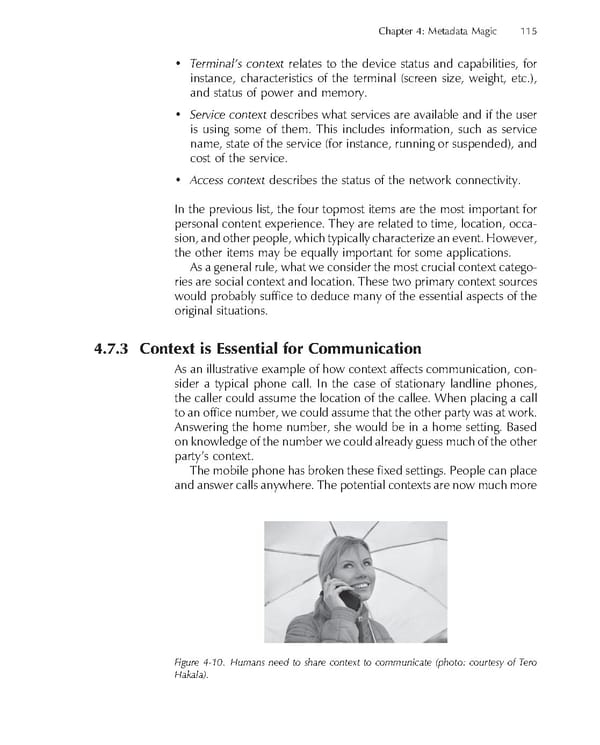
Chapter 4: Metadata Magic 115 • Terminal’s context relates to the device status and capabilities, for instance, characteristics of the terminal (screen size, weight, etc.), and status of power and memory. • Service context describes what services are available and if the user is using some of them. This includes information, such as service name, state of the service (for instance, running or suspended), and cost of the service. • Access context describes the status of the network connectivity. In the previous list, the four topmost items are the most important for personal content experience. They are related to time, location, occa- sion, and other people, which typically characterize an event. However, the other items may be equally important for some applications. As a general rule, what we consider the most crucial context catego- ries are social context and location. These two primary context sources would probably suffi ce to deduce many of the essential aspects of the original situations. 4.7.3 Context is Essential for Communication As an illustrative example of how context affects communication, con- sider a typical phone call. In the case of stationary landline phones, the caller could assume the location of the callee. When placing a call to an offi ce number, we could assume that the other party was at work. Answering the home number, she would be in a home setting. Based on knowledge of the number we could already guess much of the other party’s context. The mobile phone has broken these fi xed settings. People can place and answer calls anywhere. The potential contexts are now much more Figure 4-10. Humans need to share context to communicate (photo: courtesy of Tero Hakala).
 Personal Content Experience Page 138 Page 140