

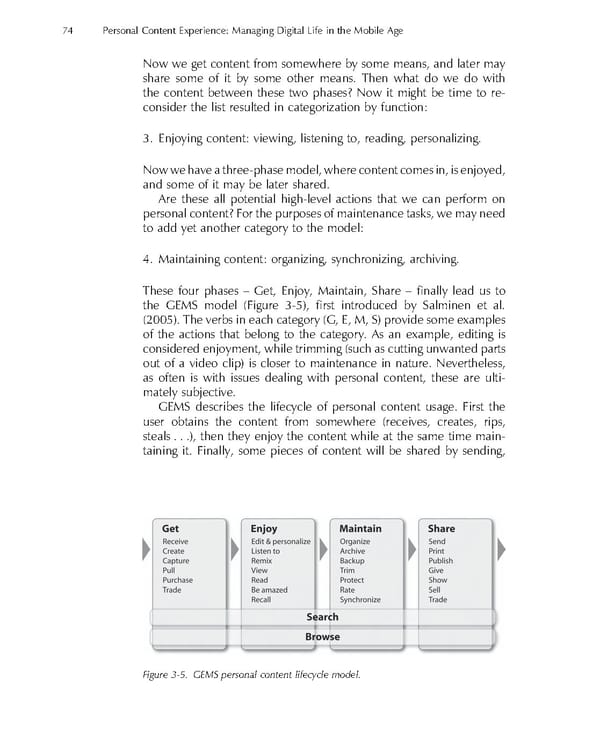
74 Personal Content Experience: Managing Digital Life in the Mobile Age Now we get content from somewhere by some means, and later may share some of it by some other means. Then what do we do with the content between these two phases? Now it might be time to re- consider the list resulted in categorization by function: 3. Enjoying content: viewing, listening to, reading, personalizing. Now we have a three-phase model, where content comes in, is enjoyed, and some of it may be later shared. Are these all potential high-level actions that we can perform on personal content? For the purposes of maintenance tasks, we may need to add yet another category to the model: 4. Maintaining content: organizing, synchronizing, archiving. These four phases – Get, Enjoy, Maintain, Share – fi nally lead us to the GEMS model (Figure 3-5), fi rst introduced by Salminen et al. (2005). The verbs in each category (G, E, M, S) provide some examples of the actions that belong to the category. As an example, editing is considered enjoyment, while trimming (such as cutting unwanted parts out of a video clip) is closer to maintenance in nature. Nevertheless, as often is with issues dealing with personal content, these are ulti- mately subjective. GEMS describes the lifecycle of personal content usage. First the user obtains the content from somewhere (receives, creates, rips, steals . . .), then they enjoy the content while at the same time main- taining it. Finally, some pieces of content will be shared by sending, Figure 3-5. GEMS personal content lifecycle model.
 Personal Content Experience Page 97 Page 99