

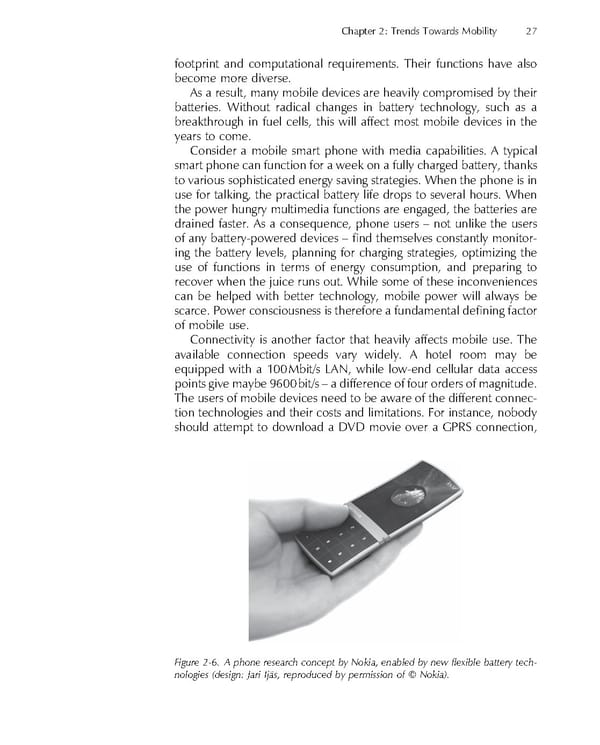
Chapter 2: Trends Towards Mobility 27 footprint and computational requirements. Their functions have also become more diverse. As a result, many mobile devices are heavily compromised by their batteries. Without radical changes in battery technology, such as a breakthrough in fuel cells, this will affect most mobile devices in the years to come. Consider a mobile smart phone with media capabilities. A typical smart phone can function for a week on a fully charged battery, thanks to various sophisticated energy saving strategies. When the phone is in use for talking, the practical battery life drops to several hours. When the power hungry multimedia functions are engaged, the batteries are drained faster. As a consequence, phone users – not unlike the users of any battery-powered devices – fi nd themselves constantly monitor- ing the battery levels, planning for charging strategies, optimizing the use of functions in terms of energy consumption, and preparing to recover when the juice runs out. While some of these inconveniences can be helped with better technology, mobile power will always be scarce. Power consciousness is therefore a fundamental defi ning factor of mobile use. Connectivity is another factor that heavily affects mobile use. The available connection speeds vary widely. A hotel room may be equipped with a 100 Mbit/s LAN, while low-end cellular data access points give maybe 9600 bit/s – a difference of four orders of magnitude. The users of mobile devices need to be aware of the different connec- tion technologies and their costs and limitations. For instance, nobody should attempt to download a DVD movie over a GPRS connection, Figure 2-6. A phone research concept by Nokia, enabled by new fl exible battery tech- nologies (design: Jari Ijäs, reproduced by permission of © Nokia).
 Personal Content Experience Page 50 Page 52