

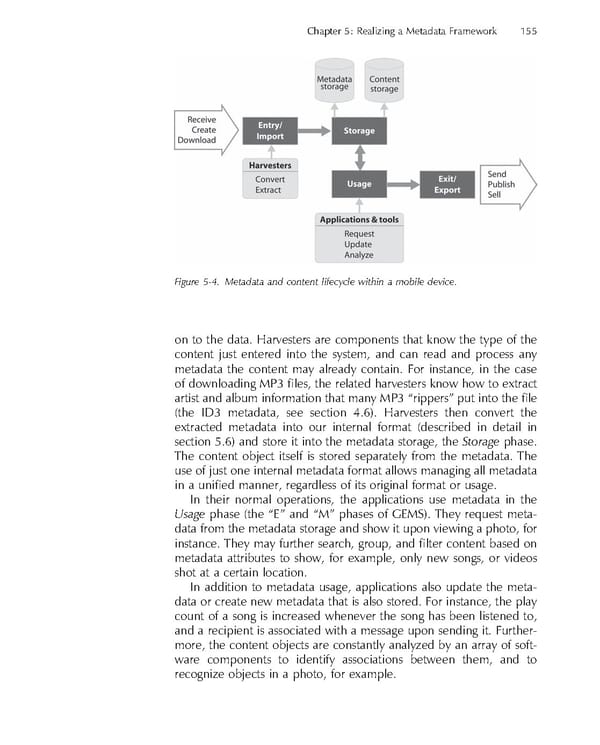
Chapter 5: Realizing a Metadata Framework 155 Figure 5-4. Metadata and content lifecycle within a mobile device. on to the data. Harvesters are components that know the type of the content just entered into the system, and can read and process any metadata the content may already contain. For instance, in the case of downloading MP3 fi les, the related harvesters know how to extract artist and album information that many MP3 “rippers” put into the fi le (the ID3 metadata, see section 4.6). Harvesters then convert the extracted metadata into our internal format (described in detail in section 5.6) and store it into the metadata storage, the Storage phase. The content object itself is stored separately from the metadata. The use of just one internal metadata format allows managing all metadata in a unifi ed manner, regardless of its original format or usage. In their normal operations, the applications use metadata in the Usage phase (the “E” and “M” phases of GEMS). They request meta- data from the metadata storage and show it upon viewing a photo, for instance. They may further search, group, and fi lter content based on metadata attributes to show, for example, only new songs, or videos shot at a certain location. In addition to metadata usage, applications also update the meta- data or create new metadata that is also stored. For instance, the play count of a song is increased whenever the song has been listened to, and a recipient is associated with a message upon sending it. Further- more, the content objects are constantly analyzed by an array of soft- ware components to identify associations between them, and to recognize objects in a photo, for example.
 Personal Content Experience Page 178 Page 180