

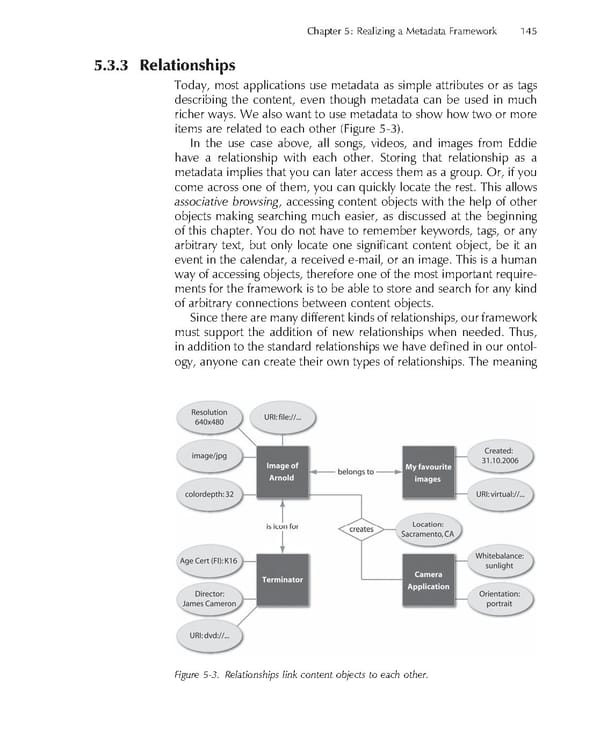
Chapter 5: Realizing a Metadata Framework 145 5.3.3 Relationships Today, most applications use metadata as simple attributes or as tags describing the content, even though metadata can be used in much richer ways. We also want to use metadata to show how two or more items are related to each other (Figure 5-3). In the use case above, all songs, videos, and images from Eddie have a relationship with each other. Storing that relationship as a metadata implies that you can later access them as a group. Or, if you come across one of them, you can quickly locate the rest. This allows associative browsing, accessing content objects with the help of other objects making searching much easier, as discussed at the beginning of this chapter. You do not have to remember keywords, tags, or any arbitrary text, but only locate one signifi cant content object, be it an event in the calendar, a received e-mail, or an image. This is a human way of accessing objects, therefore one of the most important require- ments for the framework is to be able to store and search for any kind of arbitrary connections between content objects. Since there are many different kinds of relationships, our framework must support the addition of new relationships when needed. Thus, in addition to the standard relationships we have defi ned in our ontol- ogy, anyone can create their own types of relationships. The meaning Figure 5-3. Relationships link content objects to each other.
 Personal Content Experience Page 168 Page 170