

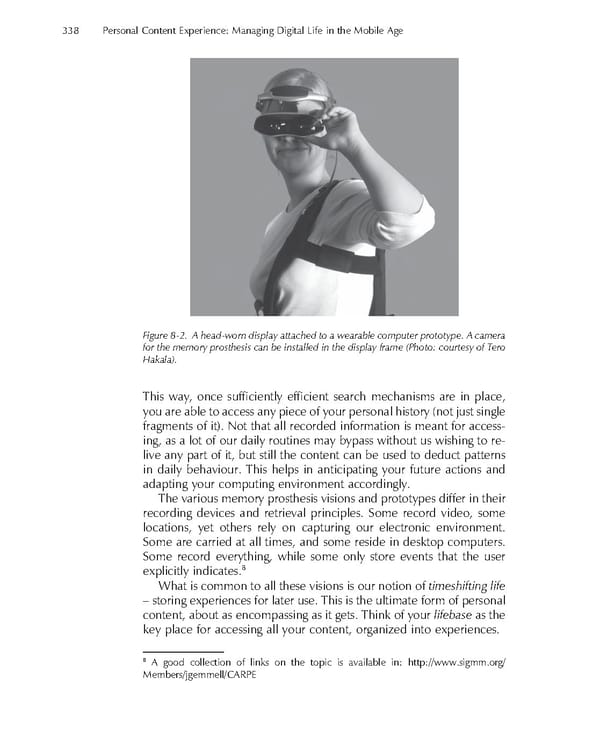
338 Personal Content Experience: Managing Digital Life in the Mobile Age Figure 8-2. A head-worn display attached to a wearable computer prototype. A camera for the memory prosthesis can be installed in the display frame (Photo: courtesy of Tero Hakala). This way, once suffi ciently effi cient search mechanisms are in place, you are able to access any piece of your personal history (not just single fragments of it). Not that all recorded information is meant for access- ing, as a lot of our daily routines may bypass without us wishing to re- live any part of it, but still the content can be used to deduct patterns in daily behaviour. This helps in anticipating your future actions and adapting your computing environment accordingly. The various memory prosthesis visions and prototypes differ in their recording devices and retrieval principles. Some record video, some locations, yet others rely on capturing our electronic environment. Some are carried at all times, and some reside in desktop computers. Some record everything, while some only store events that the user 8 explicitly indicates. What is common to all these visions is our notion of timeshifting life – storing experiences for later use. This is the ultimate form of personal content, about as encompassing as it gets. Think of your lifebase as the key place for accessing all your content, organized into experiences. 8 A good collection of links on the topic is available in: http://www.sigmm.org/ Members/jgemmell/CARPE
 Personal Content Experience Page 361 Page 363