

110 Personal Content Experience: Managing Digital Life in the Mobile Age 4.6.9 RSS The RSS metadata format (Really Simple Syndication, or Rich Site Sum- 42 maries) has become a de facto choice for describing the contents of frequently changing Web pages, such as blog entries. It has also been adopted for use in podcasts, news clips, image galleries, even weather forecasts, and any number of data sources available on the Internet. RSS stores metadata that effectively allows quick summarizing of media items. It defi nes a number of fi elds encoded in XML, such as titles, Web links, contacts, timestamps, textual summaries, etc. This allows client software, for instance a newsreader, to quickly check for new content on a page on behalf of the user. An example of a RSS feed (feed://rss.slashdot.org/Slashdot/slashdot/to)
Since RSS defi nes both fi elds that are, in principle, readable by both humans and machines, it manages to capture the best of both worlds. It allows machines to quickly process mechanical data (i.e., timestamps) and lets humans concentrate on the actual content. It is therefore a good match to describe frequently changing news-style 42 http://web.resource.org/rss/1.0/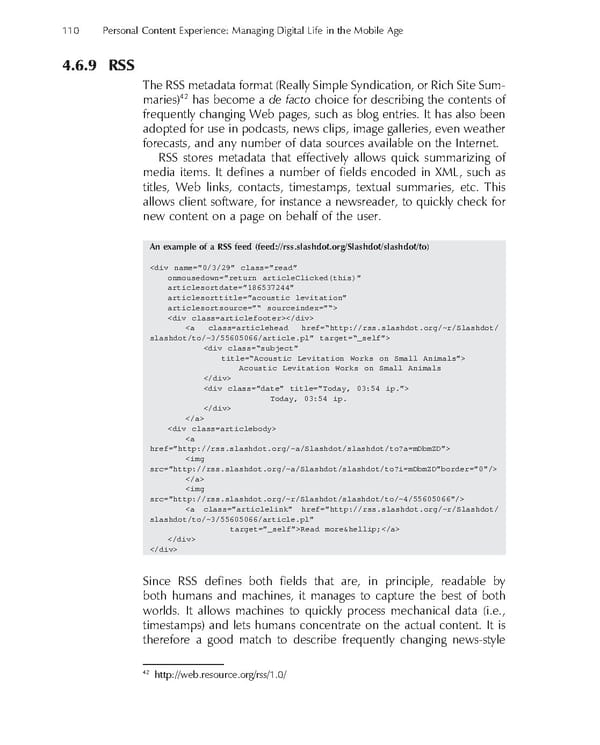 Personal Content Experience Page 133 Page 135