

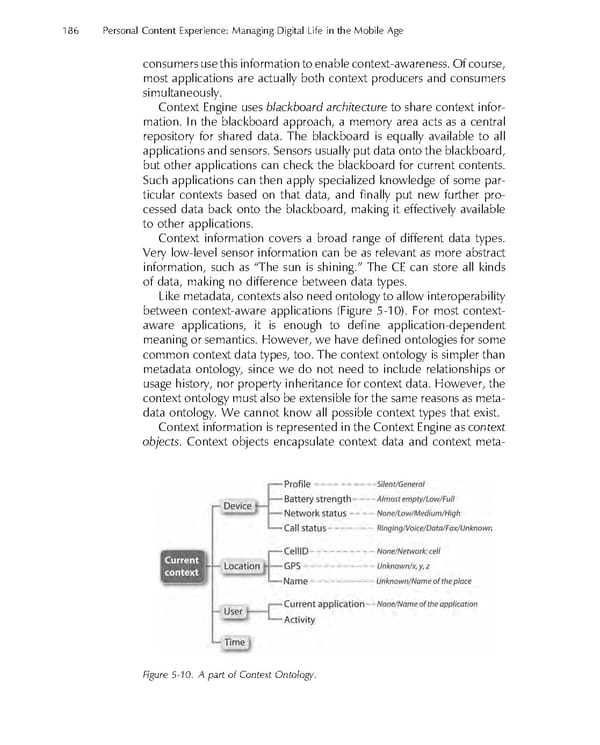
186 Personal Content Experience: Managing Digital Life in the Mobile Age consumers use this information to enable context-awareness. Of course, most applications are actually both context producers and consumers simultaneously. Context Engine uses blackboard architecture to share context infor- mation. In the blackboard approach, a memory area acts as a central repository for shared data. The blackboard is equally available to all applications and sensors. Sensors usually put data onto the blackboard, but other applications can check the blackboard for current contents. Such applications can then apply specialized knowledge of some par- ticular contexts based on that data, and fi nally put new further pro- cessed data back onto the blackboard, making it effectively available to other applications. Context information covers a broad range of different data types. Very low-level sensor information can be as relevant as more abstract information, such as “The sun is shining.” The CE can store all kinds of data, making no difference between data types. Like metadata, contexts also need ontology to allow interoperability between context-aware applications (Figure 5-10). For most context- aware applications, it is enough to defi ne application-dependent meaning or semantics. However, we have defi ned ontologies for some common context data types, too. The context ontology is simpler than metadata ontology, since we do not need to include relationships or usage history, nor property inheritance for context data. However, the context ontology must also be extensible for the same reasons as meta- data ontology. We cannot know all possible context types that exist. Context information is represented in the Context Engine as context objects. Context objects encapsulate context data and context meta- Figure 5-10. A part of Context Ontology.
 Personal Content Experience Page 209 Page 211