

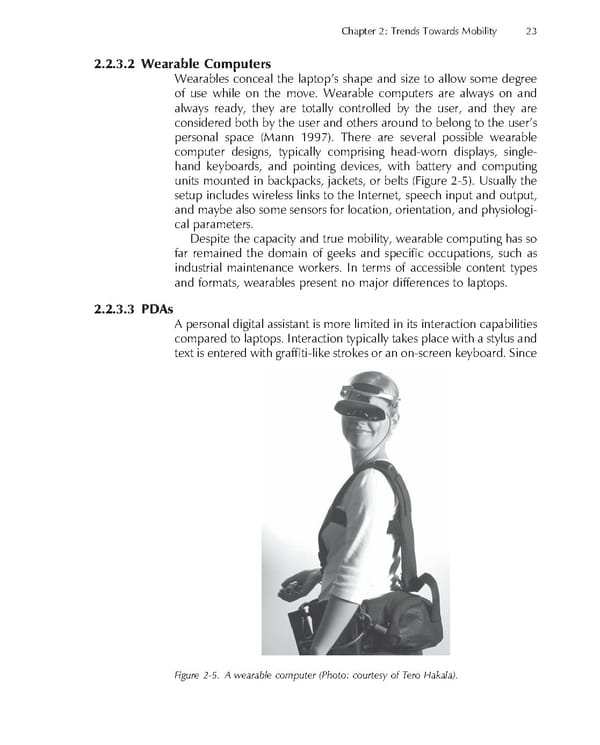
Chapter 2: Trends Towards Mobility 23 2.2.3.2 Wearable Computers Wearables conceal the laptop’s shape and size to allow some degree of use while on the move. Wearable computers are always on and always ready, they are totally controlled by the user, and they are considered both by the user and others around to belong to the user’s personal space (Mann 1997). There are several possible wearable computer designs, typically comprising head-worn displays, single- hand keyboards, and pointing devices, with battery and computing units mounted in backpacks, jackets, or belts (Figure 2-5). Usually the setup includes wireless links to the Internet, speech input and output, and maybe also some sensors for location, orientation, and physiologi- cal parameters. Despite the capacity and true mobility, wearable computing has so far remained the domain of geeks and specifi c occupations, such as industrial maintenance workers. In terms of accessible content types and formats, wearables present no major differences to laptops. 2.2.3.3 PDAs A personal digital assistant is more limited in its interaction capabilities compared to laptops. Interaction typically takes place with a stylus and text is entered with graffi ti-like strokes or an on-screen keyboard. Since Figure 2-5. A wearable computer (Photo: courtesy of Tero Hakala).
 Personal Content Experience Page 46 Page 48