

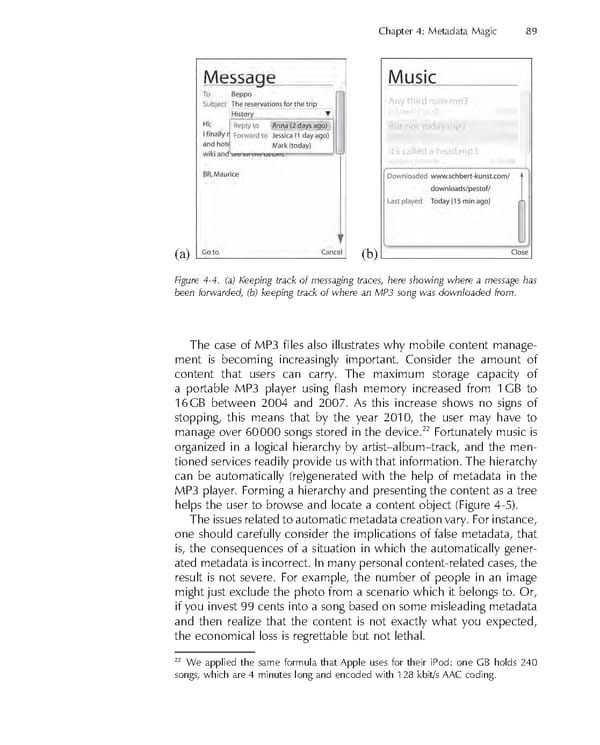
Chapter 4: Metadata Magic 89 (a) (b) Figure 4-4. (a) Keeping track of messaging traces, here showing where a message has been forwarded, (b) keeping track of where an MP3 song was downloaded from. The case of MP3 fi les also illustrates why mobile content manage- ment is becoming increasingly important. Consider the amount of content that users can carry. The maximum storage capacity of a portable MP3 player using fl ash memory increased from 1 GB to 16 GB between 2004 and 2007. As this increase shows no signs of stopping, this means that by the year 2010, the user may have to 22 manage over 60 000 songs stored in the device. Fortunately music is organized in a logical hierarchy by artist–album–track, and the men- tioned services readily provide us with that information. The hierarchy can be automatically (re)generated with the help of metadata in the MP3 player. Forming a hierarchy and presenting the content as a tree helps the user to browse and locate a content object (Figure 4-5). The issues related to automatic metadata creation vary. For instance, one should carefully consider the implications of false metadata, that is, the consequences of a situation in which the automatically gener- ated metadata is incorrect. In many personal content-related cases, the result is not severe. For example, the number of people in an image might just exclude the photo from a scenario which it belongs to. Or, if you invest 99 cents into a song based on some misleading metadata and then realize that the content is not exactly what you expected, the economical loss is regrettable but not lethal. 22 We applied the same formula that Apple uses for their iPod: one GB holds 240 songs, which are 4 minutes long and encoded with 128 kbit/s AAC coding.
 Personal Content Experience Page 112 Page 114