

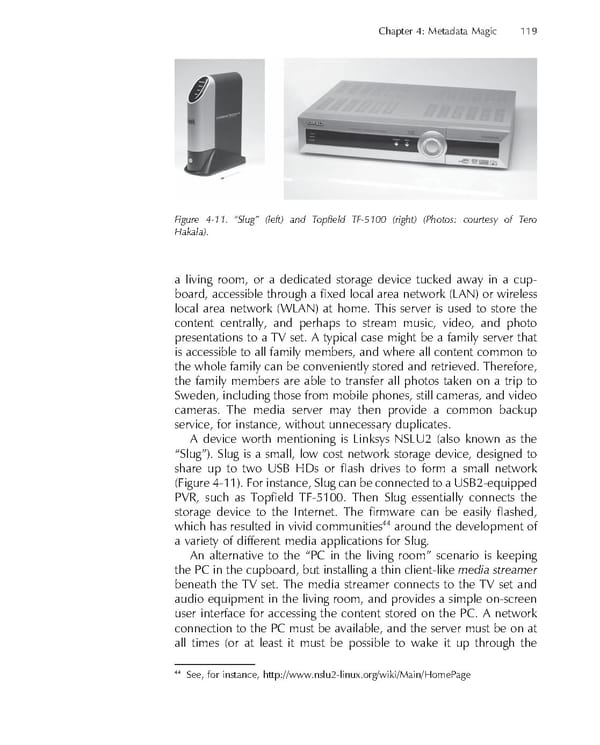
Chapter 4: Metadata Magic 119 Figure 4-11. “Slug” (left) and Topfi eld TF-5100 (right) (Photos: courtesy of Tero Hakala). a living room, or a dedicated storage device tucked away in a cup- board, accessible through a fi xed local area network (LAN) or wireless local area network (WLAN) at home. This server is used to store the content centrally, and perhaps to stream music, video, and photo presentations to a TV set. A typical case might be a family server that is accessible to all family members, and where all content common to the whole family can be conveniently stored and retrieved. Therefore, the family members are able to transfer all photos taken on a trip to Sweden, including those from mobile phones, still cameras, and video cameras. The media server may then provide a common backup service, for instance, without unnecessary duplicates. A device worth mentioning is Linksys NSLU2 (also known as the “Slug”). Slug is a small, low cost network storage device, designed to share up to two USB HDs or fl ash drives to form a small network (Figure 4-11). For instance, Slug can be connected to a USB2-equipped PVR, such as Topfi eld TF-5100. Then Slug essentially connects the storage device to the Internet. The fi rmware can be easily fl ashed, 44 which has resulted in vivid communities around the development of a variety of different media applications for Slug. An alternative to the “PC in the living room” scenario is keeping the PC in the cupboard, but installing a thin client-like media streamer beneath the TV set. The media streamer connects to the TV set and audio equipment in the living room, and provides a simple on-screen user interface for accessing the content stored on the PC. A network connection to the PC must be available, and the server must be on at all times (or at least it must be possible to wake it up through the 44 See, for instance, http://www.nslu2-linux.org/wiki/Main/HomePage
 Personal Content Experience Page 142 Page 144