

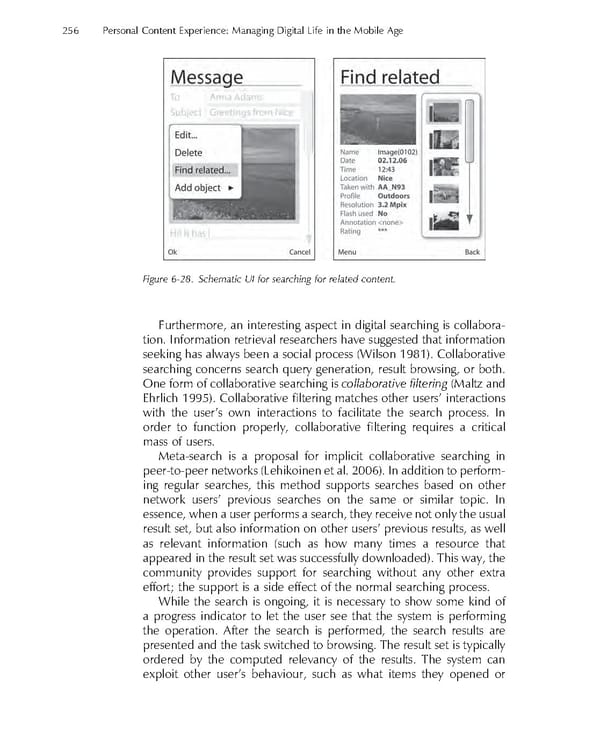
256 Personal Content Experience: Managing Digital Life in the Mobile Age Figure 6-28. Schematic UI for searching for related content. Furthermore, an interesting aspect in digital searching is collabora- tion. Information retrieval researchers have suggested that information seeking has always been a social process (Wilson 1981). Collaborative searching concerns search query generation, result browsing, or both. One form of collaborative searching is collaborative fi ltering (Maltz and Ehrlich 1995). Collaborative fi ltering matches other users’ interactions with the user’s own interactions to facilitate the search process. In order to function properly, collaborative fi ltering requires a critical mass of users. Meta-search is a proposal for implicit collaborative searching in peer-to-peer networks (Lehikoinen et al. 2006). In addition to perform- ing regular searches, this method supports searches based on other network users’ previous searches on the same or similar topic. In essence, when a user performs a search, they receive not only the usual result set, but also information on other users’ previous results, as well as relevant information (such as how many times a resource that appeared in the result set was successfully downloaded). This way, the community provides support for searching without any other extra effort; the support is a side effect of the normal searching process. While the search is ongoing, it is necessary to show some kind of a progress indicator to let the user see that the system is performing the operation. After the search is performed, the search results are presented and the task switched to browsing. The result set is typically ordered by the computed relevancy of the results. The system can exploit other user’s behaviour, such as what items they opened or
 Personal Content Experience Page 279 Page 281