

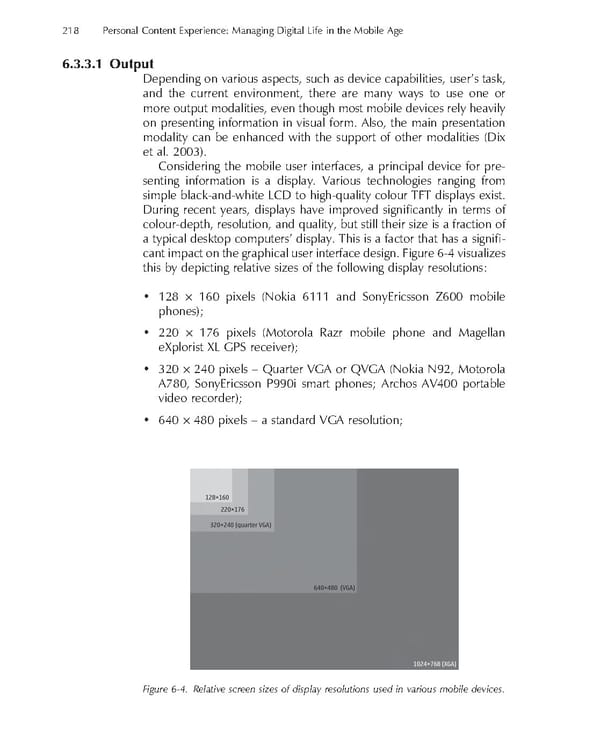
218 Personal Content Experience: Managing Digital Life in the Mobile Age 6.3.3.1 Output Depending on various aspects, such as device capabilities, user’s task, and the current environment, there are many ways to use one or more output modalities, even though most mobile devices rely heavily on presenting information in visual form. Also, the main presentation modality can be enhanced with the support of other modalities (Dix et al. 2003). Considering the mobile user interfaces, a principal device for pre- senting information is a display. Various technologies ranging from simple black-and-white LCD to high-quality colour TFT displays exist. During recent years, displays have improved signifi cantly in terms of colour-depth, resolution, and quality, but still their size is a fraction of a typical desktop computers’ display. This is a factor that has a signifi - cant impact on the graphical user interface design. Figure 6-4 visualizes this by depicting relative sizes of the following display resolutions: • 128 × 160 pixels (Nokia 6111 and SonyEricsson Z600 mobile phones); • 220 × 176 pixels (Motorola Razr mobile phone and Magellan eXplorist XL GPS receiver); • 320 × 240 pixels – Quarter VGA or QVGA (Nokia N92, Motorola A780, SonyEricsson P990i smart phones; Archos AV400 portable video recorder); • 640 × 480 pixels – a standard VGA resolution; Figure 6-4. Relative screen sizes of display resolutions used in various mobile devices.
 Personal Content Experience Page 241 Page 243