

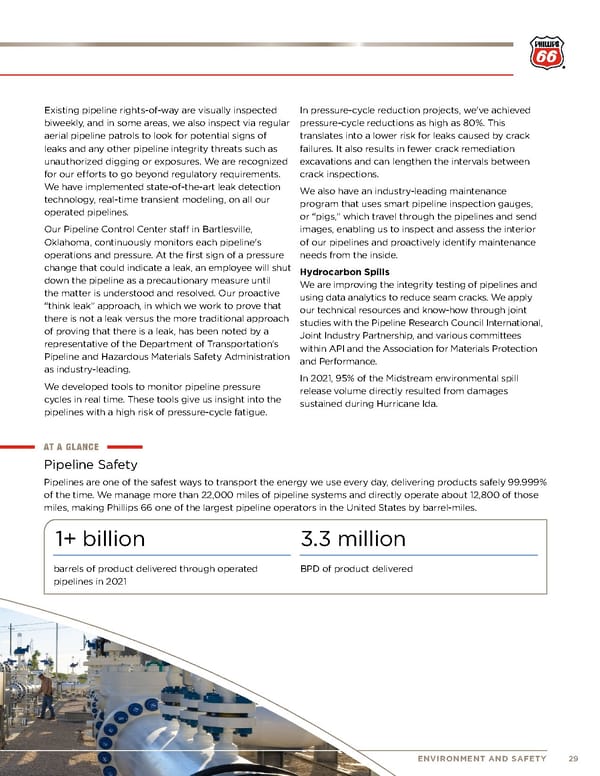
Existing pipeline rights-of-way are visually inspected biweekly, and in some areas, we also inspect via regular aerial pipeline patrols to look for potential signs of leaks and any other pipeline integrity threats such as unauthorized digging or exposures. We are recognized for our efforts to go beyond regulatory requirements. We have implemented state-of-the-art leak detection technology, real-time transient modeling, on all our operated pipelines. Our Pipeline Control Center staff in Bartlesville, Oklahoma, continuously monitors each pipeline's operations and pressure. At the first sign of a pressure change that could indicate a leak, an employee will shut down the pipeline as a precautionary measure until the matter is understood and resolved. Our proactive “think leak” approach, in which we work to prove that there is not a leak versus the more traditional approach of proving that there is a leak, has been noted by a representative of the Department of Transportation’s Pipeline and Hazardous Materials Safety Administration as industry-leading. We developed tools to monitor pipeline pressure cycles in real time. These tools give us insight into the pipelines with a high risk of pressure-cycle fatigue. In pressure-cycle reduction projects, we've achieved pressure-cycle reductions as high as 80%. This translates into a lower risk for leaks caused by crack failures. It also results in fewer crack remediation excavations and can lengthen the intervals between crack inspections. We also have an industry-leading maintenance program that uses smart pipeline inspection gauges, or “pigs,” which travel through the pipelines and send images, enabling us to inspect and assess the interior of our pipelines and proactively identify maintenance needs from the inside. Hydrocarbon Spills We are improving the integrity testing of pipelines and using data analytics to reduce seam cracks. We apply our technical resources and know-how through joint studies with the Pipeline Research Council International, Joint Industry Partnership, and various committees within API and the Association for Materials Protection and Performance. In 2021, 95% of the Midstream environmental spill release volume directly resulted from damages sustained during Hurricane Ida. Pipelines are one of the safest ways to transport the energy we use every day, delivering products safely 99.999% of the time. We manage more than 22,000 miles of pipeline systems and directly operate about 12,800 of those miles, making Phillips 66 one of the largest pipeline operators in the United States by barrel-miles. 1+ billion barrels of product delivered through operated pipelines in 2021 3.3 million BPD of product delivered AT A GLANCE Pipeline Safety 29 ENVIRONMENT AND SAFETY
 Philips 66 ESG Report Page 30 Page 32