

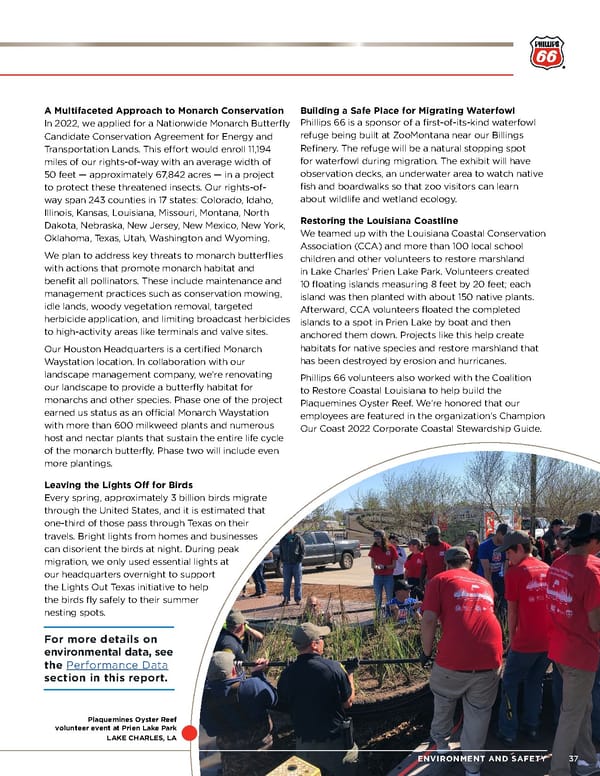
A Multifaceted Approach to Monarch Conservation In 2022, we applied for a Nationwide Monarch Butterfly Candidate Conservation Agreement for Energy and Transportation Lands. This effort would enroll 11,194 miles of our rights-of-way with an average width of 50 feet — approximately 67,842 acres — in a project to protect these threatened insects. Our rights-of- way span 243 counties in 17 states: Colorado, Idaho, Illinois, Kansas, Louisiana, Missouri, Montana, North Dakota, Nebraska, New Jersey, New Mexico, New York, Oklahoma, Texas, Utah, Washington and Wyoming. We plan to address key threats to monarch butterflies with actions that promote monarch habitat and benefit all pollinators. These include maintenance and management practices such as conservation mowing, idle lands, woody vegetation removal, targeted herbicide application, and limiting broadcast herbicides to high-activity areas like terminals and valve sites. Our Houston Headquarters is a certified Monarch Waystation location. In collaboration with our landscape management company, we’re renovating our landscape to provide a butterfly habitat for monarchs and other species. Phase one of the project earned us status as an official Monarch Waystation with more than 600 milkweed plants and numerous host and nectar plants that sustain the entire life cycle of the monarch butterfly. Phase two will include even more plantings. Leaving the Lights Off for Birds Every spring, approximately 3 billion birds migrate through the United States, and it is estimated that one-third of those pass through Texas on their travels. Bright lights from homes and businesses can disorient the birds at night. During peak migration, we only used essential lights at our headquarters overnight to support the Lights Out Texas initiative to help the birds fly safely to their summer nesting spots. For more details on environmental data, see the Performance Data section in this report. Building a Safe Place for Migrating Waterfowl Phillips 66 is a sponsor of a first-of-its-kind waterfowl refuge being built at ZooMontana near our Billings Refinery. The refuge will be a natural stopping spot for waterfowl during migration. The exhibit will have observation decks, an underwater area to watch native fish and boardwalks so that zoo visitors can learn about wildlife and wetland ecology. Restoring the Louisiana Coastline We teamed up with the Louisiana Coastal Conservation Association (CCA) and more than 100 local school children and other volunteers to restore marshland in Lake Charles’ Prien Lake Park. Volunteers created 10 floating islands measuring 8 feet by 20 feet; each island was then planted with about 150 native plants. Afterward, CCA volunteers floated the completed islands to a spot in Prien Lake by boat and then anchored them down. Projects like this help create habitats for native species and restore marshland that has been destroyed by erosion and hurricanes. Phillips 66 volunteers also worked with the Coalition to Restore Coastal Louisiana to help build the Plaquemines Oyster Reef. We’re honored that our employees are featured in the organization’s Champion Our Coast 2022 Corporate Coastal Stewardship Guide. 37 Plaquemines Oyster Reef volunteer event at Prien Lake Park LAKE CHARLES, LA ENVIRONMENT AND SAFETY 37
 Philips 66 ESG Report Page 38 Page 40