

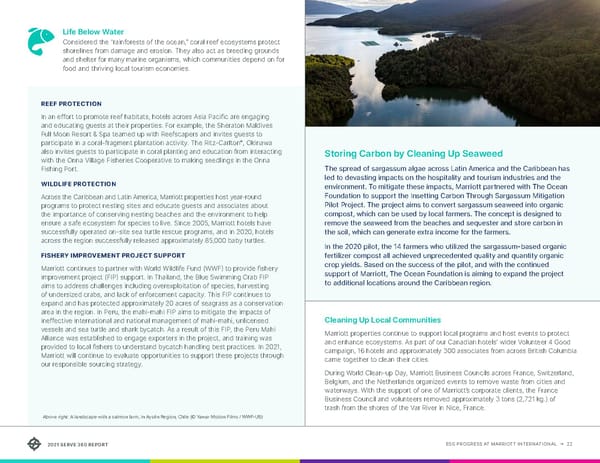
2021 SERVE 360 REPORT ESG PROGRESS AT MARRIOTT INTERNATIONAL → 22 Life Below Water Considered the “rainforests of the ocean,” coral reef ecosystems protect shorelines from damage and erosion. They also act as breeding grounds and shelter for many marine organisms, which communities depend on for food and thriving local tourism economies. REEF PROTECTION In an effort to promote reef habitats, hotels across Asia Pacific are engaging and educating guests at their properties. For example, the Sheraton Maldives Full Moon Resort & Spa teamed up with Reefscapers and invites guests to participate in a coral-fragment plantation activity. The Ritz-Carlton ® , Okinawa also invites guests to participate in coral planting and education from interacting with the Onna Village Fisheries Cooperative to making seedlings in the Onna Fishing Port. WILDLIFE PROTECTION Across the Caribbean and Latin America, Marriott properties host year-round programs to protect nesting sites and educate guests and associates about the importance of conserving nesting beaches and the environment to help ensure a safe ecosystem for species to live. Since 2005, Marriott hotels have successfully operated on-site sea turtle rescue programs, and in 2020, hotels across the region successfully released approximately 85,000 baby turtles. FISHERY IMPROVEMENT PROJECT SUPPORT Marriott continues to partner with World Wildlife Fund (WWF) to provide fishery improvement project (FIP) support. In Thailand, the Blue Swimming Crab FIP aims to address challenges including overexploitation of species, harvesting of undersized crabs, and lack of enforcement capacity. This FIP continues to expand and has protected approximately 20 acres of seagrass as a conservation area in the region. In Peru, the mahi-mahi FIP aims to mitigate the impacts of ineffective international and national management of mahi-mahi, unlicensed vessels and sea turtle and shark bycatch. As a result of this FIP, the Peru Mahi Alliance was established to engage exporters in the project, and training was provided to local fishers to understand bycatch handling best practices. In 2021, Marriott will continue to evaluate opportunities to support these projects through our responsible sourcing strategy. Storing Carbon by Cleaning Up Seaweed The spread of sargassum algae across Latin America and the Caribbean has led to devasting impacts on the hospitality and tourism industries and the environment. To mitigate these impacts, Marriott partnered with The Ocean Foundation to support the Insetting Carbon Through Sargassum Mitigation Pilot Project. The project aims to convert sargassum seaweed into organic compost, which can be used by local farmers. The concept is designed to remove the seaweed from the beaches and sequester and store carbon in the soil, which can generate extra income for the farmers. In the 2020 pilot, the 14 farmers who utilized the sargassum-based organic fertilizer compost all achieved unprecedented quality and quantity organic crop yields. Based on the success of the pilot, and with the continued support of Marriott, The Ocean Foundation is aiming to expand the project to additional locations around the Caribbean region. Cleaning Up Local Communities Marriott properties continue to support local programs and host events to protect and enhance ecosystems. As part of our Canadian hotels' wider Volunteer 4 Good campaign, 16 hotels and approximately 300 associates from across British Columbia came together to clean their cities. During World Clean-up Day, Marriott Business Councils across France, Switzerland, Belgium, and the Netherlands organized events to remove waste from cities and waterways. With the support of one of Marriott’s corporate clients, the France Business Council and volunteers removed approximately 3 tons (2,721 kg.) of trash from the shores of the Var River in Nice, France. Above right: A landscape with a salmon farm, in Aysén Region, Chile (© Yawar Motion Films / WWF-US)
 Serve360 ESG Report Page 21 Page 23