

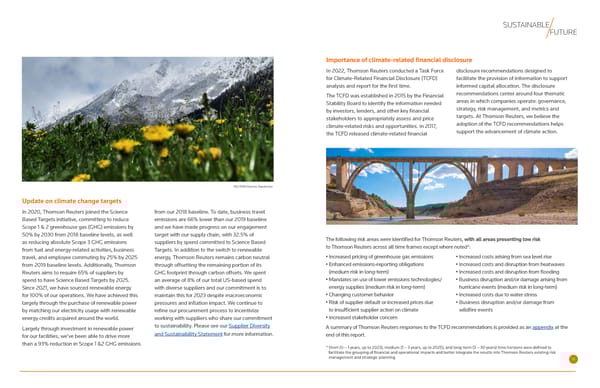
SUSTAINABLE FUTURE Importance of climate-related 昀椀nancial disclosure In 2022, Thomson Reuters conducted a Task Force disclosure recommendations designed to for Climate-Related Financial Disclosure (TCFD) facilitate the provision of information to support analysis and report for the 昀椀rst time. informed capital allocation. The disclosure The TCFD was established in 2015 by the Financial recommendations center around four thematic Stability Board to identify the information needed areas in which companies operate: governance, strategy, risk management, and metrics and by investors, lenders, and other key 昀椀nancial stakeholders to appropriately assess and price targets. At Thomson Reuters, we believe the climate-related risks and opportunities. In 2017, adoption of the TCFD recommendations helps support the advancement of climate action. the TCFD released climate-related 昀椀nancial REUTERS/Dominic Ebenbichler Update on climate change targets In 2020, Thomson Reuters joined the Science from our 2018 baseline. To date, business travel Based Targets initiative, committing to reduce emissions are 66% lower than our 2019 baseline Scope 1 & 2 greenhouse gas (GHG) emissions by and we have made progress on our engagement 50% by 2030 from 2018 baseline levels, as well target with our supply chain, with 32.5% of The following risk areas were identi昀椀ed for Thomson Reuters, with all areas presenting low risk as reducing absolute Scope 3 GHG emissions suppliers by spend committed to Science Based 4 from fuel and energy-related activities, business Targets. In addition to the switch to renewable to Thomson Reuters across all time frames except where noted : travel, and employee commuting by 25% by 2025 energy, Thomson Reuters remains carbon neutral • Increased pricing of greenhouse gas emissions • Increased costs arising from sea level rise from 2019 baseline levels. Additionally, Thomson through offsetting the remaining portion of its • Enhanced emissions-reporting obligations • Increased costs and disruption from heatwaves (medium risk in long-term) Reuters aims to require 65% of suppliers by GHG footprint through carbon offsets. We spent • Increased costs and disruption from 昀氀ooding spend to have Science Based Targets by 2025. an average of 8% of our total US-based spend • Mandates on use of lower emissions technologies/ • Business disruption and/or damage arising from Since 2021, we have sourced renewable energy with diverse suppliers and our commitment is to energy supplies (medium risk in long-term) hurricane events (medium risk in long-term) for 100% of our operations. We have achieved this maintain this for 2023 despite macroeconomic • Changing customer behavior • Increased costs due to water stress largely through the purchase of renewable power pressures and in昀氀ation impact. We continue to • Risk of supplier default or increased prices due • Business disruption and/or damage from to insuf昀椀cient supplier action on climate by matching our electricity usage with renewable re昀椀ne our procurement process to incentivize wild昀椀re events energy credits acquired around the world. working with suppliers who share our commitment • Increased stakeholder concern Largely through investment in renewable power to sustainability. Please see our Supplier Diversity A summary of Thomson Reuters responses to the TCFD recommendations is provided as an appendix at the for our facilities, we’ve been able to drive more and Sustainability Statement for more information. end of this report. than a 93% reduction in Scope 1 &2 GHG emissions 4 Short (0 – 1 years, up to 2023), medium (1 – 3 years, up to 2025), and long-term (3 – 30 years) time horizons were de昀椀ned to facilitate the grouping of 昀椀nancial and operational impacts and better integrate the results into Thomson Reuters existing risk management and strategic planning. 16
 Social Impact 2022 Page 15 Page 17