

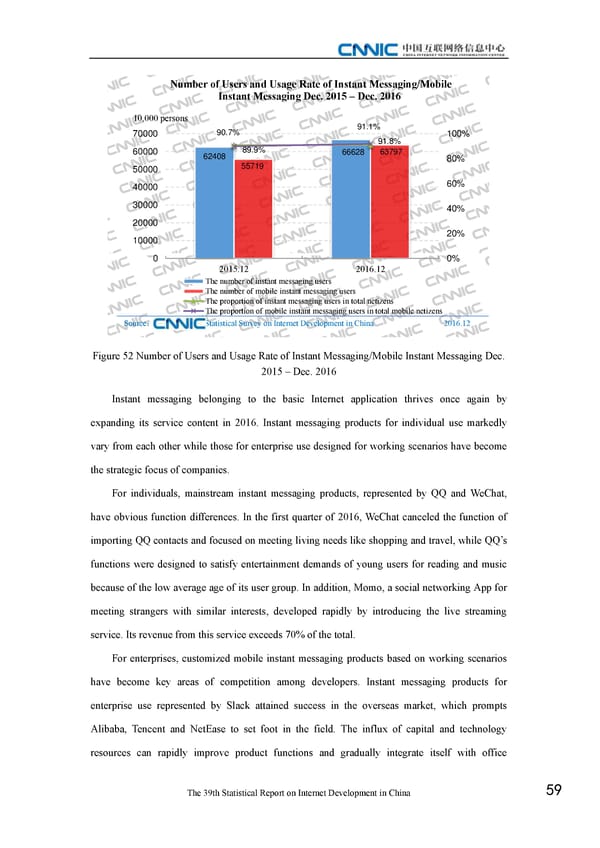
Number of Users and Usage Rate of Instant Messaging/Mobile Instant Messaging Dec. 2015 – Dec. 2016 10,000persons 91.1% 70000 90.7% 100% 91.8% 60000 62408 89.9% 66628 63797 80% 50000 55719 40000 60% 30000 40% 20000 10000 20% 0 0% 2015.12 2016.12 The number of instant messaging users The number of mobile instant messaging users The proportion of instant messaging users in total netizens The proportion of mobile instant messaging users in total mobile netizens Source: Statistical Survey on Internet Development in China 2016.12 Figure 52 Number of Users and Usage Rate of Instant Messaging/Mobile Instant Messaging Dec. 2015 – Dec. 2016 Instant messaging belonging to the basic Internet application thrives once again by expanding its service content in 2016. Instant messaging products for individual use markedly vary from each other while those for enterprise use designed for working scenarios have become the strategic focus of companies. For individuals, mainstream instant messaging products, represented by QQ and WeChat, have obvious function differences. In the first quarter of 2016, WeChat canceled the function of importing QQ contacts and focused on meeting living needs like shopping and travel, while QQ’s functions were designed to satisfy entertainment demands of young users for reading and music because of the low average age of its user group. In addition, Momo, a social networking App for meeting strangers with similar interests, developed rapidly by introducing the live streaming service. Its revenue from this service exceeds 70% of the total. For enterprises, customized mobile instant messaging products based on working scenarios have become key areas of competition among developers. Instant messaging products for enterprise use represented by Slack attained success in the overseas market, which prompts Alibaba, Tencent and NetEase to set foot in the field. The influx of capital and technology resources can rapidly improve product functions and gradually integrate itself with office 5959 The 39th Statistical Report on Internet Development in China
 Statistical Report on Internet Development in China Page 68 Page 70