

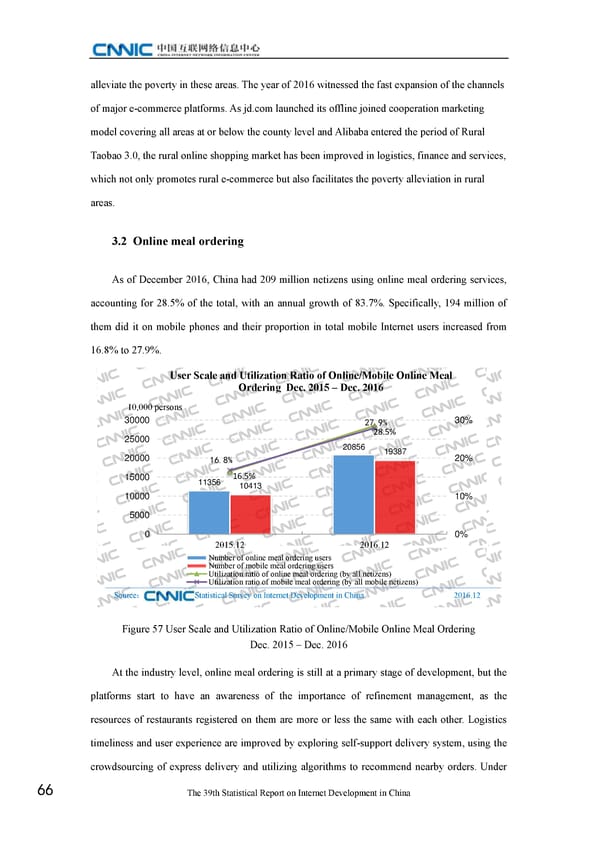
alleviate the poverty in these areas. The year of 2016 witnessed the fast expansion of the channels of major e-commerce platforms. As jd.com launched its offline joined cooperation marketing model covering all areas at or below the county level and Alibaba entered the period of Rural Taobao 3.0, the rural online shopping market has been improved in logistics, finance and services, which not only promotes rural e-commerce but also facilitates the poverty alleviation in rural areas. 3.2 Online meal ordering As of December 2016, China had 209 million netizens using online meal ordering services, accounting for 28.5% of the total, with an annual growth of 83.7%. Specifically, 194 million of them did it on mobile phones and their proportion in total mobile Internet users increased from 16.8% to 27.9%. User Scale and Utilization Ratio of Online/Mobile Online Meal Ordering Dec. 2015 – Dec. 2016 10,000 persons 30000 27.9% 30% 25000 28.5% 20856 19387 20000 16.8% 20% 15000 11356 16.5% 10413 10000 10% 5000 0 0% 2015.12 2016.12 Number of online meal ordering users Number of mobile meal ordering users Utilization ratio of online meal ordering (by all netizens) Utilization ratio of mobile meal ordering (by all mobile netizens) Source: Statistical Survey on Internet Development in China 2016.12 Figure 57 User Scale and Utilization Ratio of Online/Mobile Online Meal Ordering Dec. 2015 – Dec. 2016 At the industry level, online meal ordering is still at a primary stage of development, but the platforms start to have an awareness of the importance of refinement management, as the resources of restaurants registered on them are more or less the same with each other. Logistics timeliness and user experience are improved by exploring self-support delivery system, using the 66 crowdsourcing of express delivery and utilizing algorithms to recommend nearby orders. Under The 39th Statistical Report on Internet Development in China
 Statistical Report on Internet Development in China Page 75 Page 77