

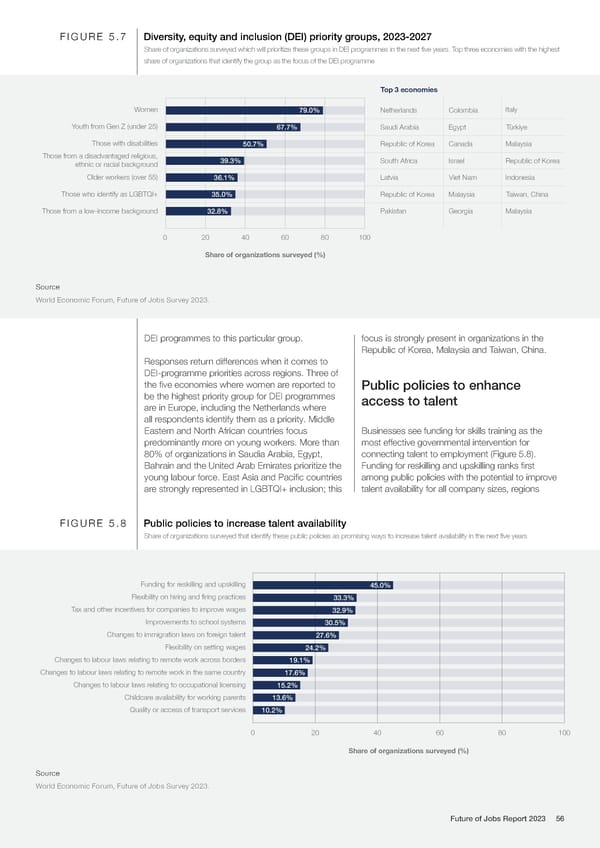
FIGURE 5.7 Diversity, equity and inclusion (DEI) priority groups, 2023-2027 Share of organizations surveyed which will prioritize these groups in DEI programmes in the next five years. Top three economies with the highest share of organizations that identify the group as the focus of the DEI programme Top 3 economies Women 79.0% Netherlands Colombia Italy Youth from Gen Z (under 25) 67.7% Saudi Arabia Egypt Türkiye Those with disabilities 50.7% Republic of Korea Canada Malaysia Those from a disadvantaged religious, 39.3% South Africa Israel Republic of Korea ethnic or racial background Older workers (over 55) 36.1% Latvia Viet Nam Indonesia Those who identify as LGBTQI+ 35.0% Republic of Korea Malaysia Taiwan, China Those from a low-income background 32.8% Pakistan Georgia Malaysia 0 20 40 60 80 100 Share of organizations surveyed (%) Source World Economic Forum, Future of Jobs Survey 2023. DEI programmes to this particular group. focus is strongly present in organizations in the Republic of Korea, Malaysia and Taiwan, China. Responses return differences when it comes to DEI-programme priorities across regions. Three of the five economies where women are reported to Public policies to enhance be the highest priority group for DEI programmes access to talent are in Europe, including the Netherlands where all respondents identify them as a priority. Middle Eastern and North African countries focus Businesses see funding for skills training as the predominantly more on young workers. More than most effective governmental intervention for 80% of organizations in Saudia Arabia, Egypt, connecting talent to employment (Figure 5.8). Bahrain and the United Arab Emirates prioritize the Funding for reskilling and upskilling ranks first young labour force. East Asia and Pacific countries among public policies with the potential to improve are strongly represented in LGBTQI+ inclusion; this talent availability for all company sizes, regions FIGURE 5.8 Public policies to increase talent availability Share of organizations surveyed that identify these public policies as promising ways to increase talent availability in the next five years Funding for reskilling and upskilling 45.0% Flexibility on hiring and firing practices 33.3% Tax and other incentives for companies to improve wages 32.9% Improvements to school systems 30.5% Changes to immigration laws on foreign talent 27.6% Flexibility on setting wages 24.2% Changes to labour laws relating to remote work across borders 19.1% Changes to labour laws relating to remote work in the same country 17.6% Changes to labour laws relating to occupational licensing 15.2% Childcare availability for working parents 13.6% Quality or access of transport services 10.2% 0 20 40 60 80 100 Share of organizations surveyed (%) Source World Economic Forum, Future of Jobs Survey 2023. Future of Jobs Report 2023 56
 The Future of Jobs Report 2023 Page 55 Page 57