

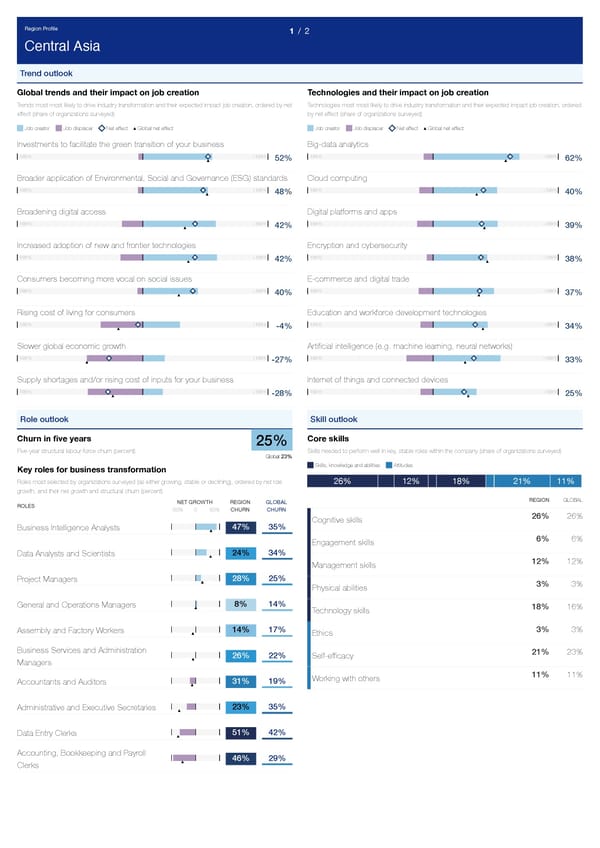
Region Profile 1 / 2 Central Asia Trend outlook Global trends and their impact on job creation Technologies and their impact on job creation Trends most most likely to drive industry transformation and their expected impact job creation, ordered by net Technologies most most likely to drive industry transformation and their expected impact job creation, ordered effect (share of organizations surveyed) by net effect (share of organizations surveyed) Job creator Job displacer Net effect Global net effect Job creator Job displacer Net effect Global net effect Investments to facilitate the green transition of your business Big-data analytics -100% +100% -100% +100% 52% 62% Broader application of Environmental, Social and Governance (ESG) standards Cloud computing -100% +100% -100% +100% 48% 40% Broadening digital access Digital platforms and apps -100% +100% -100% +100% 42% 39% Increased adoption of new and frontier technologies Encryption and cybersecurity -100% +100% -100% +100% 42% 38% Consumers becoming more vocal on social issues E-commerce and digital trade -100% +100% -100% +100% 40% 37% Rising cost of living for consumers Education and workforce development technologies -100% +100% -100% +100% -4% 34% Slower global economic growth Artificial intelligence (e.g. machine learning, neural networks) -100% +100% -100% +100% -27% 33% Supply shortages and/or rising cost of inputs for your business Internet of things and connected devices -100% +100% -100% +100% -28% 25% Role outlook Skill outlook Churn in five years Core sRills 25% Five-year structural labour-force churn (percent) 6kills needed to perform well in key, stable roles within the company (share of organizations surveyed) Global 23% Skills, knowledge and abilities Attitudes Key roles for business transformation Roles most selected by organizations surveyed (as either growing, stable or declining), ordered by net role 26% 12% 18% 21% 11% growth, and their net growth and structural churn (percent) REGION GLOBAL NET GROWTH REGION GLOBAL ROLES -50% 0 50% CHURN CHURN 26% 26% Cognitive skills 47% 35% Business Intelligence Analysts 6% 6% Engagement skills 24% 34% Data Analysts and Scientists 12% 12% Management skills 28% 25% Project Managers 3% 3% Physical abilities 8% 14% General and Operations Managers 18% 16% Technology skills 3% 3% 14% 17% Assembly and Factory Workers Ethics Business Services and Administration 21% 23% 26% 22% Self-efficacy Managers 11 % 11% Working with others 31% 19% Accountants and Auditors 23% 35% Administrative and Executive Secretaries 51% 42% Data Entry Clerks Accounting, Bookkeeping and Payroll 46% 29% Clerks
 The Future of Jobs Report 2023 Page 237 Page 239