

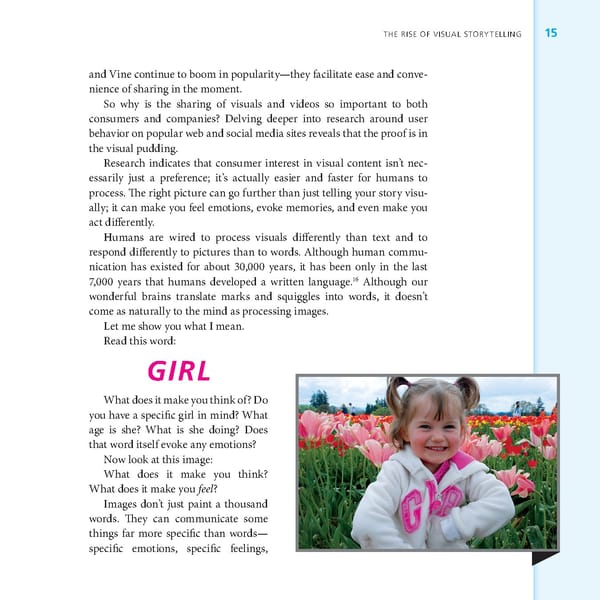
THE RISE OF VISUAL STORYTELLING 15 and Vine continue to boom in popularity—they facilitate ease and conve- nience of sharing in the moment. So why is the sharing of visuals and videos so important to both consumers and companies? Delving deeper into research around user behavior on popular web and social media sites reveals that the proof is in the visual pudding. Research indicates that consumer interest in visual content isn’t nec- essarily just a preference; it’s actually easier and faster for humans to process. The right picture can go further than just telling your story visu- ally; it can make you feel emotions, evoke memories, and even make you act differently. Humans are wired to process visuals differently than text and to respond differently to pictures than to words. Although human commu- nication has existed for about 30,000 years, it has been only in the last 16 7,000 years that humans developed a written language. Although our wonderful brains translate marks and squiggles into words, it doesn’t come as naturally to the mind as processing images. Let me show you what I mean. Read this word: GIRL What does it make you think of? Do you have a specific girl in mind? What age is she? What is she doing? Does that word itself evoke any emotions? Now look at this image: What does it make you think? What does it make you feel? Images don’t just paint a thousand words. They can communicate some things far more specific than words— specific emotions, specific feelings,
 The Power of Visual Storytelling: How to Use Visuals, Videos, and Social Media to Market Your Brand Page 28 Page 30