

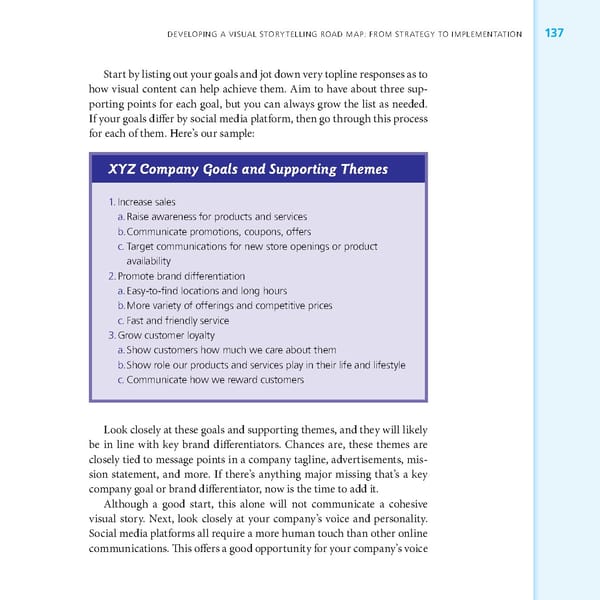
DEVELOPING A VISUAL STORYTELLING ROAD MAP: FROM STRATEGY TO IMPLEMENTATION 137 Start by listing out your goals and jot down very topline responses as to how visual content can help achieve them. Aim to have about three sup- porting points for each goal, but you can always grow the list as needed. If your goals differ by social media platform, then go through this process for each of them. Here’s our sample: XYZ Company Goals and Supporting Themes 1. Increase sales a. Raise awareness for products and services b. Communicate promotions, coupons, offers c. Target communications for new store openings or product availability 2. Promote brand differentiation a. Easy-to-find locations and long hours b. More variety of offerings and competitive prices c. Fast and friendly service 3. Grow customer loyalty a. Show customers how much we care about them b. Show role our products and services play in their life and lifestyle c. Communicate how we reward customers Look closely at these goals and supporting themes, and they will likely be in line with key brand differentiators. Chances are, these themes are closely tied to message points in a company tagline, advertisements, mis- sion statement, and more. If there’s anything major missing that’s a key company goal or brand differentiator, now is the time to add it. Although a good start, this alone will not communicate a cohesive visual story. Next, look closely at your company’s voice and personality. Social media platforms all require a more human touch than other online communications. This offers a good opportunity for your company’s voice
 The Power of Visual Storytelling: How to Use Visuals, Videos, and Social Media to Market Your Brand Page 150 Page 152