

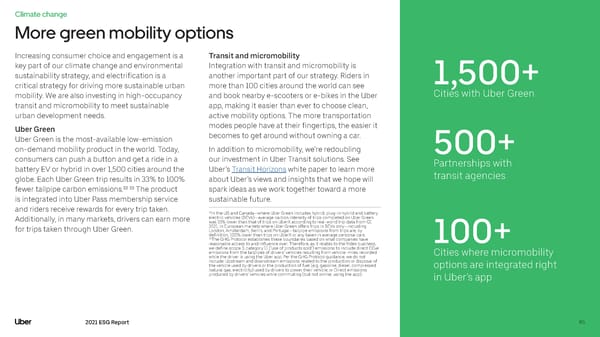
Climate change More green mobility options Increasing consumer choice and engagement is a Transit and micromobility key part of our climate change and environmental Integration with transit and micromobility is sustainability strategy, and electrification is a another important part of our strategy. Riders in 1,500+ critical strategy for driving more sustainable urban more than 100 cities around the world can see Cities with Uber Green mobility. We are also investing in high-occupancy and book nearby e-scooters or e-bikes in the Uber transit and micromobility to meet sustainable app, making it easier than ever to choose clean, urban development needs. active mobility options. The more transportation Uber Green modes people have at their fingertips, the easier it Uber Green is the most-available low-emission becomes to get around without owning a car. on-demand mobility product in the world. Today, In addition to micromobility, we’re redoubling 500+ consumers can push a button and get a ride in a our investment in Uber Transit solutions. See Partnerships with battery EV or hybrid in over 1,500 cities around the Uber’s Transit Horizons white paper to learn more transit agencies globe. Each Uber Green trip results in 33% to 100% about Uber’s views and insights that we hope will fewer tailpipe carbon emissions.³² ³³ The product spark ideas as we work together toward a more is integrated into Uber Pass membership service sustainable future. and riders receive rewards for every trip taken. 32In the US and Canada—where Uber Green includes hybrid, plug-in hybrid and battery Additionally, in many markets, drivers can earn more electric vehicles (BEVs)—average carbon intensity of trips completed on Uber Green was 33% lower than that of trips on UberX according to real-world trip data from Q1 for trips taken through Uber Green. 2021. In European markets where Uber Green offers trips in BEVs only—including London, Amsterdam, Berlin, and Portugal—tailpipe emissions from trips are, by definition, 100% lower than trips on UberX or any taken in average personal cars. 33 The GHG Protocol establishes these boundaries based on what companies have 100+ reasonable access to and influence over. Therefore, as it relates to the Rides business, we define scope 3, category 11 ("use of products sold") emissions to include direct CO₂e emissions from the tailpipes of drivers’ vehicles resulting from vehicle-miles recorded Cities where micromobility while the driver is using the Uber app. Per the GHG Protocol guidance, we do not include: Upstream and downstream emissions related to the production or disposal of the vehicle used by drivers or the production of fuel (e.g. gasoline, diesel, compressed options are integrated right natural gas, electricity) used by drivers to power their vehicle; or Direct emissions produced by drivers’ vehicles while commuting (but not online, using the app). in Uber’s app 2021 ESG Report 65 65
 Uber ESG Report Page 64 Page 66