

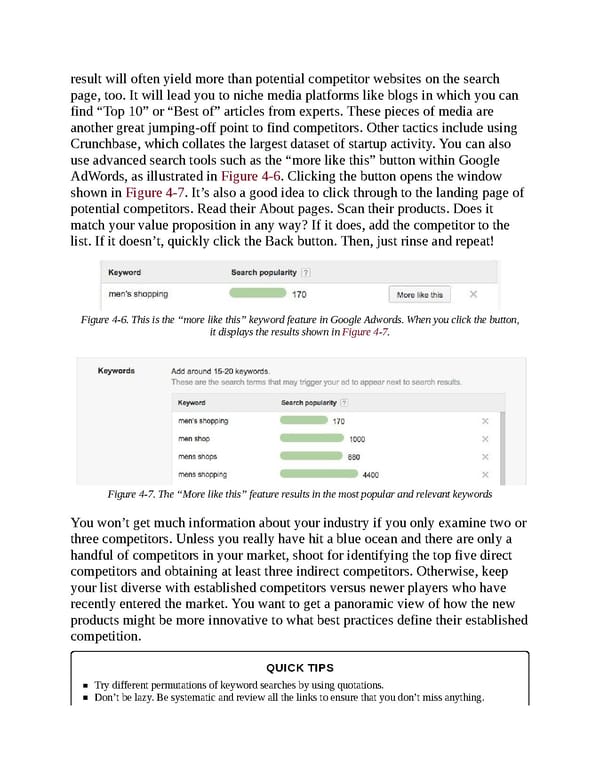
result will often yield more than potential competitor websites on the search page, too. It will lead you to niche media platforms like blogs in which you can find “Top 10” or “Best of” articles from experts. These pieces of media are another great jumping-off point to find competitors. Other tactics include using Crunchbase, which collates the largest dataset of startup activity. You can also use advanced search tools such as the “more like this” button within Google AdWords, as illustrated in Figure 4-6. Clicking the button opens the window shown in Figure 4-7. It’s also a good idea to click through to the landing page of potential competitors. Read their About pages. Scan their products. Does it match your value proposition in any way? If it does, add the competitor to the list. If it doesn’t, quickly click the Back button. Then, just rinse and repeat! Figure 4-6. This is the “more like this” keyword feature in Google Adwords. When you click the button, it displays the results shown in Figure 4-7. Figure 4-7. The “More like this” feature results in the most popular and relevant keywords You won’t get much information about your industry if you only examine two or three competitors. Unless you really have hit a blue ocean and there are only a handful of competitors in your market, shoot for identifying the top five direct competitors and obtaining at least three indirect competitors. Otherwise, keep your list diverse with established competitors versus newer players who have recently entered the market. You want to get a panoramic view of how the new products might be more innovative to what best practices define their established competition. QUICK TIPS Try different permutations of keyword searches by using quotations. Don’t be lazy. Be systematic and review all the links to ensure that you don’t miss anything.
 UX Strategy: How to Devise Innovative Digital Products that People Want Page 87 Page 89