

Our commitment
At RELAYTO, we believe great digital experiences must work for everyone. Accessibility isn't a feature we add at the end — it's a requirement built into how we think, design, and ship. Every new capability is developed against recognized accessibility standards so that the experiences you create, and the platform you create them in, are usable by people of all abilities and across every device.
We design and test RELAYTO to conform with the Web Content Accessibility Guidelines (WCAG) 2.2 at Level AA, the globally recognized benchmark for digital accessibility, and we maintain compatibility with WCAG 2.1 AA. As the standards evolve, so do we.
Standards and regulatory alignment
RELAYTO is engineered to support our customers' obligations under the major accessibility laws and standards worldwide. Our platform aligns with:
| Region | Standard / Regulation |
|---|---|
| Global | WCAG 2.1 & 2.2, Level AA (W3C / WAI) |
| European Union | European Accessibility Act (EAA) · EN 301 549 · Web Accessibility Directive (2016/2102) |
| United States | ADA Title III · Section 508 of the Rehabilitation Act |
| United Kingdom | Equality Act 2010 · Public Sector Bodies Accessibility Regulations |
| Canada | AODA (Accessibility for Ontarians with Disabilities Act) |
Because EN 301 549, Section 508, and the EU Directive all reference WCAG as their technical foundation, our WCAG 2.2 AA conformance work supports compliance across all of these frameworks simultaneously.
How accessibility is built into the platform
RELAYTO experiences are built on open, standards-based web technologies (HTML5, CSS, WAI-ARIA) that were designed with accessibility at their core. As a result, content you publish in RELAYTO is accessible across devices and assistive technologies by default. Specifically:
- Keyboard-first navigation. The entire interface — menus, navigation, sharing, and content interactions — can be operated without a mouse, with a logical focus order and visible focus states.
- Screen reader compatibility. The interface and published content are semantically tagged so that major screen readers (including JAWS, NVDA, and VoiceOver) can announce structure, controls, and actions accurately.
- Text alternatives for non-text content. Interface imagery carries descriptive alternative text, and the editor prompts creators to add alt text to the media they upload.
- Accessible documents. Uploaded PDFs are rendered so that screen readers can access their text content and links, rather than treating them as flat images.
- Meaningful structure. Native content editors generate proper heading hierarchy, landmarks, and language tags, so assistive technologies can interpret and navigate content correctly.
- Adaptable, high-contrast visuals. Color and contrast are chosen to meet WCAG AA contrast ratios, and the interface adapts responsively across screen sizes and zoom levels.
- Programmatic interactivity. Interactive elements added to your content are exposed to assistive technology with appropriate roles, names, and states.
How we test
We verify accessibility continuously using a layered approach that combines:
- Automated scanning integrated into our development workflow to catch regressions early.
- Manual expert review against the WCAG 2.2 AA success criteria.
- Assistive-technology testing with real screen readers and keyboard-only navigation.
When we identify gaps, we prioritize and remediate them, and we track upcoming standards (such as future WCAG releases) to stay ahead of requirements.
What WCAG is
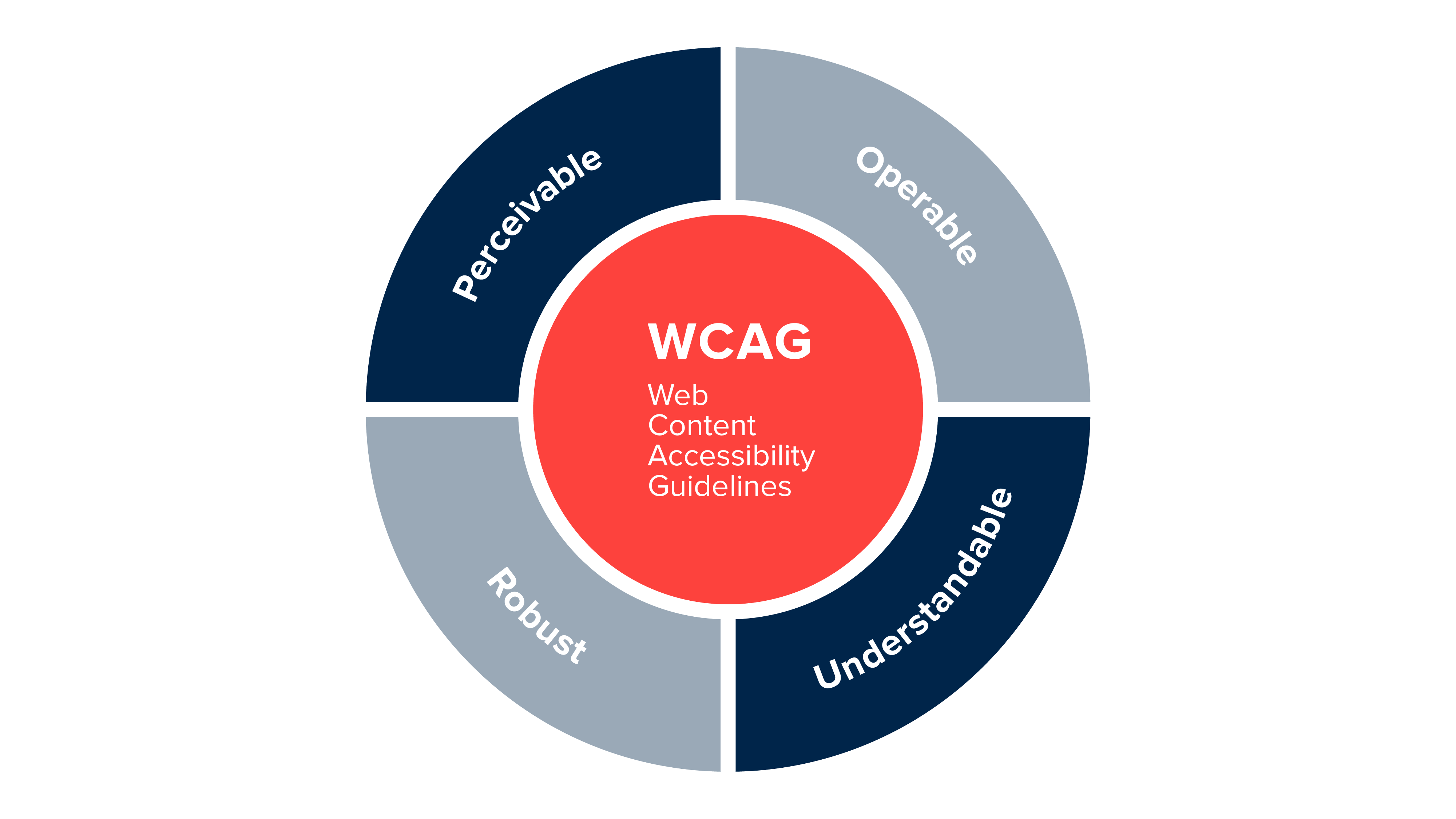
The Web Content Accessibility Guidelines (WCAG) are the international standard for digital accessibility, published by the Web Accessibility Initiative (WAI) of the World Wide Web Consortium (W3C). WCAG organizes accessibility around four principles — content must be Perceivable, Operable, Understandable, and Robust — and defines three conformance levels (A, AA, AAA). Level AA is the benchmark referenced by virtually every accessibility law worldwide, including the ADA, Section 508, the European Accessibility Act, and EN 301 549. WCAG 2.1 was published in 2018 and WCAG 2.2 in October 2023; RELAYTO targets the latest, WCAG 2.2 AA.
A shared responsibility
RELAYTO gives you an accessible foundation and the tools to build on it — but the accessibility of a finished experience also depends on the content you create. We provide guidance, training, and tooling to help your team produce conformant experiences; applying those practices to your own content remains the publisher's responsibility. We help with:
- Characteristics of accessible PDF files — preparing source documents before upload.
- Creating and verifying PDF accessibility in Adobe Acrobat Pro.
- Accessibility-focused onboarding and training for your team.
- Tailored reviews of accessibility in your existing experiences.
Feedback and contact
We welcome your feedback. If you encounter an accessibility barrier in RELAYTO, or need content in an alternative format, contact us at accessibility@relayto.com and we'll respond promptly. Your input directly informs how we improve.