

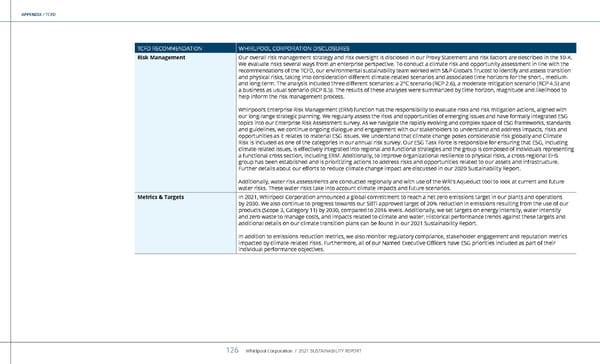
APPENDIX / TCFD TCFD RECOMMENDATION WHIRLPOOL CORPORATION DISCLOSURES Risk Management Our overall risk management strategy and risk oversight is disclosed in our Proxy Statement and risk factors are described in the 10-K. We evaluate risks several ways from an enterprise perspective. To conduct a climate risk and opportunity assessment in line with the recommendations of the TCFD, our environmental sustainability team worked with S&P Global’s Trucost to identify and assess transition and physical risks, taking into consideration different climate-related scenarios and associated time horizons for the short-, medium- and long-term. The analysis included three different scenarios: a 2°C scenario (RCP 2.6), a moderate mitigation scenario (RCP 4.5) and a business as usual scenario (RCP 8.5). The results of these analyses were summarized by time horizon, magnitude and likelihood to help inform the risk management process. Whirlpool’s Enterprise Risk Management (ERM) function has the responsibility to evaluate risks and risk mitigation actions, aligned with our long-range strategic planning. We regularly assess the risks and opportunities of emerging issues and have formally integrated ESG topics into our Enterprise Risk Assessment survey. As we navigate the rapidly evolving and complex space of ESG frameworks, standards and guidelines, we continue ongoing dialogue and engagement with our stakeholders to understand and address impacts, risks and opportunities as it relates to material ESG issues. We understand that climate change poses considerable risk globally and Climate Risk is included as one of the categories in our annual risk survey. Our ESG Task Force is responsible for ensuring that ESG, including climate-related issues, is effectively integrated into regional and functional strategies and the group is composed of individuals representing a functional cross section, including ERM. Additionally, to improve organizational resilience to physical risks, a cross-regional EHS group has been established and is prioritizing actions to address risks and opportunities related to our assets and infrastructure. Further details about our efforts to reduce climate change impact are discussed in our 2020 Sustainability Report. Additionally, water risk assessments are conducted regionally and with use of the WRI’s Aqueduct tool to look at current and future water risks. These water risks take into account climate impacts and future scenarios. Metrics & Targets In 2021, Whirlpool Corporation announced a global commitment to reach a net zero emissions target in our plants and operations by 2030. We also continue to progress towards our SBTi approved target of 20% reduction in emissions resulting from the use of our products (Scope 3, Category 11) by 2030, compared to 2016 levels. Additionally, we set targets on energy intensity, water intensity and zero waste to manage costs, and impacts related to climate and water. Historical performance trends against these targets and additional details on our climate transition plans can be found in our 2021 Sustainability Report. In addition to emissions reduction metrics, we also monitor regulatory compliance, stakeholder engagement and reputation metrics impacted by climate-related risks. Furthermore, all of our Named Executive Officers have ESG priorities included as part of their individual performance objectives. Whirlpool Corporation / 2021 SUSTAINABILITY REPORT 126
 Whirlpool Sustainability Report Page 125 Page 127