

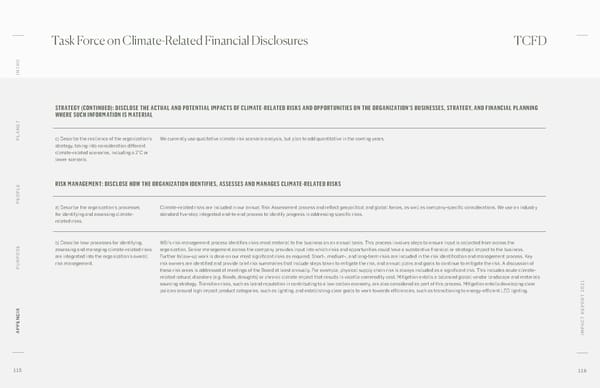
Task Force on Climate-Related Financial Disclosures TCFD O INTR STRATEGY (CONTINUED): DISCLOSE THE ACTUAL AND POTENTIAL IMPACTS OF CLIMATE-RELATED RISKS AND OPPORTUNITIES ON THE ORGANIZATION’S BUSINESSES, STRATEGY, AND FINANCIAL PLANNING WHERE SUCH INFORMATION IS MATERIAL ANET PL c) Describe the resilience of the organization’s We currently use qualitative climate risk scenario analysis, but plan to add quantitative in the coming years. strategy, taking into consideration different climate-related scenarios, including a 2°C or lower scenario. RISK MANAGEMENT: DISCLOSE HOW THE ORGANIZATION IDENTIFIES, ASSESSES AND MANAGES CLIMATE-RELATED RISKS OPLE PE a) Describe the organization’s processes Climate-related risks are included in our annual Risk Assessment process and reflect geopolitical and global forces, as well as company-specific considerations. We use an industry for identifying and assessing climate- standard five-step integrated end-to-end process to identify progress in addressing specific risks. related risks. b) Describe how processes for identifying, WSI’s risk management process identifies risks most material to the business on an annual basis. This process involves steps to ensure input is collected from across the assessing and managing climate-related risks organization. Senior management across the company provides input into which risks and opportunities could have a substantive financial or strategic impact to the business. are integrated into the organization’s overall Further follow-up work is done on our most significant risks as required. Short-, medium-, and long-term risks are included in the risk identification and management process. Key PURPOSE risk management. risk owners are identified and provide brief risk summaries that include steps taken to mitigate the risk, and annual plans and goals to continue to mitigate the risk. A discussion of these risk areas is addressed at meetings of the Board at least annually. For example, physical supply chain risk is always included as a significant risk. This includes acute climate- related natural disasters (e.g. floods, droughts) or chronic climate impact that results in volatile commodity cost. Mitigation entails a balanced global vendor landscape and materials sourcing strategy. Transition risks, such as brand reputation in contributing to a low carbon economy, are also considered as part of this process. Mitigation entails developing clear policies around high impact product categories, such as lighting, and establishing clear goals to work towards efficiencies, such as transitioning to energy-efficient LED lighting. T 2021 T REPOR C A APPENDIX IMP 115 116
 Williams-Sonoma, Inc - Impact Report Page 57 Page 59