

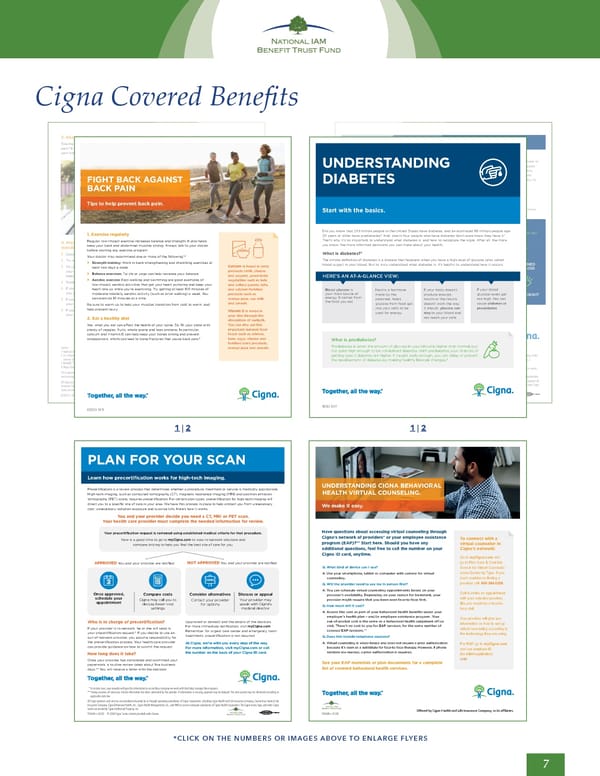
Sources: 1. National Institute of Diabetes and Digestive and Kidney Diseases. “Diabetes.” https://www.niddk.nih.gov/health-information/diabetes (accessed November 9, 2016) 2. National Institute of Diabetes and Digestive and Kidney Diseases. “What is Diabetes?” https://www.niddk.nih.gov/health-information/diabetes/overview/what-is-diabetes (November 2106) 3. National Institute of Diabetes and Digestive and Kidney Diseases. “Preventing Type 2 Diabetes.” https://www.niddk.nih.gov/health-information/diabetes/overview/preventing-type-2- diabetes (November 2016) 4. National Institute of Diabetes and Digestive and Kidney Diseases. “Symptoms and Causes of Diabetes.” https://www.niddk.nih.gov/health-information/diabetes/overview/symptoms-causes (November 2016) This is intended to be general health information and not medical advice or services. Always consult your doctor for appropriate examinations, treatment, testing, and health care recommendations. All Cigna products and services are provided exclusively by or through operating subsidiaries of Cigna Corporation, including Cigna Health and Life Insurance Company, Connecticut General Life Insurance Company, Cigna Behavioral Health, Inc., Cigna Health Management, Inc., and HMO or service company subsidiaries of Cigna Health Corporation. The Cigna name, logo, and other Cigna marks are owned by Cigna Intellectual Property, Inc. 903502 02/17 © 2017 Cigna. Some content provided under license. THE THREE MOST COMMON TYPES OF DIABETES: TYPE 1, TYPE 2 AND GESTATIONAL DIABETES. 2 TYPE 1 DIABETES Develops most often in young people, but it can also develop in adults. With type 1 diabetes, the body’s immune system has attacked and destroyed the cells that make insulin, thus decreasing the body’s insulin production. TYPE 2 DIABETES If you have type 2 diabetes, your body does not make or use insulin well. It develops most often in middle-aged and older people, but it can also affect people at any age – even children. People who are overweight and have a family history of diabetes are also more likely to develop type 2 diabetes. GESTATIONAL DIABETES Can develop when a woman is pregnant. Pregnant women make hormones that can lead to insulin resistance. All women have insulin resistance late in their pregnancy, but some experience it earlier on. If the pancreas doesn’t make enough insulin during pregnancy, a woman develops gestational diabetes. While gestational diabetes typically goes away after the baby is born, a woman who has had gestational diabetes is more likely to develop type 2 diabetes later in life. Talk with your doctor, who can make the appropriate recommendations based on your health history. Have questions or concerns about your diabetes risk? INCREASED THIRST INCREASED HUNGER FATIGUE FREQUENT URINATION UNEXPLAINED WEIGHT LOSS DRY, ITCHY SKIN BLURRY EYESIGHT PINS AND NEEDLES FEELING IN YOUR FEET LOSS OF FEELING IN YOUR FEET SLOW HEALING SORES ? WHAT ARE THE SIGNS AND SYMPTOMS? 4 Some people with diabetes don’t have any signs or symptoms at all, so it’s important to see your doctor and get your blood work. If you do experience symptoms, here are some of the most common. 3. Reach and maintain a healthy weight Staying at a healthy weight lowers your risk of back pain. 2 It can help reduce the stress and strain on your back. 4. Practice good posture when seated, standing and sleeping 2 › Good posture can help prevent back pain. › Try not to slouch when standing and sitting. › Sit up straight with your back against the back of your chair and your feet flat on the floor. If possible, keep your knees slightly higher than your hips. › Stand tall with your head up and shoulders back. › If you can, switch between standing and sitting so you aren’t in the same position for too long. › If you’re a side sleeper, place a pillow between your knees. 3 › If you sleep on your back, place a pillow under your knees. 3 5. Avoid heavy lifting or learn good form to protect your back 2 › Lift things with your legs, not your back. › Keep your back straight and bend at your knees or hips. › Get help if the load is too heavy for you to lift alone. 6. Relieve stress Get some exercise, socialize, go to a movie or try meditating to help you relieve tension and shrug off the stresses of every day. 7. Quit smoking 4 Smoking reduces the blood flow and nutrients to the lower back. It also slows healing. Talk with your doctor about ways to quit. Sources: 1. National Institute of Arthritis and Musculoskeletal and Skin Diseases. “What is back pain?” https://www.niams.nih.gov/health-topics/back-pain (last reviewed July 2019). 2. U.S. Department of Health and Human Services. “Prevent Back Pain.” https://healthfinder.gov/HealthTopics/Category/everyday-healthy-living/safety/prevent-back-pain (last updated January 30, 2019). 3. WebMD. “Sleeping Well With Low Back Pain.” https://www.webmd.com/back-pain/sleep-and-back-pain#2 (last reviewed May 16, 2019). 4. Mayo Clinic. “Back pain: Overview.” https://www.mayoclinic.org/diseases-conditions/back-pain/symptoms-causes/syc-20369906 (August 4, 2018). This is general health information and not medical advice or services. You should consult your doctor for medical advice or services, including seeking advice prior to undertaking a new diet or exercise program. All Cigna products and services are provided exclusively by or through operating subsidiaries of Cigna Corporation, including Cigna Health and Life Insurance Company, Connecticut General Life Insurance Company, Cigna Behavioral Health, Inc., Cigna Health Management, Inc., and HMO or service company subsidiaries of Cigna Health Corporation. The Cigna name, logo, and other Cigna marks are owned by Cigna Intellectual Property, Inc. All pictures are used for illustrative purposes only. 855023 b 10/19 © 2019 Cigna. Some content provided under license. 7 Cigna Covered Benefits 855023 b 10/19 FIGHT BACK AGAINST BACK PAIN Tips to help prevent back pain. 1. Exercise regularly Regular, low-impact exercise increases balance and strength. It also helps keep your back and abdominal muscles strong. Always talk to your doctor before starting any exercise program. Your doctor may recommend one or more of the following. 1,2 › Strength training: Work in back-strengthening and stretching exercises at least two days a week. › Balance exercises: Tai chi or yoga can help increase your balance. › Aerobic exercise: Fast-walking and swimming are good examples of low-impact, aerobic activities that get your heart pumping and keep your heart rate up while you’re exercising. Try getting at least 150 minutes of moderate-intensity aerobic activity (such as brisk walking) a week. You can even do 10 minutes at a time. Be sure to warm up to help your muscles transition from cold to warm, and help prevent injury. 2. Eat a healthy diet Yes, what you eat can affect the health of your spine. So, fill your plate with plenty of veggies, fruits, whole grains and lean proteins. In particular, calcium and Vitamin D can help keep your bones strong and prevent osteoporosis, which can lead to bone fractures that cause back pain. 2 Calcium is found in dairy products (milk, cheese and yogurt), green leafy vegetables such as kale and collard greens, tofu, and calcium-fortified products such as orange juice, soy milk and cereals. Vitamin D is made in your skin through the absorption of sunlight. You can also get this important nutrient from foods such as salmon, tuna, eggs, cheese and fortified dairy products, orange juice and cereals. Learn how precertification works for high-tech imaging. PLAN FOR YOUR SCAN Precertification is a review process that determines whether a procedure, treatment or service is medically appropriate. High-tech imaging, such as computed tomography (CT), magnetic resonance imaging (MRI) and positron emission tomography (PET) scans, requires precertification. For certain plan types, precertification for high-tech imaging will direct you to a specific site of care in your area. We have this process in place to help protect you from unnecessary cost, unnecessary radiation exposure and surprise bills. Here’s how it works. APPROVED You and your provider are notified Compare costs Cigna may call you to discuss lower-cost settings Once approved, schedule your appointment NOT APPROVED You and your provider are notified Consider alternatives Contact your provider for options Discuss or appeal Your provider may speak with Cigna’s medical director You and your provider decide you need a CT, MRI or PET scan. Your health care provider must complete the needed information for review. Your precertification request is reviewed using established medical criteria for that procedure. Now is a good time to go to myCigna.com to view in-network solutions and compare pricing to help you find the best site of care for you. Who is in charge of precertification? If your provider is in-network, he or she will send in your precertification request.* If you decide to use an out-of-network provider, you assume responsibility for the precertification process. Your health care provider can provide guidance on how to submit the request. How long does it take? Once your provider has completed and submitted your paperwork, a routine review takes about five business days.** You will receive a letter with the decision (approved or denied) and the details of the decision. For more immediate notification, visit myCigna.com . Remember, for urgent care center and emergency room treatments, precertification is not required. At Cigna, we’re with you every step of the way. For more information, visit myCigna.com or call the number on the back of your Cigna ID card. * In certain cases, your provider will give this information to an ancillary company we work with that helps manage these requests. ** Timing assumes all necessary clinical information has been submitted by the provider. If information is missing, approval may be delayed. This time period may be shortened according to applicable state law. All Cigna products and services are provided exclusively by or through operating subsidiaries of Cigna Corporation, including Cigna Health and Life Insurance Company, Connecticut General Life Insurance Company, Cigna Behavioral Health, Inc., Cigna Health Management, Inc., and HMO or service company subsidiaries of Cigna Health Corporation. The Cigna name, logo, and other Cigna marks are owned by Cigna Intellectual Property, Inc. 935644 a 02/20 © 2020 Cigna. Some content provided under license. What is diabetes? 2 The simple definition of diabetes is a disease that happens when you have a high level of glucose (also called blood sugar) in your blood. But to truly understand what diabetes is, it’s helpful to understand how it occurs. Did you know that 29.1 million people in the United States have diabetes, and an estimated 86 million people age 20 years or older have prediabetes? And, one in four people who have diabetes don’t even know they have it. 1 That’s why it’s so important to understand what diabetes is, and how to recognize the signs. After all, the more you know, the more informed decisions you can make about your health. UNDERSTANDING DIABETES Start with the basics. 903502 02/17 Blood glucose is your main source of energy. It comes from the food you eat. Insulin, a hormone made by the pancreas, helps glucose from food get into your cells to be used for energy. If your body doesn’t produce enough insulin or the insulin doesn’t work the way it should, glucose can stay i n your blood and not reach your cells. If your blood glucose levels get too high, this can cause diabetes or prediabetes . What is prediabetes? Prediabetes is when the amount of glucose in your blood is higher than normal, but not quite high enough to be considered diabetes. With prediabetes your chances of getting type 2 diabetes are higher. If caught early enough, you can delay or prevent the development of diabetes by making healthy lifestyle changes. 3 HERE’S AN AT-A-GLANCE VIEW: Have questions about accessing virtual counseling through Cigna’s network of providers* or your employee assistance program (EAP)?** Start here. Should you have any additional questions, feel free to call the number on your Cigna ID card, anytime. Q. What kind of device can I use? A. Use your smartphone, tablet or computer with camera for virtual counseling. Q. Will the provider need to see me in person first? A. You can schedule virtual counseling appointments based on your provider’s availability. Depending on your reason for treatment, your provider might require that you been seen face-to-face first. Q. How much will it cost? A. Access this care as part of your behavioral health benefits under your employer’s health plan – and/or employee assistance program. Your out-of-pocket cost is the same as a behavioral health outpatient office visit. There’s no cost to you for EAP services, for the same number of covered EAP sessions.** Q. Does this include telephone sessions? A. Virtual counseling is video-based and does not require a prior authorization because it’s seen as a substitute for face-to face therapy. However, if phone sessions are needed, a prior authorization is required. See your EAP materials or plan documents for a complete list of covered behavioral health services. Offered by Cigna Health and Life Insurance Company, or its affiliates. UNDERSTANDING CIGNA BEHAVIORAL HEALTH VIRTUAL COUNSELING. We make it easy. To connect with a virtual counselor in Cigna’s network: Go to myCigna.com and go to Find Care & Cost tab. Search for Virtual Counselor under Doctor by Type. If you need assistance finding a provider call Call to make an appointment with your selected provider, like you would for a face-to- face visit. Your provider will give you information on how to set up virtual counseling according to the technology they are using. For EAP, go to myCigna.com and use employer ID (for initial registration): 903608 e 01/20 800.244.6224. IAM 1 | 2 1 | 2 *CLICK ON THE NUMBERS OR IMAGES ABOVE TO ENLARGE FLYERS
 BFO Benefit Spotlight Winter 2022-23 Page 6 Page 8