

Glossary of Health Coverage and Medical Terms
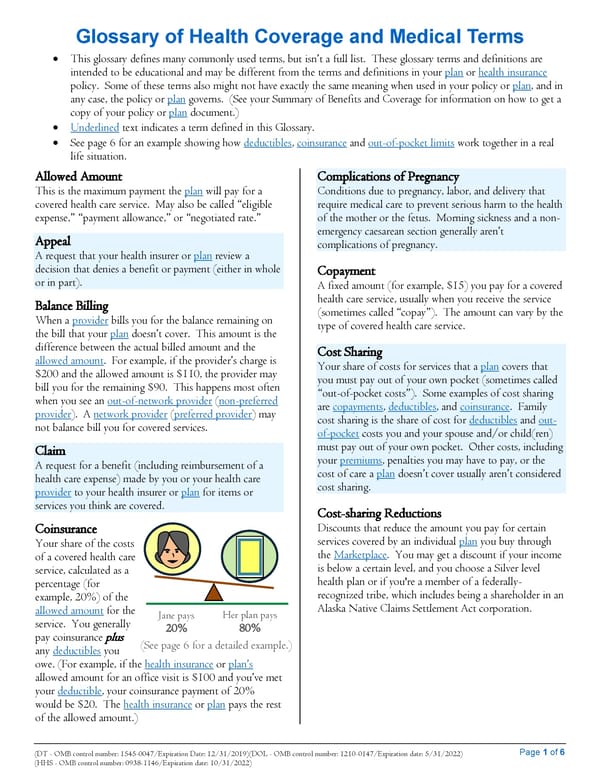
Glossary of Health Coverage and Medical Terms x This glossary defines many commonly used terms, but isn’t a full list. These glossary terms and definitions are intended to be educational and may be different from the terms and definitions in your plan or health insurance policy. Some of these terms also might not have exactly the same meaning when used in your policy or plan, and in any case, the policy or plan governs. (See your Summary of Benefits and Coverage for information on how to get a copy of your policy or plan document.) x Underlined text indicates a term defined in this Glossary. x See page 6 for an example showing how deductibles, coinsurance and out-of-pocket limits work together in a real life situation. Allowed Amount Complications of Pregnancy This is the maximum payment the plan will pay for a Conditions due to pregnancy, labor, and delivery that covered health care service. May also be called “eligible require medical care to prevent serious harm to the health expense,” “payment allowance,” or “negotiated rate.” of the mother or the fetus. Morning sickness and a non- Appeal emergency caesarean section generally aren’t complications of pregnancy. A request that your health insurer or plan review a decision that denies a benefit or payment (either in whole Copayment or in part). A fixed amount (for example, $15) you pay for a covered Balance Billing health care service, usually when you receive the service When a provider bills you for the balance remaining on (sometimes called “copay”). The amount can vary by the the bill that your plan doesn’t cover. This amount is the type of covered health care service. difference between the actual billed amount and the Cost Sharing allowed amount. For example, if the provider’s charge is Your share of costs for services that a plan covers that $200 and the allowed amount is $110, the provider may you must pay out of your own pocket (sometimes called bill you for the remaining $90. This happens most often “out-of-pocket costs”). Some examples of cost sharing when you see an out-of-network provider (non-preferred are copayments, deductibles, and coinsurance. Family provider). A network provider (preferred provider) may cost sharing is the share of cost for deductibles and out- not balance bill you for covered services. of-pocket costs you and your spouse and/or child(ren) Claim must pay out of your own pocket. Other costs, including A request for a benefit (including reimbursement of a your premiums, penalties you may have to pay, or the health care expense) made by you or your health care cost of care a plan doesn’t cover usually aren’t considered provider to your health insurer or plan for items or cost sharing. services you think are covered. Cost-sharing Reductions Coinsurance Discounts that reduce the amount you pay for certain Your share of the costs services covered by an individual plan you buy through of a covered health care the Marketplace. You may get a discount if your income service, calculated as a is below a certain level, and you choose a Silver level percentage (for health plan or if you're a member of a federally- example, 20%) of the recognized tribe, which includes being a shareholder in an allowed amount for the Jane pays Her plan pays Alaska Native Claims Settlement Act corporation. service. You generally 20% 80% pay coinsurance plus (See page 6 for a detailed example.) any deductibles you owe. (For example, if the health insurance or plan’s allowed amount for an office visit is $100 and you’ve met your deductible, your coinsurance payment of 20% would be $20. The health insurance or plan pays the rest of the allowed amount.) Glossary of Health Coverage and Medical Terms Page 1 of 6 (DT - OMB control number: 1545-0047/Expiration Date: 12/31/2019)(DOL - OMB control number: 1210-0147/Expiration date: 5/31/2022) (HHS - OMB control number: 0938-1146/Expiration date: 10/31/2022)
 Glossary of Health Coverage and Medical Terms Page 2