

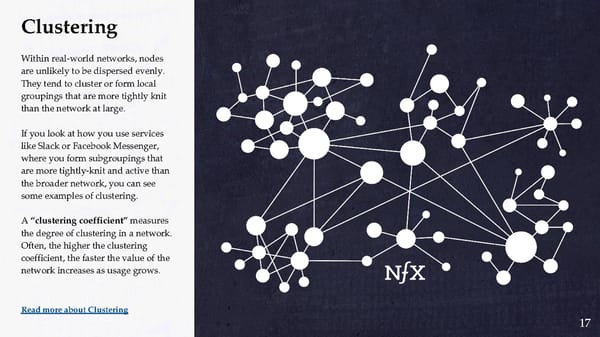
Clustering Within real-world networks, nodes are unlikely to be dispersed evenly. They tend to cluster or form local groupings that are more tightly knit than the network at large. If you look at how you use services like Slack or Facebook Messenger, where you form subgroupings that are more tightly-knit and active than the broader network, you can see some examples of clustering. A “clustering coefficient” measures the degree of clustering in a network. Often, the higher the clustering coefficient, the faster the value of the network increases as usage grows. Read more about Clustering 17
 The Network Effects Bible Page 16 Page 18