

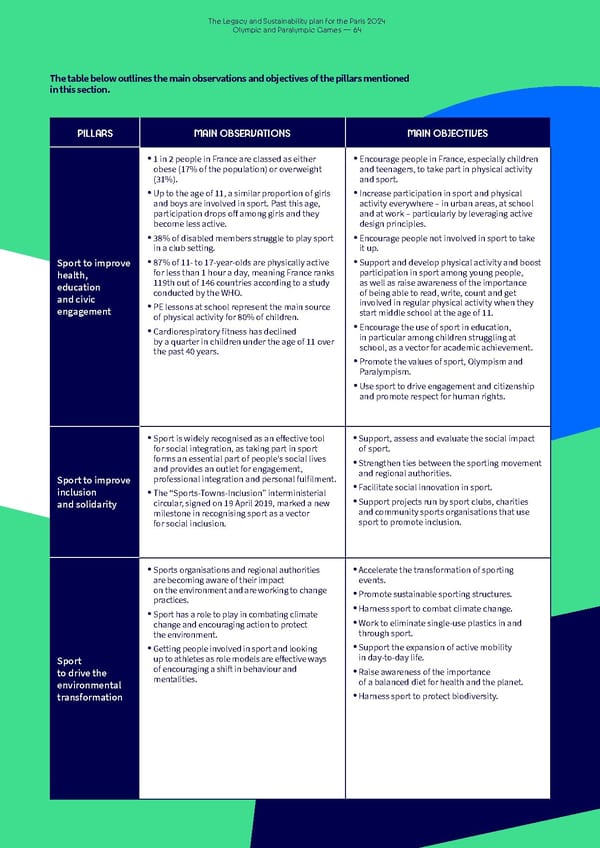
The Legacy and Sustainability plan for the Paris 2024 Olympic and Paralympic Games — 64 The Legacy and Sustainability plan for the Paris 2024 Olympic and Paralympic Games — 64 The table below outlines the main observations and objectives of the pillars mentioned in this section. • 1 in 2 people in France are classed as either obese (17% of the population) or overweight (31%). • Up to the age of 11, a similar proportion of girls and boys are involved in sport. Past this age, participation drops off among girls and they become less active. • 38% of disabled members struggle to play sport in a club setting. • 87% of 11- to 17-year-olds are physically active for less than 1 hour a day, meaning France ranks 119th out of 146 countries according to a study conducted by the WHO. • PE lessons at school represent the main source of physical activity for 80% of children. • Cardiorespiratory fitness has declined by a quarter in children under the age of 11 over the past 40 years. • Sport is widely recognised as an effective tool for social integration, as taking part in sport forms an essential part of people's social lives and provides an outlet for engagement, professional integration and personal fulfilment. • The “Sports-Towns-Inclusion” interministerial circular, signed on 19 April 2019, marked a new milestone in recognising sport as a vector for social inclusion. • Sports organisations and regional authorities are becoming aware of their impact on the environment and are working to change practices. • Sport has a role to play in combating climate change and encouraging action to protect the environment. • Getting people involved in sport and looking up to athletes as role models are effective ways of encouraging a shift in behaviour and mentalities. • Support, assess and evaluate the social impact of sport. • Strengthen ties between the sporting movement and regional authorities. • Facilitate social innovation in sport. • Support projects run by sport clubs, charities and community sports organisations that use sport to promote inclusion. • Accelerate the transformation of sporting events. • Promote sustainable sporting structures. • Harness sport to combat climate change. • Work to eliminate single-use plastics in and through sport. • Support the expansion of active mobility in day-to-day life. • Raise awareness of the importance of a balanced diet for health and the planet. • Harness sport to protect biodiversity. • Encourage people in France, especially children and teenagers, to take part in physical activity and sport. • Increase participation in sport and physical activity everywhere – in urban areas, at school and at work – particularly by leveraging active design principles. • Encourage people not involved in sport to take it up. • Support and develop physical activity and boost participation in sport among young people, as well as raise awareness of the importance of being able to read, write, count and get involved in regular physical activity when they start middle school at the age of 11. • Encourage the use of sport in education, in particular among children struggling at school, as a vector for academic achievement. • Promote the values of sport, Olympism and Paralympism. • Use sport to drive engagement and citizenship and promote respect for human rights. PILLARS MAIN OBSERVATIONS MAIN OBJECTIVES Sport to improve health, education and civic engagement Sport to improve inclusion and solidarity Sport to drive the environmental transformation
 Paris24 Legacy and Sustainability Page 63 Page 65