

Altria Protect the Environment Report
Protect the Environment 2020 –2021 Corporate Responsibility Progress
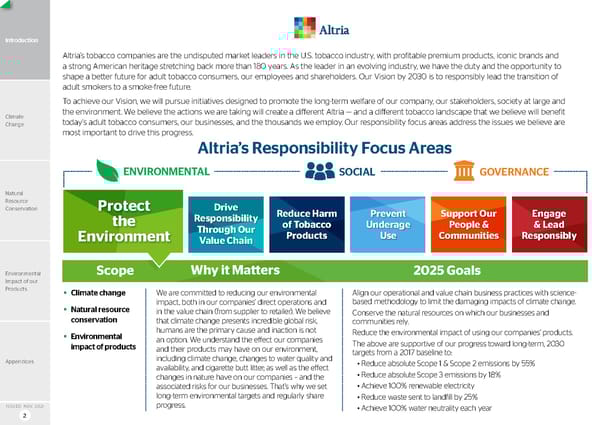
2 ISSUED: NOV. 2021 Altria’s tobacco companies are the undisputed market leaders in the U.S. tobacco industry, with profitable premium products, iconic brands and a strong American heritage stretching back more than 180 years. As the leader in an evolving industry, we have the duty and the opportunity to shape a better future for adult tobacco consumers, our employees and shareholders. Our Vision by 2030 is to responsibly lead the transition of adult smokers to a smoke-free future. To achieve our Vision, we will pursue initiatives designed to promote the long-term welfare of our company, our stakeholders, society at large and the environment. We believe the actions we are taking will create a different Altria — and a different tobacco landscape that we believe will benefit today's adult tobacco consumers, our businesses, and the thousands we employ. Our responsibility focus areas address the issues we believe are most important to drive this progress. We are committed to reducing our environmental impact, both in our companies’ direct operations and in the value chain (from supplier to retailer). We believe that climate change presents incredible global risk, humans are the primary cause and inaction is not an option. We understand the effect our companies and their products may have on our environment, including climate change, changes to water quality and availability, and cigarette butt litter; as well as the effect changes in nature have on our companies – and the associated risks for our businesses. That’s why we set long-term environmental targets and regularly share progress. Scope Align our operational and value chain business practices with science- based methodology to limit the damaging impacts of climate change. Conserve the natural resources on which our businesses and communities rely. Reduce the environmental impact of using our companies’ products. The above are supportive of our progress toward long-term, 2030 targets from a 2017 baseline to: • Reduce absolute Scope 1 & Scope 2 emissions by 55% • Reduce absolute Scope 3 emissions by 18% • Achieve 100% renewable electricity • Reduce waste sent to landfill by 25% • Achieve 100% water neutrality each year Why it Matters 2025 Goals ƒ Climate change ƒ Natural resource conservation ƒ Environmental impact of products Altria’s Responsibility Focus Areas ENVIRONMENTAL SOCIAL GOVERNANCE Reduce Harm of Tobacco Products Drive Responsibility Through Our Value Chain Prevent Underage Use Engage & Lead Responsibly Support Our People & Communities Protect the Environment
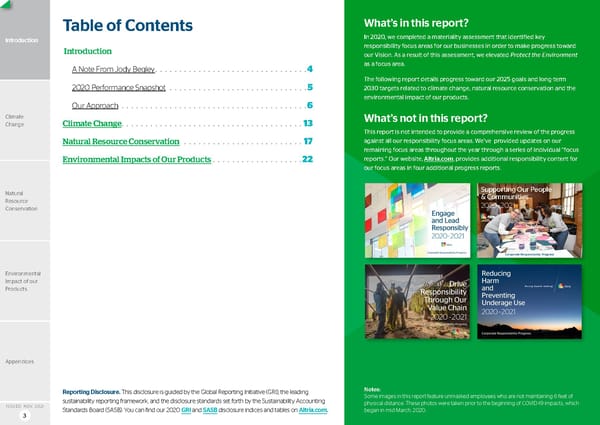
3 ISSUED: NOV. 2021 Reporting Disclosure. This disclosure is guided by the Global Reporting Initiative (GRI), the leading sustainability reporting framework, and the disclosure standards set forth by the Sustainability Accounting Standards Board (SASB). You can find our 2020 GRI and SASB disclosure indices and tables on Altria.com . What’s in this report? In 2020, we completed a materiality assessment that identified key responsibility focus areas for our businesses in order to make progress toward our Vision. As a result of this assessment, we elevated Protect the Environment as a focus area. The following report details progress toward our 2025 goals and long-term 2030 targets related to climate change, natural resource conservation and the environmental impact of our products. What’s not in this report? This report is not intended to provide a comprehensive review of the progress against all our responsibility focus areas. We’ve provided updates on our remaining focus areas throughout the year through a series of individual “focus reports.” Our website, Altria.com , provides additional responsibility content for our focus areas in four additional progress reports. Table of Contents Introduction A Note From Jody Begley . . . . . . . . . . . . . . . . . . . . . . . . . . . . . . . . 4 2020 Performance Snapshot . . . . . . . . . . . . . . . . . . . . . . . . . . . . . 5 Our Approach . . . . . . . . . . . . . . . . . . . . . . . . . . . . . . . . . . . . . . . 6 Climate Change . . . . . . . . . . . . . . . . . . . . . . . . . . . . . . . . . . . . . . 13 Natural Resource Conservation . . . . . . . . . . . . . . . . . . . . . . . . . 17 Environmental Impacts of Our Products . . . . . . . . . . . . . . . . . . . 22 Supporting Our People & Communities 2020 –2021 Corporate Responsibility Progress Notes: Some images in this report feature unmasked employees who are not maintaining 6 feet of physical distance. These photos were taken prior to the beginning of COVID-19 impacts, which began in mid-March, 2020.
4 ISSUED: NOV. 2021 "For Altria, this focus is not only about helping to solve a global challenge, it’s also about ensuring our ability to mitigate, manage and prevent real business impacts." A Note From Jody As my colleagues have emphasized across our other focus area reports, the pace of changing stakeholder expectations is accelerating. And what is expected is both increasing and intensifying – especially as it relates to environmental and social issues with broad, global impact. Over the past year, we’ve seen investors and financial regulators increasingly interested in disclosures that demonstrate and quantify actions toward addressing climate change. More products and brands are responding to heightened consumer interest by touting commitments to environmental sustainability. The pressure for governments, NGOs and businesses to do more continues to mount – as societies are experiencing greater impacts of a rapidly-changing world and calling for action. In fact, as we wrote this report, the Intergovernmental Panel on Climate Change released new analyses that identified the next few decades as our only chance to keep global warming below 2 ° C, a level that scientists agree is vital for life and economic stability across the planet. As our changing planet drives shifts in our stakeholders’ expectations, we understand the elevated importance of the work we do at Altria to sustain our business into the future – a key part of which is Protecting the Environment . We recognize our responsibility to minimize our environmental footprint and work to prevent the most damaging effects of climate change. For Altria, this focus is not only about helping to solve a global challenge, it’s also about ensuring our ability to mitigate, manage and prevent real business impacts. Our communities and businesses have felt those impacts acutely as the result of climate change-related natural disasters. In 2020, wildfires across the western United States forced employees to flee their homes and threatened Ste. Michelle Wine Estates’ vineyards and grape suppliers. The Texas ice storm in February 2021 left many of our Texas-based employees without power or heat for days and disrupted regional supply chain networks, impacting many manufacturers, including U.S. Smokeless Tobacco Company. While Protecting the Environment has always been important to us, these events reaffirmed how critical it is to the success of our businesses and achieving our Vision to responsibly transition adult smokers to a smoke-free future. This past year, I joined Altria’s Chief Financial Officer, Sal Mancuso, as a co-executive sponsor for our environmental initiatives. Along with senior leaders in product development, operations, manufacturing, finance and government affairs, we’ve formed an environmental steering committee to provide oversight and guidance to our efforts. We regularly meet and discuss environmental strategy and operational integration. In 2020, we announced new 2030 targets, including a goal to significantly reduce our greenhouse gas emissions by 55% off a 2017 base. Our targets were approved by the Science Based Targets Initiative as a key contribution to help limit rising global temperatures to 1.5 ° C. We took steps to further understand the forest, water and climate impact of our value chain by participating in the CDP supplier survey and the international Sustainable Tobacco Program. This year, we also completed our first standalone Task Force on Climate-related Financial Disclosures (TCFD) report. While we have reported against many of the TCFD recommendations for several years through our CDP Climate Change response, this year we were able to go deeper after conducting preliminary climate-related scenario analysis workshops. We continue to align our work in Protecting the Environment with operational need and stakeholder expectations. And we will continue to communicate our progress. As you will read in this report, we are working toward solutions with an increasingly integrated approach. Environmental, social and governance responsibility is being infused into critical facets of our business and value chain. I’m proud of the unwavering commitment of Altria’s employees to make progress toward our 2025 Protect the Environment goals, and their work to continue identifying new opportunities that demand action. Jody Begley Executive Vice President, Chief Operating Officer, Altria Group, Inc. “Protect the Environment” Executive Co-Sponsor
5 ISSUED: NOV. 2021 CDP Scores: Environmental Impact of Products Achieved a Double 'A' Rating in CDP Climate and Water: 1% of 5,800+ organizations received this Double A rating. CDP Forests Score: C Climate Change Natural Resource Conservation Over 46,000 adult smokers pledged not to litter cigarette filters 48%-52% decrease in cigarette litter in communities with CLPP 21 million points were donated to KAB through Marlboro Rewards, equaling more than $42,000 . Marlboro Rewards is an engagement program where adult smokers 21+ can earn points by scanning unique codes printed on Marlboro packs and redeem those points for gear, coupons and charitable donations 47 communities were given grants through the Cigarette Litter Prevention Program (CLPP) with Keep America Beautiful (KAB) 1 Data reflects market-based Scope 2 emissions to align with renewable energy accounting. 2 We update Scope 3 emission data using a hybrid life cycle assessment methodology. 3 Water neutrality means we offset our operational water use through onsite treatment and/or conservation projects with non-profit partners in our operating and growing communities. 4 In 2019 and 2020, we had a large increase in waste due to renovation and construction at our headquarters location. Approximately 80% of waste generated from this project was recycled or beneficially reused. 2020 Performance Snapshot Waste reduction 4 100% 53.4% neutrality 2020 2030 target Renewable electricity Reduce absolute Scope 3 emissions 2 Reduce absolute Scope 1 & Scope 2 emissions 1 2.2% electricity from renewables 100% electricity from renewables 1.4% reduction 18% reduction from 2017 base 16.6% reduction 55% reduction from 2017 base 2020 2030 targets 25% reduction from 2017 base +185% increase Water neutrality 3 2020 2030 target
6 ISSUED: NOV. 2021 The 2020 materiality assessment identified six areas in which our business and stakeholders expect meaningful progress. For the first time Protect the Environment was identified as a focus area, directly aligned to Altria’s Vision and responsible leadership. Altria’s tobacco and wine operating companies rely on agricultural products, so it isn’t new for us to prioritize environmental responsibility in our business practices. However, events over the past 18 months have elevated interconnected social and environmental crises and increased stakeholder ESG expectations of all companies, including Altria. As the humanitarian and economic costs of the climate crisis increase, investors are calling for transparent climate-related reporting. Communities around the globe are calling for a just transition to a low carbon economy. At Altria we recognize that we must continue our progress to meet stakeholder expectations and position our businesses for success in a social, economic and ecological future that will probably look very different from today. As such, we believe Protecting the Environment will remain a top responsibility priority as we work towards achieving our Vision. Our Approach Climate Justice & the Low Carbon Economy Most business and economic practices produce greenhouse gas (GHG) emissions. The accumulation of these gases in our atmosphere has trapped heat from the sun, causing changes in our climate that threaten the lives and livelihoods of everyone on our planet. Climate Justice acknowledges the adverse impacts of climate change are felt unequally among people and communities. In fact, the communities that have the lowest GHG emissions and have benefitted the least from economic activities that emit GHGs are most at risk from changes in nature resulting from human-caused climate change. Climate Justice attempts to address these inequities in political and economic responses to climate change. In the 2015 Paris Agreement on climate change, countries around the world, including the U.S., pledged to stop or change economic activities that emit GHG. These changes will likely impact every business and sector of the economy. This profound change represents a new economic model called the low carbon economy. 5 BioScience. September 2021. World Scientists’ Warning of a Climate Emergency 2021. Climate Crisis and Climate Change According to leading climate scientists, climate change is a range of global phenomena caused predominantly by burning fossil fuels; it includes not just global warming, but also rising sea levels, ice melting, extreme weather events and shifts in seasonal events. The climate crisis describes the various negative effects that unmitigated climate change is causing or threatening to cause to our planet and economy, especially where these effects have direct impact on humanity. The term climate crisis describes the urgency with which we must act to avoid catastrophic disruptions to the global economy and society. 5
7 ISSUED: NOV. 2021 Responsibly Achieving Our Vision The tobacco industry is changing rapidly, and expectations of all companies are rising. Our long-standing practice of continuously listening to stakeholders, aligning business practices where appropriate, and measuring and communicating progress is more important than ever. To achieve our Vision by 2030, we will pursue initiatives designed to promote the long-term welfare of our company, our stakeholders, society and the environment. Our environmental sustainability efforts begin with governance through our environmental management framework, and are supported through integration with business practices – from operations to product development and a focus on internal and external stakeholder engagement. Future of Facilities and Manufacturing As we move toward our Vision we are looking deeply into the footprint of our facilities and how we expect the use of our buildings and manufacturing infrastructure will change. We are guided by the principles of fiscal responsibility, resource efficiency and sustainability, and flexibility for evolving businesses. We are learning more about how to incorporate sustainability into our buildings and facilities; projects that exemplify this evolution are our HQ Building , Water Recycling Hub at Philip Morris USA (PM USA) , Wetlands at Park 500 and U.S. Smokeless Tobacco (USSTC) Company’s Rain Gardens . Smoke-free Product Pipeline In creating our smoke-free product portfolio, we have the opportunity to incorporate the newest sustainable design thinking from ideation to market. We are being thoughtful about the full life cycle of products, taking into consideration the impact of how materials are created and sourced and how they can be disposed or reused at end of life. At the heart of our product design is the adult tobacco consumer (ATC) experience. We want to make sustainability an intuitive part of how the product is used so we are testing how ATCs interact with potential products. By understanding the ATC experience, we hope to design products with sustainable life cycles that align with ATC values and enhance the product offering. Building a Culture of Sustainability We understand that society’s transition to a sustainable economy will have far-reaching implications for many parts of our business. We are increasingly integrating sustainability strategy into critical parts of our business to align with stakeholder expectations and business need. In 2020, we identified functional leaders critical to our environmental strategies and regularly engaged them through an Environmental Steering Committee to discuss sustainability trends and implications for functional departments. We also created a new position, ESG Director of Procurement, to lead the integration of enterprise ESG strategy into our supply chain management infrastructure, including sustainability and equity focuses. Additionally, we expanded opportunities for all employees to engage with our environmental targets. To celebrate Earth Day, we leveraged our employee engagement program — Altria Contributing Together (act.) — to create opt-in learning modules about Altria’s environmental efforts. Together, employees completed over 1,900 learning activities focused on our business impact, environmental targets and personal responsibility to protect the environment. The conversation continues year-round in Altria’s employee social platform where employees engage with each other in our Green Up! channel dedicated to all employees interested in stewardship of Altria’s environmental goals and reducing their environmental footprint at work and at home. As sustainability expectations and business need increase, we will continue to build a culture of sustainability and report on our progress.
8 ISSUED: NOV. 2021 Leadership & Processes As environmental risks and opportunities increasingly shape how we will deliver a smoke-free future to ATCs, we designed an Environmental Management Framework to help set direction, guide decision-making and promote continuous improvement across our companies. Environmental Management Framework Management Guidance Actions/ Implementation Measurement Review/ Feedback Vision Environmental Management Principle & Policies Supplier Code of Conduct Environmental Goals Leadership Involvement Environmental Sustainability Teams Training Environmental Sustainability Initiatives Environmental Metrics Information Systems Facility Assssments Reporting Certification & Recognition Review of Benchmarking Results Management Review
9 ISSUED: NOV. 2021 Environmental Management Framework Management Guidance ƒ Variations in weather patterns caused by climate change may impact our ability to procure high quality tobacco and wine grapes to support our operations. Through our Business Continuity Planning process, we proactively engage suppliers to maintain the availability and sustainability of material supply chains, such as monitoring inventory levels and adjusting buying patterns of these materials if needed. We engage in programs to promote sustainable agricultural practices among our U.S. and international tobacco growers and suppliers. In 2020, 67% of our domestic contracted growers participated in the Good Agricultural Practices Connections (GAPC) certification program towards a 2021 goal of 100%. 90% of our international tobacco suppliers participated in the Sustainable Tobacco Program (STP) . Both programs encourage agricultural practices to produce a quality crop while protecting, sustaining or enhancing the environment with regard to soil, water, air and biodiversity while also protecting the rights of farm laborers. ƒ The Natural Treatment System at Park 500 and the WaterHub at PM USA contribute toward our 100% water neutrality target. ƒ Efficiency Projects & Energy Efficient Buildings Initiatives contribute to our GHG emissions reductions targets. ƒ We were able to recycle or beneficially reuse nearly 80% of the waste generated in the HQ Building remodel. Actions/Implementation ƒ Altria's Safety, Health and Environment department maintains an Environmental Metrics Information System that captures key measures across our companies, such as GHG emissions and water withdrawals. ƒ We leverage third-party assurance for key environmental data. We have engaged ERM Certification and Verification Services, Inc . (ERM CVS) to provide independent, third-party assurance in relation to greenhouse gas, water and waste consolidated data for each calendar year since 2013. To learn more, read our Environmental Assurance Letter in the Appendix . Measurement ƒ Our emission reductions targets were approved by the Science Based Targets initiative (SBTi) as consistent with levels required to meet the Paris Agreement’s goal to stay below 1.5 ° C warming above pre-industrial levels. ƒ We participate in external disclosures to provide stakeholders relevant information on our environmental strategies and progress. read our full TCFD report and CDP Climate Change , Water Security and Forests responses. Review/Feedback In 2021, we established the Environment Steering Committee co-sponsored by our CFO and COO and comprised of senior leaders within critical functions across the enterprise. This approach increases inclusion and ownership of the functions responsible for shaping and integrating environmental strategy. Altria’s Board of Directors’ Nominating, Corporate Governance and Social Responsibility Committee ƒ provides oversight of public affairs, corporate reputation and environmental and social responsibility strategies; ƒ reviews key environmental trends in order to determine whether we should consider additional actions; ƒ considers the impact of business operations and business practices on the communities where we do business; and ƒ reviews environmental initiatives and goals and progress toward those goals. Altria’s Enterprise Risk Management (ERM) process contemplates a number of risk areas including environmental impacts which could pose threats to business continuity. For the first time in 2021, we conducted workshops on the Ta s k Fo r c e on Climate-related Financial Disclosures (TCFD) to explore specific climate change scenarios and potential impacts on our businesses. To learn more, read our full TCFD report .
10 ISSUED: NOV. 2021 Business Partnerships Achieving our environmental goals requires collaborating with growers and suppliers throughout our value chain. Our tobacco and wine growers implement good agricultural practices, which are critical on farms where there is both a large environmental impact and potential for experiencing impacts from climate change. Our suppliers, investments and other partnerships contribute to our Scope 3 (or value chain) GHG emissions, which is the largest part of our carbon footprint. We understand the environmental impact of our products and business practices includes our entire value chain. That is why we use internal and external programs to understand the impact of our value chain, set expectations, train and educate, monitor compliance and remediate issues. Here we’ve highlighted our approach to protecting the environment in our value chain. Read our 2021 report Drive Responsibility Through Our Value Chain to learn more. Stakeholder Engagement Protecting the Environment is important to our businesses and communities and we are committed to responsibly engaging with stakeholders to advance common goals. We partner with community organizations and businesses in our value chain and we advocate for policies aligned with our environmental goals. Community Partnerships We are honored to partner with many leading community organizations aligned with our environmental focus areas of climate change, natural resource conservation and reducing the environmental impact of our products. Click on our community partner logos to find out more about the work we support.
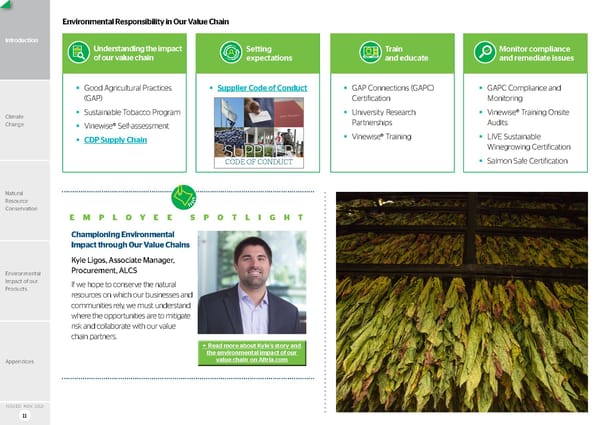
11 ISSUED: NOV. 2021 Environmental Responsibility in Our Value Chain ƒ Good Agricultural Practices (GAP) ƒ Sustainable Tobacco Program ƒ Vinewise® Self-assessment ƒ CDP Supply Chain Understanding the impact of our value chain ƒ Supplier Code of Conduct ƒ GAP Connections (GAPC) Certification ƒ University Research Partnerships ƒ Vinewise® Training Philip Morris USA • U.S. Smokeless Tobacco Company • John Middleton Ste. Michelle Wine Estates • Philip Morris Capital Corporation • Helix Innovations CODE OF CONDUCT SUPPLIER EMPLOYEE SPOTLIGHT Championing Environmental Impact through Our Value Chains Kyle Ligos, Associate Manager, Procurement, ALCS If we hope to conserve the natural resources on which our businesses and communities rely, we must understand where the opportunities are to mitigate risk and collaborate with our value chain partners. + Read more about Kyle’s story and the environmental impact of our value chain on Altria.com Setting expectations Tr a i n and educate Monitor compliance and remediate issues ƒ GAPC Compliance and Monitoring ƒ Vinewise® Training Onsite Audits ƒ LIVE Sustainable Winegrowing Certification ƒ Salmon Safe Certification
12 ISSUED: NOV. 2021 Public Policy Advocacy We recognize the importance of business and government working together toward a sustainable economy, as leading scientists agree that failure to limit environmental degradation will cause significant disruption to businesses and communities 6 . Our initial environmental policy advocacy steps include the following: 6 Intergovernmental Panel on Climate Change. August 2021. Climate Change 2021 the Physical Science Basis We joined the U.S. Chamber of Commerce Task Force on Climate Action , a forum where companies can learn about the Chamber’s environmental positions and exchange ideas on climate, energy and environmental policy. We joined the VA Chamber Corporate Sustainability and Environmental Executive Committee where companies can discuss policy research and corporate sustainability initiatives that promote long-term economic success. Signed an open letter to lawmakers in July 2020 , sponsored by the Environmental Defense Fund. We support increased investments in clean energy infrastructure and grid modernization, the creation of new clean energy jobs, greater integration of renewable resources such as wind and solar, and improved energy efficiency. It’s clear that we must double down on clean energy infrastructure to put Americans back to work and come back stronger and cleaner than before this pandemic-driven recession. Signed an open letter to President Biden in April 2021 in coordination with the We Mean Business Coalition and Ceres . The letter communicates business and investor support for a highly ambitious 2030 GHG emissions reduction target, or Nationally Determined Contribution in pursuit of reaching net-zero GHG emissions by 2050. As business leaders, we care deeply about the future of the U.S. and the health of its people and economy...We, therefore, call on you to adopt the ambitious and attainable target of cutting GHG emissions by at least 50% below 2005 levels by 2030. EMPLOYEE SPOTLIGHT New Opportunities to Responsibly Engage Stakeholders on Environmental Policy Todd Walker, Senior Vice President Government Affairs & Public Policy, Altria Client Services LLC We know Altria has a role to play in protecting the natural resources on which our businesses and communities rely. While we have engaged on environmental issues for a number of years, increasingly, there have been opportunities for us to responsibly engage on environmental policy that could affect our businesses. + Read more about our partnerships and stakeholder engagement on Altria.com.
13 ISSUED: NOV. 2021 Climate Change 2025 Goal: Align our operational and value chain business practices with science-based methodology to limit the damaging impacts of climate change. Changes in nature as a result of climate change and society’s response to those changes can affect the future of our businesses. Climate change presents very significant global risk, humans are the primary cause and inaction is not an option. We’re focused on aligning our operational and value chain business practices with science-based methodology. We have set ambitious 2030 targets approved by the Science Based Targets initiative (SBTi) as consistent with levels required to stay below 1.5 ° C of warming and avoid the most catastrophic impacts of climate change. We will assess our ability to establish a 2050 net- zero target when the SBTi finalizes its methodology. However, achieving global net-zero emissions by 2050 will require new investments, technology and international cooperation. We believe business, governments and society must work together to avoid the worst impacts of the climate crisis. At Altria, we are committed to doing our part and engaging responsibly with governments and society to limit the damaging impacts of climate change. SBTi & Net-zero The SBTi validates that company plans to reduce GHG emissions are in-line with what the latest science deems necessary to keep global temperature below 1.5 ° C of warming above pre-industrial levels. This is the temperature scientists have determined we must stay below to avoid catastrophic climate change impacts, including intense drought, storms, heat waves and ocean changes that would threaten the lives and livelihoods of billions across the planet. According to the United Nation’s body for assessing the science related to climate change, the Intergovernmental Panel On Climate Change (IPCC), to stay below 1.5 ° C of warming the world must reach net-zero emissions by 2050, followed by net-negative emissions. As stated by the IPCC, the largest source of global emissions comes from burning fossil fuels including oil, coal and natural gas. Intergovernmental Panel on Climate Change. August 2021. Climate Change 2021 the Physical Science Basis.
14 ISSUED: NOV. 2021 The Impact of COVID-19 on GHG Emissions In the beginning of 2020, we took several steps to mitigate risk and protect the health of our employees, including travel restrictions and remote work for non-manufacturing salaried employees. These protocols intended to protect employees resulted in a reduction to our Scope 1 emissions as our remote sales force used less gasoline, as well as reduced Scope 3 emissions from reduced employee commutes and business travel. We estimate reductions for these reasons contributed to over a third of our total GHG emissions decline from 2019 to 2020. We will continue to prioritize employee health as the COVID- 19 pandemic evolves and we will inform our stakeholders of emissions impacts in future reports. 2.2% Manufacturing operations 0.2% Company vehicles, including field sales force fleet 0.2% Offices <0.1% Company aircraft Our 2020 Greenhouse Gas Emissions Footprint 57.1% 3 7. 8 % 2.6% 2.6% Purchased Electricity | Scope 2 (market-based) Direct Operations | Scope 1 Upstream Value Chain | Scope 3 Capital goods 0.5% Fuel and energy related activities 1.8% Upstream transportation & distribution 4.2% Waste generated in operations 0.4% Business travel <0.1% Employee commuting 0.1% Purchased goods and services 30.7% ƒ Tobacco and wine growing 19.3% 1.2% End-of-life treatment of sold products 3.7% Downstream transportation & distribution 52.2% 7 Investments (driven almost entirely by our 10% investment in Anheuser-Busch InBev SA/NV (ABI) Downstream Value Chain | Scope 3 7 We estimate our share of investment emissions based on our percent of ownership or equity stake. For ABI, we use the emissions (Scope 1, 2, and 3) as disclosed in ABI’s disclosures and annual reports.
15 ISSUED: NOV. 2021 Scope 1 & 2 Emissions Scope 1 GHG emissions stem from our direct operations, such as gasoline in our field sales force vehicles or natural gas boilers at our manufacturing facilities. Scope 2 GHG emissions are from the electricity we purchase to run our facilities and offices. We are implementing and exploring projects throughout our businesses to reduce these emissions. Our operating companies continue to replace lighting and equipment in their facilities with more energy-efficient options, which reduced over 2,400 tonnes of C02e emissions in 2020. Note: Data reflects market-based Scope 2 emissions to align with renewable energy accounting. In 2020, we completed a three-year renovation project to our headquarters facility in Richmond, Virginia. The campus was reimagined with a priority on our environmental footprint and has received two Green Globes, an environmental assessment and certification program for commercial buildings. The design team was intentional to include eco-friendly features in the remodel like water recycling, energy conservation measures, green energy use, electric vehicle charging, expanded recycling, food composting, locally sourced or recycled materials and low-VOC paint and finishes, which contain fewer environmentally harmful chemicals. Scope 3 Emissions Scope 3 emissions include those across our entire value chain, both upstream including suppliers and tobacco growing, to downstream including disposal of our products. Scope 3 emissions are allocated to 15 different categories. The largest category for our Scope 3 footprint is investments, driven by our 10% investment in ABI. ABI has GHG emissions goals validated by the SBTi and is making progress on initiatives such as renewable electricity. 8 8 ABInBev Bringing People Together for a Better World: 2020 Environmental, Social & Governance Report. 2020 Note: We update Scope 3 emission data using a hybrid life cycle assessment methodology. Another significant portion of our Scope 3 emissions is from the goods and services we purchase from our suppliers, including our agricultural supply chain. We source most of our tobacco from the United States and our tobacco operating companies support sustainable agriculture through industry programs. We communicate sustainable agriculture expectations with all domestic growers through our Tobacco Leaders Program. 2030 Target: Reduce Absolute Scope 1 & Scope 2 Emissions by 55% Scope 1 & Scope 2 Greenhouse Gas Emissions 2030 Target: <151,653 280,968 302,416 329,282 3 3 7,0 07 2020 2019 2018 2017 0 600,000 Metric Tonnes CO 2 e 2030 Target: Reduce Absolute Scope 3 Emissions by 18% Scope 3 Greenhouse Gas Emissions 2030 5,227,733 5,189,893 5,078,448 5,264,365 2019 2020 2018 2017 0 9,000,000 Metric Tonnes CO 2 e Target: <4,316,779 16.6% decrease between 2017 and 2020 1.4% decrease between 2017 and 2020
16 ISSUED: NOV. 2021 In 2020, 67% of our growers participated in the GAP Connections Certification Program, which sets standards and assesses growers in areas such as: ƒ Crop management (integrated pest management, nutrient management, curing and barn management) ƒ Soil and water management ƒ Agrochemical management In 2020, 90% of our international leaf suppliers participated in the Sustainable Tobacco Program (STP), a due diligence platform for sustainable agricultural supply chains. Part of STP focuses specifically on climate change to encourage suppliers to address GHG emissions and adopt climate change resilient agricultural practices. In addition to the emissions reductions benefits of these international and domestic leaf supplier programs, sustainable agricultural practices such as rotation, fertilizer management, integrated pest management, land use change and seed variety selection all have benefits to biodiversity, soil health and water quality in tobacco growing regions. We support the continued improvement of sustainable agriculture by investing in the development of tobacco curing efficiency processes, seed variety research, and university and agricultural extension programs. Renewable Electricity In 2020, we committed to procure 100% renewable electricity by 2030, which will significantly contribute to achieving the Scope 2 portion of our operational science-based target. We currently purchase a small number of renewable energy certificates (RECs) and participate in green power programs offered by some of our facilities’ utility providers. To achieve our goal, we are exploring virtual power purchase agreements to offset organization-wide electricity consumption. We are working with a leading third-party energy advisor to evaluate these agreements to cover the electricity load of all our facilities, which could reduce our emissions by 141,000 tonnes CO2e based on 2020 metrics. Task Force on Climate-related Financial Disclosures (TCFD) In 2021, we conducted an enterprise level risk assessment aligned with the TCFD disclosure framework. We aim to further integrate potential climate change impacts into our Enterprise Risk Management (ERM) and Business Planning processes. The TCFD disclosure framework supports standardized climate-related financial disclosures to promote more informed investment, credit and insurance underwriting decisions. If interested, please read our TCFD Report . 2030 2.3% 2.2% 2.2% 2.1% 2019 2020 2018 2017 0% 100% Percent Target: 100% 2030 Target: Achieve 100% renewable electricity Renewable Electricity Cannabis & Climate Justice In 2019, Altria acquired a 45 percent ownership interest in Cronos Group Inc., a leading global cannabinoid company, headquartered in Toronto, Canada. An estimate of Cronos’ GHG emissions is included in our Scope 3 emissions inventory. Altria supports a comprehensive federal framework for all cannabis products that is based on science and evidence. We are members of the Coalition for Cannabis Policy, Education and Regulation , which has stated principles of environmental sustainability, social justice and climate justice as part of comprehensive cannabis regulation. See Altria’s full public policy positions on Cannabis & CBD .
17 ISSUED: NOV. 2021 We believe we have a responsibility to conserve the natural resources on which our business and communities rely. That’s why we set 2030 targets to reduce waste sent to landfill by 25% and achieve 100% water neutrality annually. Natural Resource Conservation 2025 Goal: Conserve the natural resources on which our businesses and communities rely.
18 ISSUED: NOV. 2021 Reduce Waste Sent to Landfill Altria's companies implement waste management programs at our offices and production facilities to manage business waste, production waste, chemical waste and solid waste. This includes waste reduction and recycling programs to reduce the amount of waste we send to landfill. In 2019 and 2020, we had a large increase in waste sent to landfill due to renovation and construction of our headquarters facility. Nearly 80% of waste generated from this project was recycled or beneficially reused. With the completion of our headquarters remodel in 2021 we expect to resume progress toward our 2030 target. Additionally, our companies work to reduce waste in alignment with business risks and opportunities. For example, in February 2021, the Texas ice storm cut off power to the petrochemical industry and disrupted the plastic resin supply that USSTC uses in smokeless tobacco packaging. Texas produces much of the world's petrochemical products, so the ice storm posed a risk for many manufacturers who rely on plastic. Our business inventory practice is to maintain a safety stock of resin and moist smokeless tobacco cans, but this supply was lower than normal because of compounding supply issues from COVID-19, hurricanes and other weather events from 2020. At the time, our procurement team worried that running out of resin — and therefore cans — was a real possibility. A cross-functional business continuity team worked diligently to mitigate the risk. They followed established continuity plans and explored innovative solutions based on the unprecedented disruption. One solution identified packaging waste created in the manufacturing process that could be reclaimed and reused. While the team was able to find a new resin supplier, reclaiming previously wasted cans is still an opportunity we are exploring and holds great promise to meet the future needs of the business and support our waste reduction targets. Note: In 2019 and 2020, we had a large increase in waste due to renovation and construction at our headquarters location. Approximately 80% of waste generated from this project was recycled or beneficially reused. 2030 86.8 79.5 21.0 2 7. 9 2019 2020 2018 2017 0 100 Millions of Pounds Target: <20.9 2030 Target: Reduce waste sent to landfill by 25% Waste to Landfill
19 ISSUED: NOV. 2021 Water Conservation Our water neutrality target means we offset our operational water use through onsite treatment or reuse, or by funding water conservation projects in our operational and growing regions. At PM USA's Park 500 facility, we treated over 280 million gallons of water in 2020 before returning it to the James River. The facility uses innovative techniques to reduce nitrogen and phosphorus levels in the facility’s wastewater, including 48 acres of engineered wetlands that use plants to absorb the nutrients in the wastewater and create a new wildlife habitat. At PM USA’s manufacturing center, we utilize a water reclamation hub to reduce the amount of water we take from the local utility. We take wastewater from our manufacturing process and facilities, treat it onsite by removing debris and other contaminates from the water, and reuse the water in our cooling towers and HVAC systems. In 2020, we were able to reuse over 117 million gallons of water through this process. 2030 109.7% 53.4% 46.4% 59.5% 2019 2020 2018 2017 0% 150% Percent Target: >100% 2030 Target: Achieve 100% water neutrality each year Water Neutrality Onsite Treatment/Reuse Conservation 10.6% 10.3% 8.7% 9.2% 42.8% 3 7.7 % 50.3% 99.4%
20 ISSUED: NOV. 2021 In 2021, at our USSTC manufacturing facility in downtown Nashville, we partnered with the Cumberland River Compact to construct three rain gardens in our parking lot. Like many cities, Nashville has a "combined sewer," where both storm and sewer water use the same pipe to go to a treatment facility. During big rains, water overwhelms the system. The excess runoff flows across city streets, collecting contaminants like fuel, pesticides and trash, eventually going into the river. A rain garden is a depression with native plants and soil that absorbs that runoff and provides natural cleaning and filtration before it goes back into the system. It also reduces peak storm flows and river-bank erosion. Water Stewardship at Altria Facilities Municipal water Collection point Greywater to recycle MC operations Water Recycling at PM USA WaterHub treated water storage Hydroponic reactors WaterHub admin building Equalization & membrane tanks Greenhouse Hydroponic treatment Water Cooling System Natural Treatment System (NTS) at Park 500 We use water from the Chesterfield County municipality that originates from the James River Primary water treatment at Park 500 removes nitrogen and phosphorous. Water used in manufacturing absorbs nitrogen and phosphorous from tobacco Treated water from the wetlands returns to the James River. The NTS engineered wetlands remove carbon, phosphorous and nitrogen from the water using native plants and microbes. The wetlands create habitat for native animals and birds.
21 ISSUED: NOV. 2021 Supplier Partnership for Responsible Water Use Altria conducts an annual comprehensive water risk assessment to examine physical, regulatory and reputational water risks to Altria’s companies’ direct operations and their value chains. Based on our 2020 risk assessment, several of our international tobacco growing regions and a few of our domestic growing regions were considered high risk for overall water stress, resulting in 26.9% of tobacco volume in 2020 sourced from water-stressed areas. These findings helped to prioritize conversations with suppliers in water-stressed areas related to our environmental expectations. For domestic growing regions, the risk assessment findings served as an input to determine regions where we direct charitable contributions for water conservation projects. For Ste. Michelle, the water risk assessment indicated most of eastern Washington is at high or extremely high water stress. Ste. Michelle wineries in Washington, Oregon and California use drip irrigation on their vineyards. It minimizes water loss by efficiently delivering water to the plant’s roots, as compared to overhead systems that water the entire vineyard. 95% of the company’s contract growers also employ water conservation practices to reduce water intensity. Weather stations and soil moisture probes monitor water use and eliminate wasted water. These practices have helped Chateau Ste. Michelle’s Cold Creek, Canoe Ridge Estate and Northstar vineyards achieve third-party sustainable certification for LIVE and Salmon Safe since 2009. Ste. Michelle uses the most water in its operations out of all of our companies, accounting for over 78% of water used in 2020. We plan to re-set our long-term environmental targets to account for the sale of Ste. Michelle, which we sold in October 2021. Altria's Leaf Procurement organization also provides ongoing training and support on sustainable agriculture practices to improve water stewardship across our value chain. We use grower communications, training and assessments like GAPC Certification Program to encourage domestic direct contracted growers to use production best practices to mitigate water risk. We engage with stakeholders like the Farm Labor Practices Group and the North Carolina Agribusiness Council to improve implementation and reporting of good agricultural practices. And our international leaf suppliers participate in STP with a focus on positive environmental impact and continuous improvement. Community Water Partnerships We know that runoff from farmland into streams or rivers can hurt water quality. We partner with the National Fish and Wildlife Foundation (NFWF) to understand how agriculture, like tobacco farming, affects watersheds. In 2020, Altria and NFWF celebrated 10 years of partnership in water conservation, sustainable agriculture and habitat restoration in regions aligned with Altria’s agricultural value chain in the United States. At the core of the partnership is a shared priority to ensure clean, abundant water for people and the environment in the communities Altria and their employees call home. Beginning with early investments in NFWF’s Chesapeake Bay watershed programs, the partnership has since grown beyond the mid-Atlantic and now includes the Cumberland Plateau in Kentucky and Tennessee, longleaf pine ecosystems of the southeast, and the Columbia Basin in Washington and Oregon. Since 2010, Altria has donated over $14 million to educate farmers, implement soil health management practices, plant riparian buffers around waterways, and other conservation projects that protect natural habitats and reduce the environmental impact of agricultural practices on local watersheds. In 2020, we supported a new environmental justice initiative through the James River Association (JRA). According to JRA, more than one-third of all Virginians rely on the James River and its tributaries for water, commerce and recreation. JRA has a history of reaching underserved communities through providing environmental education programs in Title I schools, advocating for equitable access to the James River in Richmond city planning, and creating walkable greenspaces in traditionally underserved communities. This year JRA added environmental justice as a principal for setting advocacy priorities and they’ve launched an internal cultural initiative to further integrate diversity, equity, inclusion and justice values into their mission and programs. 680 miles of stream restored More than 8 billion gallons of water conserved 1 million acres of land restored 10 years of partnership outcomes with NFWF
22 ISSUED: NOV. 2021 Our companies and their products have an impact on the environment, and we have a responsibility to minimize that impact. Environmental impacts can be realized in the materials used in our products and packaging and how those materials are disposed of at end-of-life. That’s why we have an ongoing focus to reduce cigarette butt litter and are exploring impacts around biodiversity, deforestation, product packaging and our innovative product pipeline. Environmental Impacts of Our Products 2025 Goal: Reduce the environmental impact of using our companies’ products.
23 ISSUED: NOV. 2021 Litter Prevention We understand that cigarette butts are one of the most littered items in the world, which is why we have several programs and community partnerships that work to prevent our products and packaging from becoming litter. First, we work to inspire and empower adult smokers 21+ (AS21+) to protect the land that we all call home by responsibly disposing their cigarette butts. Te a m Marlboro is a community-fueled platform where AS21+ can take a pledge not to litter their cigarette butts. Since 2012, more than 1.3 million adult smokers have pledged to properly dispose of their cigarette butts. We also partner with Keep America Beautiful (KAB) to prevent litter. In 2022, Altria will celebrate 20 years of partnership with KAB. During this two-decade partnership, KAB has implemented the Cigarette Litter Prevention Program in over 1,850 communities, making it the nation’s largest cigarette litter prevention program. KAB encourages enforcement of litter laws, raises awareness about the issue using public service messages, places cigarette receptacles at transition points such as entrances to public buildings, distributes portable ashtrays to adult smokers and organizes community litter clean-ups. In markets with KAB tobacco waste receptacles and stands, KAB has documented a 48% - 52% decrease in cigarette litter. In 2020, KAB installed Seabins for the first time in three critical watersheds around the U.S. The Seabins skim trash from waterways, like marinas and ports, and trap litter before it gets to a larger body of water or oceans. Since 2002, Altria has granted $13.7 million to KAB in support of their litter prevention programs. An additional $114,000 has been donated to KAB through the Marlboro Rewards program, where AS21+ can collect points from unique codes on Marlboro packs and redeem their points for gear, coupons and donations. AS21+ have donated over 57 million points to KAB as of July 2021. Altria has granted $13.7 million to KAB AS21+ have donated over 57 million points to KAB The search for a better cigarette butt Current cigarette filters are made from materials that will naturally degrade if exposed to moisture and microbes. However, this process can take years under optimal conditions and therefore the materials are not considered biodegradable under regulatory requirements. There are several challenges when considering less environmentally impactful filter materials: ƒ FDA authorization – changes to the filter material would most likely require FDA review and authorization. ƒ Acceptable experience – the product must have comparable filtration qualities and meet adult smoker expectations ƒ Commercial viability – current supply markets for biodegradable filters are limited and materials can cost up to twice as much as current materials As regulation evolves and new technologies become available, we will continue to explore the viability of sustainable alternatives. Sustainable Products & Packaging Materials We know that materials used in our products and packaging, such as paper and plastic, can have negative environmental impacts. According to KAB, improperly disposed plastics can end up in our waterways and natural landscapes where they can degrade into microplastics, leach toxic chemicals and be ingested by animals. Paper and pulp-based packaging is made from timber, a high-risk commodity with the potential to drive deforestation and biodiversity loss. At Altria, reducing the environmental impacts of our products means being thoughtful about the materials we use. We continue to explore ways we can use more sustainable materials in our products and packaging.
24 ISSUED: NOV. 2021 Why Biological Diversity & Deforestation Matter Biodiversity or biological diversity refers to all living things on Earth, including plants, animals, insects and microbes. Biodiversity benefits society, human health, businesses and economic growth. The World Economic Forum has estimated that 44 trillion dollars of economic value, more than half of the world’s GDP, is moderately or highly dependent on natural resources 9 . The World Wildlife Fund reports that today, more animal and plant species are under threat than at any time in human history 10 . This crisis is recognized as a mass extinction 11 . Natural forests are home to most of the world’s plant and animal life. Forests also act as a carbon sink, taking carbon out of the air to grow plants. Deforestation’s main commodity drivers are soy, palm oil, timber and, to a lesser extent, cocoa and coffee. Of these main drivers, we use timber and limited amounts of cocoa and coffee in flavoring. We recognize protecting forests and biodiversity is a vital component of Protecting the Environment and we plan to explore impacts and initiatives around biodiversity, deforestation, product packaging and our innovative product pipeline. 9 Source: World Economic Forum. January 19, 2020. Half of the World’s GDP Moderately or Highly Dependent on Nature, Says new Report 10 Source: World Wildlife Fund. October 29, 2018. WWF Report Reveals Staggering Extent of Human Impact on Planet 11 Source: Science Advances. June 19, 2015. Accelerated Modern Human-Induced Species Losses: Entering the Sixth Mass Extinction Today, all the plastics used in our products and packaging are fossil-fuel derived. In support of our environmental targets, we are exploring sustainable plastic alternatives with lower carbon footprints and reduced waste at end- of-life. We are looking into biodegradable, bioderived and recycled content plastics. In transitioning to sustainable plastics, we must be able to source enough material at competitive costs to meet our product and packaging needs. Right now, recycled and bioderived plastics are not commercially available in quantities needed. Additionally, any new plastic materials would need to meet regulatory requirements and the high product quality standards of our premium brands. We anticipate consumer sentiment, regulation and a global focus on plastic pollution will continue to elevate the issue of plastic sustainability. Future technological innovations and regulations could also support markets for the responsible creation and disposal of plastics. In the meantime, we remain committed to partnering with our plastic suppliers in search of sustainable solutions. Types of Sustainable Plastics Biodegradable plastics can be broken down by microorganisms into natural byproducts under certain conditions. Bioderived plastics are made from plants including corn, sugar and plant-based oils. Recycled content plastics are made from recycled plastic material like plastic bottles. EMPLOYEE SPOTLIGHT Environmental Sustainability in the Smoke-free Product Development Pipeline Terry Bache, Principal Engineer, Product Development, ALCS Adult smokers are looking for smoke- free alternatives, and more and more we are hearing a demand for sustainability. ATCs in this category are starting to ask environmental questions- about materials, disposal options and more. + Read more about our approach to product development sustainability on Altria.com.
25 ISSUED: NOV. 2021 Timber products, like wood, cork and paper, are materials used in our products and packaging with the potential for negative environmental impacts. We partner with a number of suppliers who use certification and tracing programs to responsibly source timber products. Programs like the Forest Stewardship Council (FSC) Controlled Wood, the Program for the Endorsement of Forest Certification (PEFC) and Sustainable Forest Initiative (SFI) Certified Sourcing standards set standards for responsible forest management by applying conservation values, pesticide policies and climate change adaptation strategies to support responsible forest management. Read more about supplier certifications in our Driving Responsibility Through Our Value Chain report . Additionally, Ste. Michelle uses labelling, packaging and shipping materials from some suppliers who are in compliance with FSC, SFI and PECF certification programs; in these cases, the identification is on the packaging material. Natural cork closure suppliers used by Ste. Michelle are members of the Cork Quality Council (CQC), a non-profit organization founded to promote education and improve quality assurance performance for the wine and cork industries. According to these suppliers, and the work of the CQC, the cork groves of Portugal and the Mediterranean Basin contain some of the world’s highest levels of forest biodiversity, including endemic plants and endangered species. We are also working to increase the sustainability of materials we use to communicate with ATC21+. Direct mail sent to ATC21+ is made from 10% post-consumer waste fiber while Team Marlboro uses 100% post-consumer waste fiber. Additionally, 95% of all paper stocks used by Altria for direct mail are made with chain of custody fiber and certified through FSC, SFI and PECF certification programs. We are also replacing shipping boxes used to mail point of sale (POS) materials to our field sales force (FSF) with recycled content. Recycled content conserves natural resources and is unbleached, reducing the risk of harmful chemicals ending up in our waterways. It also weighs less than virgin paper, reducing energy used in shipping. By the end of 2021 we expect to use 85% recycled material in shipping boxes and 100% by 2022. AGDC is also phasing out plastic materials from some pieces of POS and leveraging new technology to sustainably manage POS quantities and disposal. AGDC is developing artificial intelligence capabilities to identify POS needs from store photos to improve efficiency and reduce waste from overproduction. In 2020, AGDC added a recycling center location finder to the POS ordering site so members of the sales force can recycle used POS. EMPLOYEE SPOTLIGHT Capitalizing on Simplification and Sustainability in Sales Ike Konstantinakos, Manager, Trade Marketing Innovation, AGDC In 2020, we received feedback that the FSF had a lot of printed POS materials to manage. There were so many different types of POS, so we said, “what can we do about that?” We set a goal to reduce the total number of POS materials by 20 percent each month. We worked to optimize and simplify how we communicate with ATCs at point of sale and we were able to cut out about 800 items for our FSF and achieve our goal. This reduced POS clutter and drove efficiencies so the FSF could be more effective, more nimble and accomplish more in less time in stores. Today, we continue to find ways to simplify our approach, reduce the number of items we use, create less waste and apply more environmentally friendly practices. The best part is simplification and sustainability have become more of a focus. Each one of our POS materials now includes a recycle code and we’ve worked to increase training and awareness so that all FSF members understand how they can contribute to our sustainability initiatives. + Read more about sustainability in sales on Altria.com By the end of 2021 we expect to use 85% recycled material in POS shipping boxes and 100% by 2022.
26 ISSUED: NOV. 2021 Looking Forward As the latest science makes clear, the global community needs to quickly increase the ambition and progress of environmental targets, build climate- resilient businesses and prepare for the net zero economy. Altria is committed to doing our part and sharing our progress as we work to overcome these challenges. This includes assessing our ability to establish a 2050 net zero GHG emissions target when the SBTi releases its methodology for companies to set credible targets. We will also explore a more ambitious Scope 3 science- based target when we re-baseline and re-set our targets to account for the sale of Ste. Michelle Wine Estates. We will also pursue our target to reduce the environmental impact of our companies’ products by working to understand impacts and determine initiatives around biodiversity, deforestation, product packaging and the smoke-free product pipeline.
27 ISSUED: NOV. 2021 Appendix A Independent Assurance Statement to Altria ERM Certification and Verification Services (ERM CVS) was engaged by Altria Group, Inc. (Altria) to provide assurance in relation to the selected 2020 consolidated data as set out in Section 1 of Altria’s CY2020 Environmental Metrics assertion (attached as an Appendix to this statement). Engagement summary Scope : Whether the consolidated corporate data for calendar year 2020 set out in Section 1 of the attached ‘Altria CY2020 Environmental Metrics’ assertion for the following indicators are, in all material respects, appropriately presented in accordance with the r eporting criteria: Energy Use (Billions of BTUs) Total GHG emissions (Metric tonnes CO 2 e): - Scope 1 Direct GHG emissions from on -site fossil fuel combustion and refrigerant gases; and emissions from sales vehicles and company -controlled aircraft (Metric tonnes CO 2 e) - Scope 2 Indirect GHG emi ssi ons from purchased electricity (Metric tonnes CO 2 e) - Scope 3 Other Indirect GHG emissions from global air travel and rented vehicles ( Metric tonnes CO 2 e) Water Consumption (Millions of gallons) Waste disposed at landfill (Millions of pounds) Waste recycled, composted, converted to fuel or reused (Millions of pounds) Hazardous waste generated (Short tons) ‘Appropriately presented’ means we have assessed the selected data for reliability which includes: completenes s (whether all relevant locations and sources were captured); comparability (across locations and over time); and accuracy of calculations (including the use of appropriate formula, conversion factors, estimates and assumptions). Reporting criteria used: Altria’s internal environmental reporting processes, including GHG data based on the World Resources Institute and the World Business Council for Sustainable Development (WRI/WBCSD) GHG Protocol (Revised 2004) . Assurance standard used: ERM CVS’s assurance methodology, based on the International Standard on Assurance Engagements ISAE 3000 (Revised). Assurance level : Limited assurance. Respective responsibilities : Altria is responsible for preparing the Altria 2020 CR Progress Report and for the collection and presentation of the data within it, including disclosure of the reporting criteria and boundary. ERM CVS’s responsibility is to provide conclusions on the agreed scope based on the assurance activities performed and exercising our professional judgement. Our conclusions Based on our activities, nothing has come to our attention to indicate that the consolidated corpo rate data for calendar year 2020 for the indicators listed under ‘Scope’ above, and set out in Section 1 of Altria CY2020 Environmental Metrics, are not appropriately presented in accordance with the reporting criteria. Our assurance activities We planned and per formed our work to obtain all the information and explanations that we believe were necessary to provide a basis for our assurance conclusions. A team of environmental and assurance specialists performed the following activities: Interviews with relevant staff to understand Altria’s internal reporting processes, including the use of its EMIS database for each indicator. Interviews with relevant staff to understand and evaluate the data management systems and processes (including d ata collection and internal review processes) used for collecting and reporting the selected data. A review of the calculations undertaken, including conversion factors and emission factors used. A virtual visit to the Richmond HQ, including a review of th e EMIS database and vendor data management. Virtual visits to the Columbia Crest, King of Prussia, and CRT sites to interview relevant staff and review source documentation for the selected indicators. A review of the consolidated year end data submitte d by all sites for the selected indicators, and follow up of queries. The limitations of our engagement The reliability of the assured data is subject to inherent uncertainties, given the available methods for determining, calculating or estimating the und erlying information. It is important to understand our assurance conclusions in this context. Due to COVID travel restrictions, we planned our assurance engagement to include virtual site visits. While we believe this approach does not affect our limited assurance conclusion(s) above, we draw attention to the possibility that if we had undertaken in person visits we may have identified errors and omissions in the assured information that we did not discover through the alternative assurance program . Beth Wyke , Partner, Global Head of Corporate Assurance Services 11 March 2021 ERM Certification and Verification Services, Inc. www.ermcvs.com Email: post@ermcvs.com Declaration of Independence : ERM CVS is a member of the ERM Group and an accredited Certification Body. The work that ERM CVS conducts for clien ts is solely related to independent assurance activities and auditor training. Our processes are designed and implemented to ensure that the work we undertake with clients is free from bias and conflict of interest. ERM CVS and the staff that have underta ken work on this assurance exercise provide no consultancy related services to Altria in any respect . _________________________________________________________________________________________________________ Altria Client Services March 11, 2021 Safety, Health and Environmental 1 of 2 ALTRIA CY2020 ENVIRONMENTAL METRICS Section 1: 2020 Metrics with Independent Assurance Indicator Amount Unit of measure Energy use 3,873 Billions of BTUs Total GHG Emissions 286,553 Metric tonnes CO 2 e Scope 1 GHG emissions* 139,868 Metric tonnes CO 2 e Scope 2 GHG emissions** 144,140 (location-based) 141,100 (market-based) Metric tonnes CO 2 e Scope 3 GHG emissions*** 2,546 Metric tonnes CO 2 e Water consumption 2,695 Millions of gallons Waste disposed at landfill 79.54 Millions of pounds Waste recycled, composted, converted to fuel or reused 302.1 Millions of pounds Hazardous waste generated 474.2 Short tons * Scope 1 Direct GHG emissions from on-site fossil fuel combustion and refrigerant gases; process emissions; emissions from sales vehicles and company-controlled aircraft (tonnes CO 2 e) ** Scope 2 Indirect GHG emissions from purchased electricity (tonnes CO 2 e) *** Scope 3 Other Indirect GHG emissions from global air travel and rented vehicles (tonnes CO 2 e) Greenhouse gas (GHG) emissions prepared in accordance with the Greenhouse Gas Protocol. Scope 2 GHG market-based emissions were calculated according to the market-based approach set out in the Greenhouse Gas Protocol Scope 2 Guidance, January 2015. The market-based Scope 2 GHG emissions represent a zero emission rate from renewable energy certificates (RECs) and supplier- specific emission rates for renewable energy program purchases. The market-based Scope 2 GHG emissions are not included in Total GHG Emissions. Water consumption consists of all sources of water, including cooling water, with the exception of minor, non-metered sources. It is equivalent to GRI Total Water Withdrawal. Independent Assurance was provided by ERM Certification and Verification Services Inc. Please refer to their Independent Assurance Statement for full details of the scope, assurance activities and conclusions. Section 2: Additional Information to Support GRI Indicators Energy Usage Fuel Consumption from Non-Renewable Sources Natural Gas 18,655,601 hcf Fuel Oil 3,330 gallons Propane 2,421,815 gallons Diesel 123,428 gallons Gasoline 1,339,266 gallons Jet Fuel 290,661 gallons Fuel Consumption from Renewable Sources Not applicable. Electricity, Heating, Cooling, and Steam Purchased for Consumption Purchased Electricity 440,923 mWh Heating, Cooling, Steam Not applicable. Electricity, Heating, Cooling, and Steam Sold Not applicable. Total Energy Consumption Purchased Electricity 1,504,491 MMBtu Total Natural Gas 1,921,527 MMBtu 3,873 Billion Btu Fuel Oil 460 MMBtu Propane 222,807 MMBtu Diesel 17,033 MMBtu Gasoline 167,408 MMBtu Jet Fuel 39,239 MMBtu Energy data collected using utility invoices, meter readings, tank fill receipts, fuel logs, and run time logs. Estimation methodology applied to de minimis sources.
28 ISSUED: NOV. 2021 Appendix A (Continued) _________________________________________________________________________________________________________ Altria Client Services March 11, 2021 Safety, Health and Environmental 2 of 2 Source of Conversion Factors Fuel energy conversion factors from U.S. Code of Federal Regulations 40 CFR 98 Subpart C; Appendix Table C-1 - USEPA Mandatory Greenhouse Gas Reporting; Default CO 2 Emission Factors and High Heat Values for Various Types of Fuel. Greenhouse Gas Emissions Greenhouse gas (GHG) emissions were prepared in accordance with the Greenhouse Gas Protocol. The consolidation approach for GHG emissions is operational control. Scope 1 Direct GHG emissions [tonnes CO 2 e] Emissions from on-site fossil fuel combustion, refrigerant gases, fuel use from sales fleet and leased vehicles, and company- controlled aircraft (tonnes CO 2 e). Gases included in the calculation are CO 2 , CH 4 , N 2 O, and refrigerant gases (CFCs, HCFCs, and HFCs). Source of Emission Factors Combustion fuels based on USEPA Climate Leaders document (last modified March 2020). Global Warming Potential (GWP) factors for the GHG pollutants (including refrigerant gases) are based on IPCC Fifth Assessment Report (AR5 – 100 years). GHG factors for mobile fuels and combustion fuels (USEPA Climate Leaders; last modified March 2020). Scope 2 Indirect GHG emissions (tonnes CO 2 e) [Location-based] Emissions from purchased electricity. Gases included in the calculation are CO 2 , CH 4 , and N 2 O. Source of Emission Factors Location-based purchased electricity based on USEPA Emissions & Generation Resource Integrated Database (eGRID), 2019. eGRID2019 (Released February 23, 2021). GWP factors for the GHG pollutants based on IPCC Fifth Assessment Report (AR5 – 100 years). Scope 2 Indirect GHG Emissions (tonnes CO 2 e) [Market-based] The market-based Scope 2 GHG emissions represent a zero emission rate from renewable energy certificates (RECs) and supplier- specific emission rates for renewable energy program purchases. Market-based emissions calculated according to the market-based approach in the Greenhouse Gas Protocol Scope 2 Guidance, January 2015. Scope 3 Other Indirect GHG emissions (tonnes CO 2 e ) Emissions from global air travel and rented vehicles. Gases included in the calculation are CO 2 , CH 4 , and N 2 O. Source of Emission Factors GHG factors for mobile fuels and combustion fuels (USEPA Climate Leaders; last modified March 2020). GHG factors for air travel from UK Government Conversion Factors (DEFRA 2020 Government Greenhouse Gas Conversion Factors for Company Reporting). GWP factors for the GHG pollutants based on IPCC Fifth Assessment Report (AR5). Waste by Type and Disposal Method Non-Hazardous Waste (Million lbs.) Hazardous Waste (Tons) Re-use 0.845 Re-use 0.0 Recycling 275.6 Recycling 0.085 Composting 23.55 Composting 0.0 Recovery, incl. Energy 1.64 Recovery, incl. Energy 225.26 Incineration 0.005 Incineration 192.71 Landfill 79.04 Landfill 55.97 Deep Well Injection n/a Deep Well Injection n/a On-site Storage n/a On-site Storage n/a Other n/a Other 0.183 *n/a=not applicable. 380.7 Total 474.2 Total Waste Disposal Methods Disposed of directly by organization or otherwise directly confirmed. Information provided by waste disposal contractor. Total Water Withdrawal Volume by Source (million gallons) 733.7 Surface water, including water from wetlands, rivers, lakes, and oceans 1,090.2 Ground water 0 Rainwater 0 Waste water from another organization 871.0 Municipal water supplies or other water utilities 2,695 Total Standards, methodologies, and assumptions used The method of collecting water usage data is supplier invoicing and on-site meter reading.
29 ISSUED: NOV. 2021 About this Report Unless otherwise noted, this report includes data and progress for Altria Group, Inc. and its wholly-owned subsidiaries for calendar year 2020. It covers Altria’s tobacco operating companies Philip Morris USA Inc., John Middleton Co., U.S. Smokeless Tobacco Company LLC, Helix Innovations LLC, and wine company, Ste. Michelle Wine Estates Ltd, representing more than 99% of revenue of Altria’s family of companies. The report also covers other Altria subsidiaries including Altria Group Distribution Company, which provides sales and distribution services to certain Altria operating companies, and Altria Client Services LLC, which provides various support services in areas such as legal, regulatory, consumer engagement, finance, procurement, human resources and external affairs to Altria and its companies. Philip Morris Capital Corporation, Altria’s subsidiary which maintains a portfolio of finance assets, is not in scope. Altria and its companies operate principally in the United States and substantially all of Altria’s net revenues are from sales generated in the United States. Certain statements in this report are “forward-looking statements” within the meaning of Private Securities Litigation Reform Act of 1995. Such forward-looking statements are based on current plans, estimates and expectations and projections, and are not guarantees of future performance. They are based on management’s beliefs, projections or expectations that involve a number of risks and uncertainties, any of which could cause actual results to differ materially from those expressed in or implied by the forward-looking statements. Altria undertakes no obligation to publicly update or revise any forward-looking statement in this report. The risks and uncertainties relating to the forward-looking statements in this report include those described in Altria’s publicly filed reports, including its Annual Reports on Form 10-K and Quarterly Reports on Form 10-Q. If you have questions about our report, please feel free to contact us .