

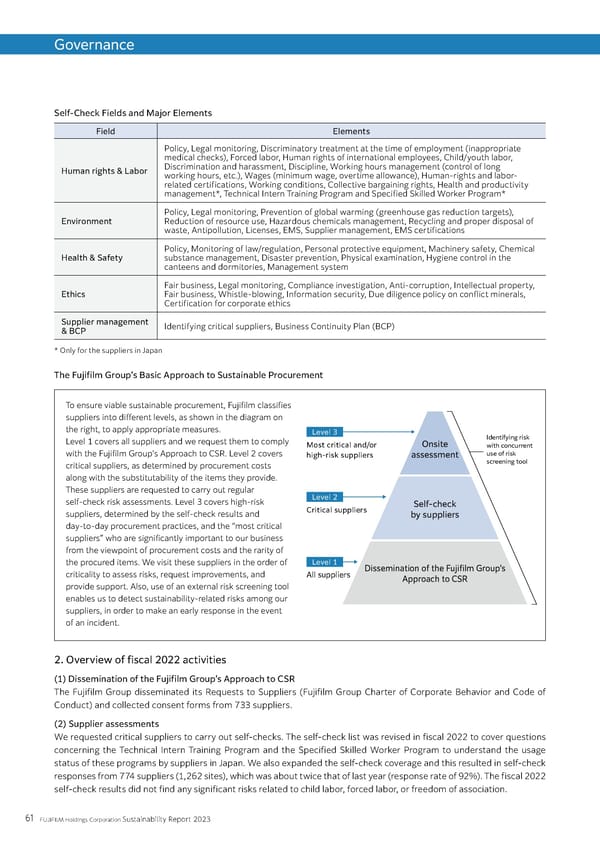
Governance Self-Check Fields and Major Elements Field Elements Policy, Legal monitoring, Discriminatory treatment at the time of employment (inappropriate medical checks), Forced labor, Human rights of international employees, Child/youth labor, Human rights & Labor Discrimination and harassment, Discipline, Working hours management (control of long working hours, etc.), Wages (minimum wage, overtime allowance), Human-rights and labor- related certifications, Working conditions, Collective bargaining rights, Health and productivity management*, Technical Intern Training Program and Specified Skilled Worker Program* Policy, Legal monitoring, Prevention of global warming (greenhouse gas reduction targets), Environment Reduction of resource use, Hazardous chemicals management, Recycling and proper disposal of waste, Antipollution, Licenses, EMS, Supplier management, EMS certifications Policy, Monitoring of law/regulation, Personal protective equipment, Machinery safety, Chemical Health & Safety substance management, Disaster prevention, Physical examination, Hygiene control in the canteens and dormitories, Management system Fair business, Legal monitoring, Compliance investigation, Anti-corruption, Intellectual property, Ethics Fair business, Whistle-blowing, Information security, Due diligence policy on conflict minerals, Certification for corporate ethics Supplier management Identifying critical suppliers, Business Continuity Plan (BCP) & BCP * Only for the suppliers in Japan The Fujifilm Group’s Basic Approach to Sustainable Procurement To ensure viable sustainable procurement, Fujifilm classifies suppliers into different levels, as shown in the diagram on the right, to apply appropriate measures. Level 3 Level 1 covers all suppliers and we request them to comply Onsite Identifying risk Most critical and/or with concurrent with the Fujifilm Group's Approach to CSR. Level 2 covers high-risk suppliers assessment use of risk critical suppliers, as determined by procurement costs screening tool along with the substitutability of the items they provide. These suppliers are requested to carry out regular Level 2 self-check risk assessments. Level 3 covers high-risk Self-check suppliers, determined by the self-check results and Critical suppliers by suppliers day-to-day procurement practices, and the “most critical suppliers” who are significantly important to our business from the viewpoint of procurement costs and the rarity of the procured items. We visit these suppliers in the order of Level 1 Dissemination of the Fujifilm Group’s criticality to assess risks, request improvements, and All suppliers Approach to CSR provide support. Also, use of an external risk screening tool enables us to detect sustainability-related risks among our suppliers, in order to make an early response in the event of an incident. 2. Overview of fiscal 2022 activities (1) Dissemination of the Fujifilm Group’s Approach to CSR The Fujifilm Group disseminated its Requests to Suppliers (Fujifilm Group Charter of Corporate Behavior and Code of Conduct) and collected consent forms from 733 suppliers. (2) Supplier assessments We requested critical suppliers to carry out self-checks. The self-check list was revised in fiscal 2022 to cover questions concerning the Technical Intern Training Program and the Specified Skilled Worker Program to understand the usage status of these programs by suppliers in Japan. We also expanded the self-check coverage and this resulted in self-check responses from 774 suppliers (1,262 sites), which was about twice that of last year (response rate of 92%). The fiscal 2022 self-check results did not find any significant risks related to child labor, forced labor, or freedom of association. 61 FUJIFILM Holdings Corporation Sustainability Report 2023
 2023 | Sustainability Report Page 61 Page 63