

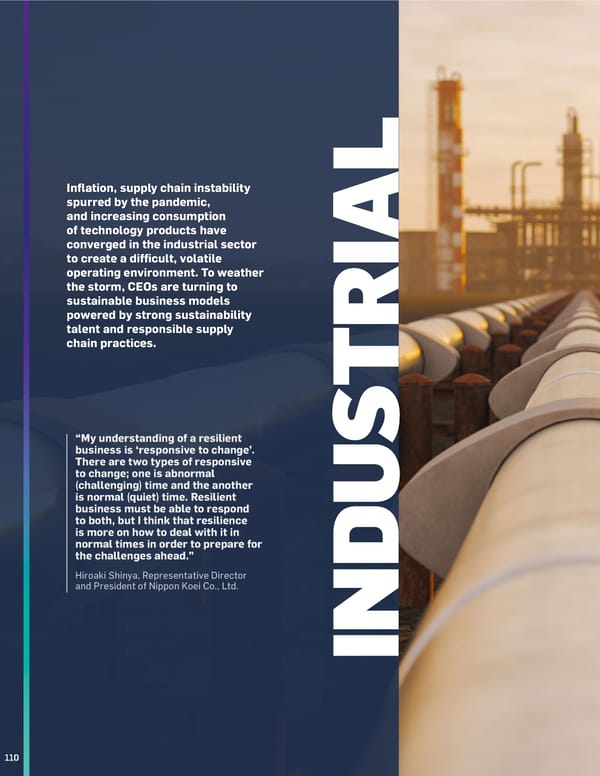
T H E 1 2 T H U THE MOST PRESSING CHALLENGES INDUSTRIAL CROSS INDUSTRY N I T E D N A 1 INFLATION & PRICE VOLATILITY 2 TALENT SCARCITY 3 THREATS TO PUBLIC HEALTH T I O N S G 8% L O B A 3% 3% L C O 65% 57% M P L 39% 42% 37% 40% A C T - A Inflation, supply chain instability C C E N spurred by the pandemic, T U R and increasing consumption CURRENT LANDSCAPE E C E of technology products have O S A T TOP RESILIENCE ACTIONS FOR INDUSTRIAL CEOS U converged in the industrial sector D to create a difficult, volatile Y of CEOs are of CEOs are of CEOs are upskilling or digitizing launching new operating environment. To weather 75% 70% 60% the storm, CEOs are turning to reskilling their workforce business processes product and service offerings for the future labor market sustainable business models powered by strong sustainability RI Industrial CEOs were severely impacted by the pandemic. Shortages of key raw materials, compounded by limited slack in the system talent and responsible supply and price volatility, shed light on the weak spots of the industry’s value chains. CEOs are, therefore, reshaping their business models to chain practices. reduce their dependency on volatile markets by embracing sustainability, and launching new products while simultaneously improving existing products and processes. To support these new business models, CEOs are investing in skills development opportunities for the workforce. In addition, many CEOs are focusing on building a responsible supply chain, harnessing renewables for industrial manufacturing processes, and increasing transparency in supply chains through real-time tracking and data monitoring to predict T capacity issues. WHERE IS THE INDUSTRY GOING? TOP SUSTAINABILITY PRIORITIES FOR INDUSTRIAL CEOS “My understanding of a resilient S business is ‘responsive to change’. of CEOs are of CEOs are of CEOs are constructing a lowering introducing new There are two types of responsive 64% 56% 55% to change; one is abnormal responsible supply chain greenhouse gas emissions and sustainable business (challenging) time and the another models is normal (quiet) time. Resilient business must be able to respond To build the future of the industry, industrial CEOs believe in the transformative power of sustainable product design – reimagining their to both, but I think that resilience products to reduce environmental impact across the product lifecycle. To enable the development of these sustainable products, some industrial CEOs are investing in artificial intelligence (AI) and digital twin capabilities to understand where there may be sustainable is more on how to deal with it in improvements across the production chain. This end-to-end approach does not just focus on sourcing sustainable materials that reduce normal times in order to prepare for environmental impact, but also allows CEOs to understand product performance across the lifecycle down to product remanufacturing the challenges ahead.” and recycling at the end of life. Hiroaki Shinya, Representative Director TRANSFORMATIVE INNOVATIONS and President of Nippon Koei Co., Ltd. Sustainable products design 57% Circular business models 48% NDU R to identify new sources for sustainable material inputs 48% Low-or-no waste production processes 47% I Concentrated renewables for heavy industrial manufacturing 37% Alternative fuels 36% Materials passports for value chain transparency 34% Electrification 33% HIGH IMPACT MODERATE IMPACT LOW IMPACT NO IMPACT 110 111
 Accenture CEO Study United Nations Global Compact Page 109 Page 111