

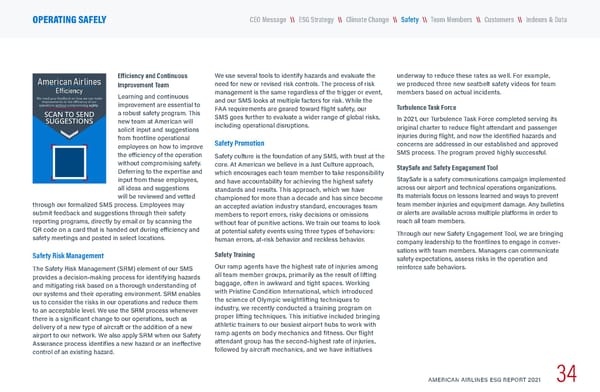
Efficiency and Continuous Improvement Team Learning and continuous improvement are essential to a robust safety program. This new team at American will solicit input and suggestions from frontline operational employees on how to improve the efficiency of the operation without compromising safety. Deferring to the expertise and input from these employees, all ideas and suggestions will be reviewed and vetted through our formalized SMS process. Employees may submit feedback and suggestions through their safety reporting programs, directly by email or by scanning the QR code on a card that is handed out during efficiency and safety meetings and posted in select locations. Safety Risk Management The Safety Risk Management (SRM) element of our SMS provides a decision-making process for identifying hazards and mitigating risk based on a thorough understanding of our systems and their operating environment. SRM enables us to consider the risks in our operations and reduce them to an acceptable level. We use the SRM process whenever there is a significant change to our operations, such as delivery of a new type of aircraft or the addition of a new airport to our network. We also apply SRM when our Safety Assurance process identifies a new hazard or an ineffective control of an existing hazard. We use several tools to identify hazards and evaluate the need for new or revised risk controls. The process of risk management is the same regardless of the trigger or event, and our SMS looks at multiple factors for risk. While the FAA requirements are geared toward flight safety, our SMS goes further to evaluate a wider range of global risks, including operational disruptions. Safety Promotion Safety culture is the foundation of any SMS, with trust at the core. At American we believe in a Just Culture approach, which encourages each team member to take responsibility and have accountability for achieving the highest safety standards and results. This approach, which we have championed for more than a decade and has since become an accepted aviation industry standard, encourages team members to report errors, risky decisions or omissions without fear of punitive actions. We train our teams to look at potential safety events using three types of behaviors: human errors, at-risk behavior and reckless behavior. Safety Training Our ramp agents have the highest rate of injuries among all team member groups, primarily as the result of lifting baggage, often in awkward and tight spaces. Working with Pristine Condition International, which introduced the science of Olympic weightlifting techniques to industry, we recently conducted a training program on proper lifting techniques. This initiative included bringing athletic trainers to our busiest airport hubs to work with ramp agents on body mechanics and fitness. Our flight attendant group has the second-highest rate of injuries, followed by aircraft mechanics, and we have initiatives underway to reduce these rates as well. For example, we produced three new seatbelt safety videos for team members based on actual incidents. Turbulence Task Force In 2021, our Turbulence Task Force completed serving its original charter to reduce flight attendant and passenger injuries during flight, and now the identified hazards and concerns are addressed in our established and approved SMS process. The program proved highly successful. StaySafe and Safety Engagement Tool StaySafe is a safety communications campaign implemented across our airport and technical operations organizations. Its materials focus on lessons learned and ways to prevent team member injuries and equipment damage. Any bulletins or alerts are available across multiple platforms in order to reach all team members. Through our new Safety Engagement Tool, we are bringing company leadership to the frontlines to engage in conver - sations with team members. Managers can communicate safety expectations, assess risks in the operation and reinforce safe behaviors. AMERICAN AIRLINES ESG REPORT 2021 34 \\ Indexes & Data \\ Customers \\ Team Members \\ Climate Change \\ ESG Strategy CEO Message OPERATING SAFELY \\ Safety
 American Airlines ESG Report Page 34 Page 36